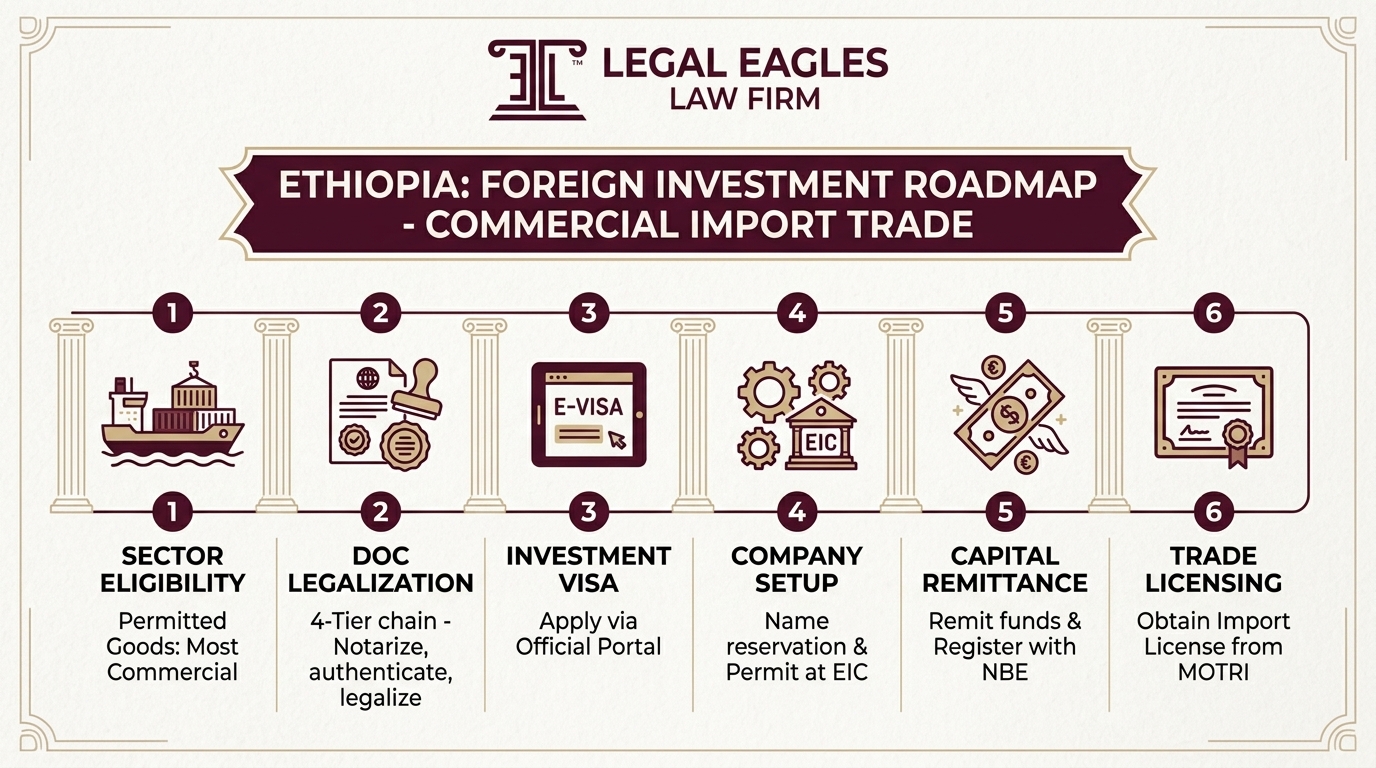
Foreign Commercial Import Investments in Ethiopia: A Step-by-Step Legal Roadmap
Recent trade reforms allow foreign entities to enter commercial import activities in Ethiopia. Formerly, these sectors were reserved for domestic operators. Foreign investors can establish import operations by securing an Ethiopian Investment Commission (EIC) permit. They must also meet minimum capital requirements.
This legal guide outlines the step-by-step procedure required for foreign investors to enter and operate within Ethiopia’s liberalized import market.
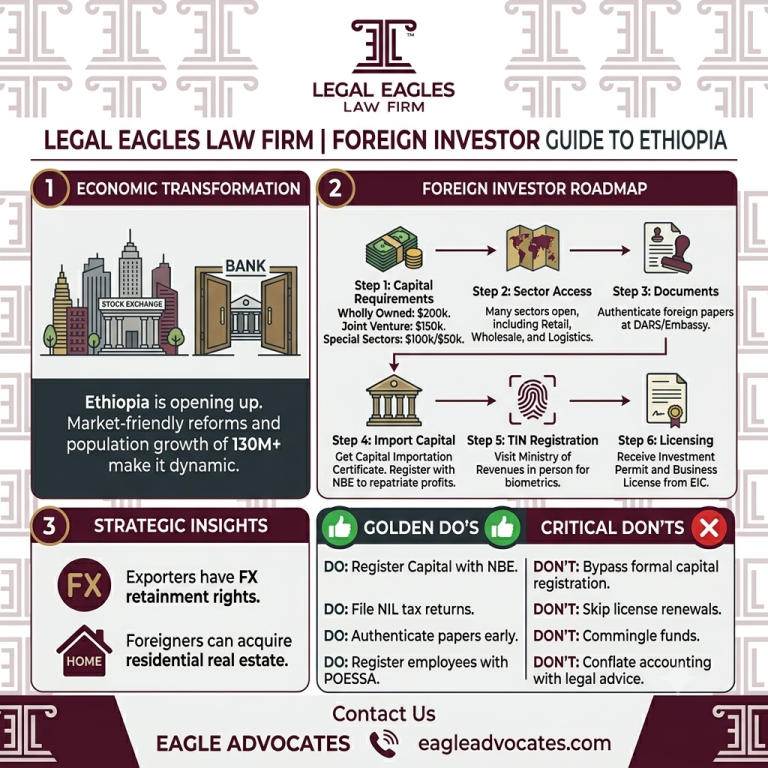
Step 1: Check Sector Eligibility & Minimum Capital
- Permitted Import Goods: Foreign investors can import most commercial products. However, petroleum and fertilizers remain restricted under national trade directives.
- Minimum Capital Requirements:
- USD 200,000 for a wholly foreign-owned enterprise.
- USD 150,000 if investing jointly with a domestic partner.
Step 2: Pre-Arrival Document Legalization
Corporate documents from outside Ethiopia must complete four authentication steps before visa processing or registration.
- Notarization: Notarize all primary corporate documents with a public notary in your home jurisdiction.
- Home Foreign Ministry: Authenticate the notarized instruments at your home country’s Ministry of Foreign Affairs (or equivalent authority).
- Ethiopian Foreign Mission: Legalize the authenticated documents at an Ethiopian Embassy to obtain an official Embassy Support Letter.
- In-Country Registration: Upon arrival, finalize legalization at MoFA and register the documents with DARA.
Step 3: Secure an Investment Visa (IV)
Before traveling, investors must apply online via the official Ethiopia e-Visa Portal for an Investment Visa (IV) under the Business Visa category.
- Visa Category: Investment Visa (IV).
- Validity Options: Single Entry (30 Days) or Multiple Entry (90 Days, 6 Months, or 12 Months).
- Key Uploads Required:
- Passport valid for at least 6 months.
- Passport-sized photograph.
- The authenticated Embassy Support Letter (or an official support letter issued directly by the Ethiopian Investment Commission).
Note: Entering on a standard Tourist Visa (VT) is strongly discouraged, as tourist visas cannot be legally converted into work or foreign residence permits within Ethiopia.
Step 4: Corporate Registration & Investment Permit
Once in Ethiopia on an Investment Visa:
- Name Reservation: Reserve the proposed business name at the EIC One-Stop Shop.
- Articles of Association: Draft and execute the company’s Memorandum and Articles of Association.
- Due Diligence Submission: Provide an investor due diligence report confirming financial standing and compliance with anti-money laundering (AML) regulations.
- Obtain Investment Permit: Submit the application, authenticated corporate documents, and investor profile to the EIC to obtain the Investment Permit.
Step 5: Capital Injection, NBE Registration & Tax Setup
- Bank Account Opening: Present the Investment Permit to an authorized commercial bank to open a dedicated capital account.
- Remit Foreign Currency: Transfer the required minimum capital (USD 200,000 or USD 150,000) in convertible foreign currency.
- Capital Registration: Obtain bank credit advice and formally register the imported capital with both the National Bank of Ethiopia (NBE) and the EIC. Proper registration is legally required to guarantee the right to repatriate dividends and profits.
- Tax Registration: Register with the Ministry of Revenues to obtain a Tax Identification Number (TIN) and Value Added Tax (VAT) certificate.
Step 6: Trade Licensing & Operational Residency
- Import Trade License: Secure an Import Trade License from the Ministry of Trade and Regional Integration (MOTRI).
- Sector Approvals: Obtain specific competency certificates if importing regulated products (e.g., Ethiopian Food and Drug Authority clearance for pharmaceuticals or processed foods).
- Residence & Work Permits: Convert entry status into a long-term Foreign Residence Permit via the Immigration and Citizenship Service (ICS), and secure an EIC-backed Foreign Work Permit for corporate management.