
Launching in the Land of Origins: A Foreigner’s Guide to Business Registration in Ethiopia
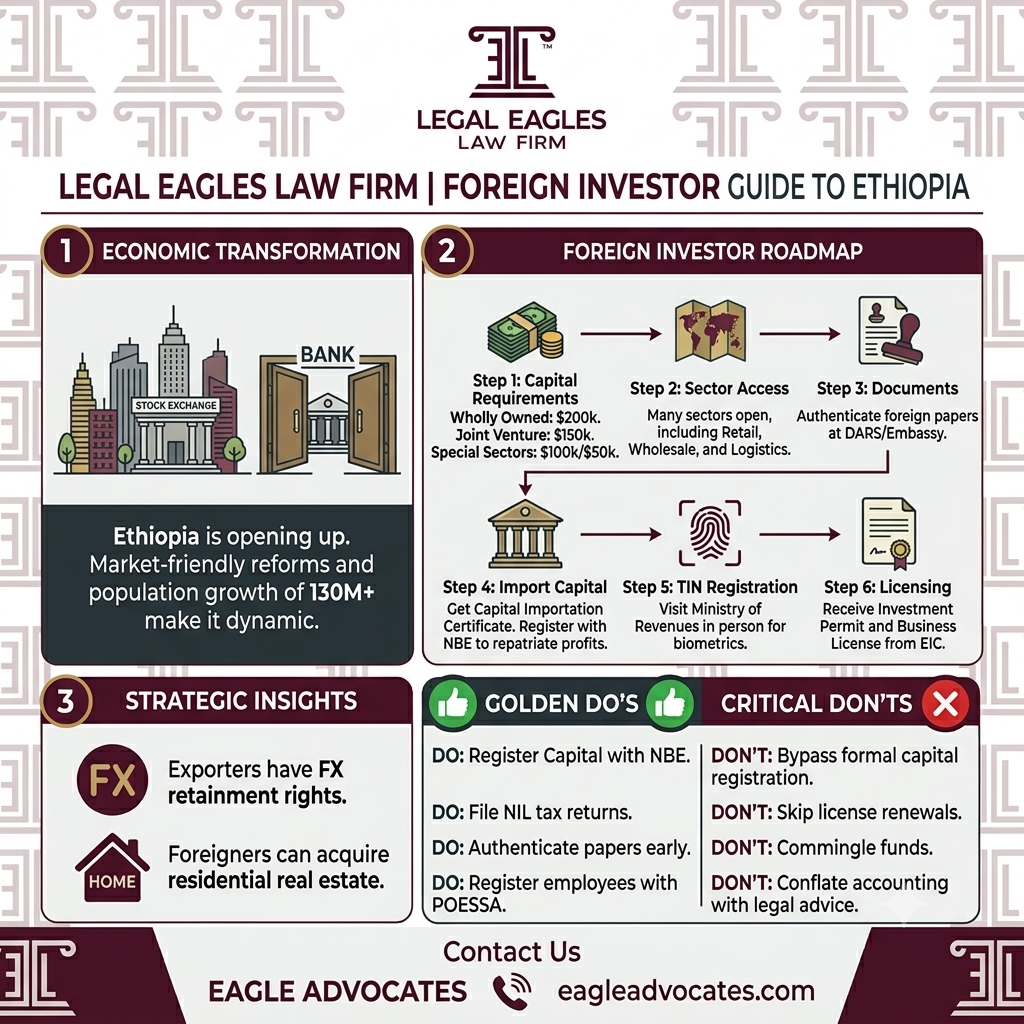
Ethiopia is undergoing a historic economic transformation. The country is opening up to global capital. It boasts a fast-growing economy, a population over 130 million, and market-friendly reforms. The introduction of the Ethiopian Securities Exchange (ESX) is a milestone. Additionally, the state has opened banking and allowed foreigners to buy residential real estate. There has never been a more dynamic time to enter this market.
However, establishing a business in Ethiopia as a foreign national requires a distinct legal path compared to local registrants. This guide breaks down the registration process and specific capital requirements. It also outlines essential “Do’s and Don’ts” for international investors looking to tap into this booming market.
Part 1: The Foreign Investor’s Step-by-Step Roadmap
The registration workflow for foreign-owned entities is managed centrally. The Ethiopian Investment Commission (EIC) handles this process and acts as an efficient “one-stop shop”.
[Determine Entry & Capital]➔[Register at EIC & Name Check]➔[Bring in Capital (NBE)]➔[DARS & TIN Registration]➔[Obtain Permits & License]
Step 1: Meet the Minimum Capital Requirements
To qualify as a foreign investor, Ethiopia’s investment laws require you to bring in a minimum threshold of foreign capital:
- Wholly Foreign-Owned PLC: Minimum of USD 200,000.
- Joint Venture (JV) with a Local Partner: Minimum of USD 150,000.
- Reduced Capital Sectors: If you are investing in architectural, engineering, technical consultancy, publishing, or testing services, the threshold drops to USD 100,000 for wholly owned, or USD 50,000 for a Joint venture.
- Note: Foreign reinvestment of dividends or profits is exempt from these minimum capital requirements.
Step 2: Clear Sector Restrictions (The “Negative List”)
Ethiopia has shifted to a negative list system. This means any sector not explicitly reserved is open to foreign investment.
- Newly Opened Sectors: Retail and wholesale trade (subject to a USD 2.5 million threshold), export of strategic commodities (like coffee and oilseeds), banking, and freight forwarding (which was fully liberalized to 100% foreign ownership in May 2026).
- Still Restricted: Micro-credit, small retail, and defense.
Step 3: Secure Your Name Reservation & Submit EIC Documents
Submit your proposal, passport copies, and notarized parent-company documents (if registering a subsidiary or branch) to the EIC. They will handle the name reservation check and approve your initial application.
Step 4: Transfer and Verify Your Investment Capital
You must transfer your minimum capital into an Ethiopian bank account from an overseas source. The receiving commercial bank will issue a Capital Importation Certificate, which must be registered with the National Bank of Ethiopia (NBE) to ensure your eventual right to repatriate profits.
Step 5: Document Authentication & TIN Biometrics
- DARS Authentication: Draft your Memorandum of Association (MoA) and lease agreement. All foreign shareholders or their legally appointed proxies (carrying a notarized Power of Attorney) must present their documents to the Documents Authentication and Registration Service (DARS).
- TIN Registration: The Company’s General Manager must go to the Ministry of Revenues sub-city branch in person to submit biometric data (fingerprints and photo) to obtain the company’s TIN.
Step 6: Claim Your Investment Permit & Business License
With your capital verified, documents authenticated, and TIN generated, the EIC will issue your official Investment Permit and Commercial Registration Certificate. Following any required sector-specific competency checks, you will receive your active Business License.
Part 2: Essential “Do’s” & “Don’ts” for International Investors
Successfully operating in Ethiopia’s rapidly evolving legal landscape requires keeping a few strict operational boundaries in mind.
The Golden DO’s
- DO align with the foreign exchange reforms: Familiarize yourself with the National Bank of Ethiopia’s recent currency liberalizations (including FX retainment rights for exporters and forward-exchange contracts).
- DO explore real estate incentives: Under the latest laws, foreign investors can purchase residential property (subject to minimum transaction thresholds and investment criteria).
- DO ensure all foreign parent-company documents are fully authenticated: Any corporate resolution, certificate of incorporation, or power of attorney signed abroad must be notarized in its country of origin and authenticated by the nearest Ethiopian Embassy before being presented to DARS.
- DO file NIL returns monthly/quarterly: If your setup phase takes several months and your business records zero revenue, you must still file regular “NIL” tax declarations to avoid heavy administrative fines.
The Critical DON’Ts
- DON’T assume local legal and financial advisors are interchangeable: While your legal counsel is crucial for drafting contracts, structuring JVs, navigating disputes, and ensuring corporate compliance, accounting audits, bookkeeping, and tax filing are legally restricted to certified local auditors and accountants. Keep these scopes separate.
- DON’T lease premises before verifying the landlord’s title deed: DARS will not authenticate a commercial lease unless the landlord presents a clear, unencumbered property title deed. Do not wire any security deposit until this is verified.
- DON’T bypass the formal capital registration step: Failing to get your bank’s Capital Importation Certificate verified and registered by the NBE will create immense bottlenecks when you attempt to legally repatriate dividends or profits later.
- DON’T forget the POESSA pension registrations: Even as a foreign-owned company, you are strictly required to register your local employees with the Private Organizations Employees’ Social Security Administration (POESSA) and pay monthly pension contributions.
Establish Your Presence with Expert Legal Support
Entering a new market is a high-reward venture, but navigating local bureaucracy requires experienced on-the-ground counsel.
For tailored corporate legal advisory, joint-venture structuring, and regulatory navigation, contact Legal Eagles Law Firm LLP (Eagle Advocates). We bridge the gap between global investment goals and local legal frameworks.
- Office: Sajadah Business Center, Lideta Sub-City, Floor 5, Office 512, Addis Ababa, Ethiopia
- Website: eagleadvocates.com



Pretty nice post. I simply stumbled upon your blog and wished
to mention that I have truly enjoyed surfing around your
blog posts. After all I’ll be subscribing for your feed and I am hoping you
write again soon!
WOW just what I was looking for. Came here by searching for
Continue Reading