Construction Law in Ethiopia: A Comprehensive Guide to Legal Frameworks and Modern Practices
Ethiopia’s rapid urbanization and ambitious infrastructure drives have transformed its real estate and infrastructure sectors into major economic engines. Seeing large-scale commercial developments or private residential projects requires a firm understanding of Ethiopian construction law.
Construction law in Ethiopia operates on two main pillars: foundational statutory rules codified in the Ethiopian Civil Code of 1960 and modern standard contractual frameworks regulated by public authorities and international standards.
The Legal Framework: The 1960 Civil Code
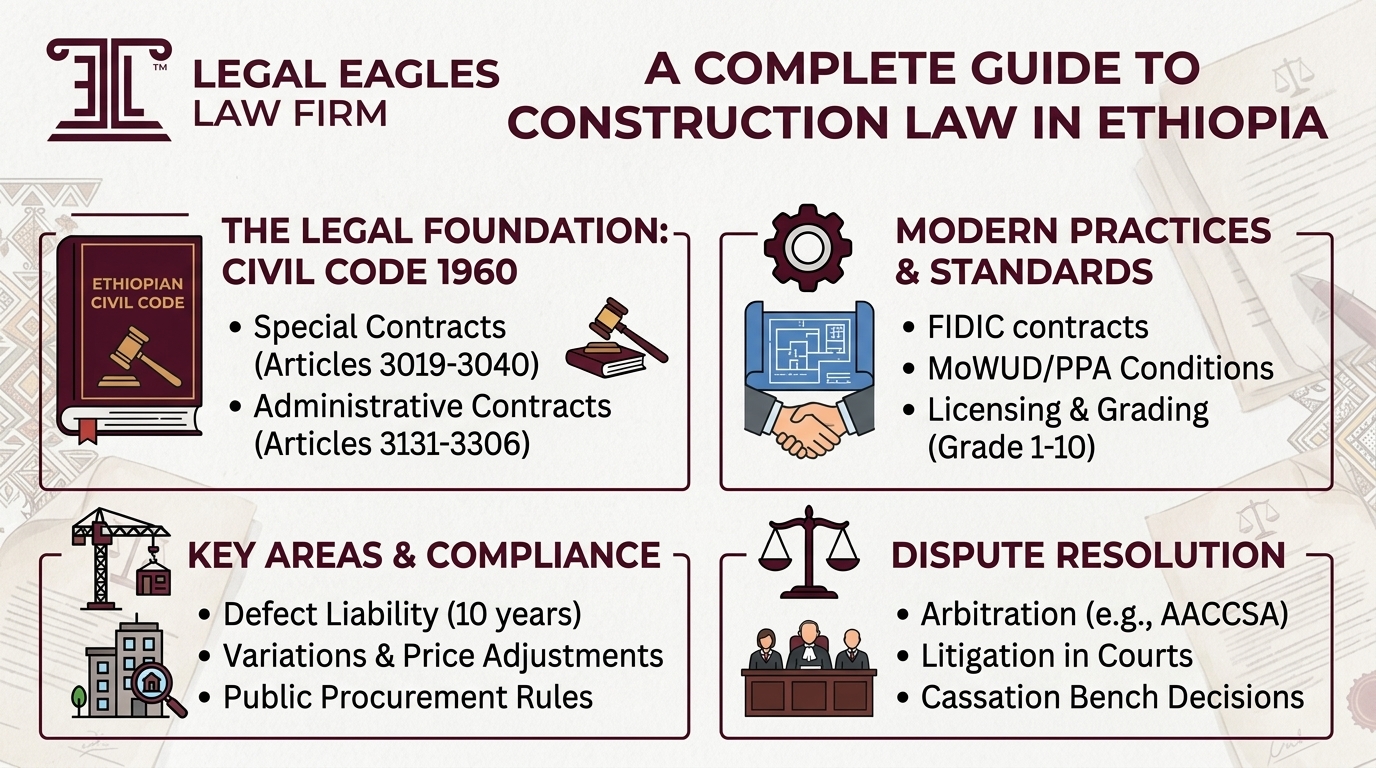
The Civil Code of 1960 remains the primary statutory foundation governing construction agreements in Ethiopia. Depending on the parties involved and the scope of work, construction contracts fall under distinct legal regimes within the Civil Code:
Special Contracts Relating to Immovables (Articles 3019–3040)
This regime governs private construction projects involving buildings, repairs, or physical installations. Key legal obligations under these provisions include:
- Scope and Specifications: The contractor must execute the work strictly according to the agreed plan and specifications.
- Variations and Price Adjustments: If an owner requests major alterations that significantly increase costs, the contractor can adjust the price or time frame accordingly.
- Defect Liability: Contractors and architects bear strict liability for total or partial collapse of a building caused by structural defects or soil conditions for 10 years post-completion.
Administrative Contracts for Public Works (Articles 3131–3306)
When a government entity acts as the employer, the agreement is classified as an administrative contract. Public works contracts grant the state distinct prerogatives such as unilateral modification rights or strict performance oversight while binding the contractor to public procurement laws and stringent compliance measures.
Modern Standard Contract Conditions
While the Civil Code provides the statutory base, modern daily construction practice relies heavily on standardized contract templates:
- MoWUD / PPA Standard Conditions: The Ministry of Works and Urban Development (MoWUD) standard contract conditions and the Public Procurement Agency (PPA) standard bidding documents are standard baseline references for government and public infrastructure projects across the country.
- FIDIC Contracts: For large-scale commercial projects, foreign investments, and international development initiatives, parties frequently adopt FIDIC (International Federation of Consulting Engineers) standard form contracts particularly the Red, Yellow, and Silver books.
Licensing, Grading, and Compliance
Constructing legally in Ethiopia requires strict regulatory compliance before breaking ground:
- Contractor Grading: Contractors must hold valid registration with the Ministry of Urban and Infrastructure (MUI). Classifications span General Contractors (GC), Building Contractors (BC), and Road Contractors (RC), graded from Grade 1 (unlimited financial and technical capability) down to Grade 10.
- Building Codes & Permits: Construction works must comply with local building regulations and the Ethiopian Building Code Standards (EBCS). Building permits must be obtained from local municipal authorities (such as the Addis Ababa City Administration) prior to site mobilization.
Managing Variations, Delays, and Claims
Two common friction points in Ethiopian construction projects involve project delays and cost variations:
- Price Variations: Adjustments must follow contract price adjustment clauses or Civil Code provisions covering inflation and material fluctuations.
- Extension of Time (EOT): Contractors can claim EOT for delayed employer handovers, design modifications, or unpreventable force majeure events.
- Liquidated Damages: Failure to complete projects on time without an approved EOT subjects contractors to pre-agreed financial penalties, typically capped at a set percentage of the contract value.
Dispute Resolution Mechanisms
When conflicts arise over payments, scope changes, or defective works, parties typically navigate a multi-tiered dispute resolution process:
- Engineer/Consultant Determination: The project consultant acts as the initial decision-maker on claims and performance issues.
- Amicable Settlement & Mediation: Parties attempt structured negotiations to reach a mutual settlement.
- Arbitration: Ethiopian law recognizes arbitration agreements. Institutional hubs like the Addis Ababa Chamber of Commerce and Sectoral Associations (AACCSA) Arbitration Center frequently handle commercial construction disputes.
- Litigation: If arbitration is not specified in the contract, disputes proceed through the Federal or Regional Court systems, with final points of law subject to review by the Federal Supreme Court Cassation Bench.
Strategic Advice for Developers and Contractors
- Draft Clear Scopes: Avoid vague task descriptions. Reference specific technical standards to minimize scope-creep disputes down the line.
- Maintain Meticulous Documentation: Record site instructions, daily logs, variation orders, and correspondence to substantiate or defend against EOT and financial claims.
- Align Contracts with Local Directives: Ensure subcontracts and consultant agreements harmonize with both statutory Civil Code rules and current municipal building directives.