Unlocking Rural Credit: Inside Ethiopia’s Game-Changing European Investment Bank Proclamation
Deep in Ethiopia’s regional highlands, smallholder farmers and rural entrepreneurs face a shared, persistent hurdle: they can harvest bountiful crops or devise clever local enterprises, but getting a bank loan to scale up often feels like chasing water through a filter. A major legislative move by the Ethiopian parliament aims to change that equation dramatically.
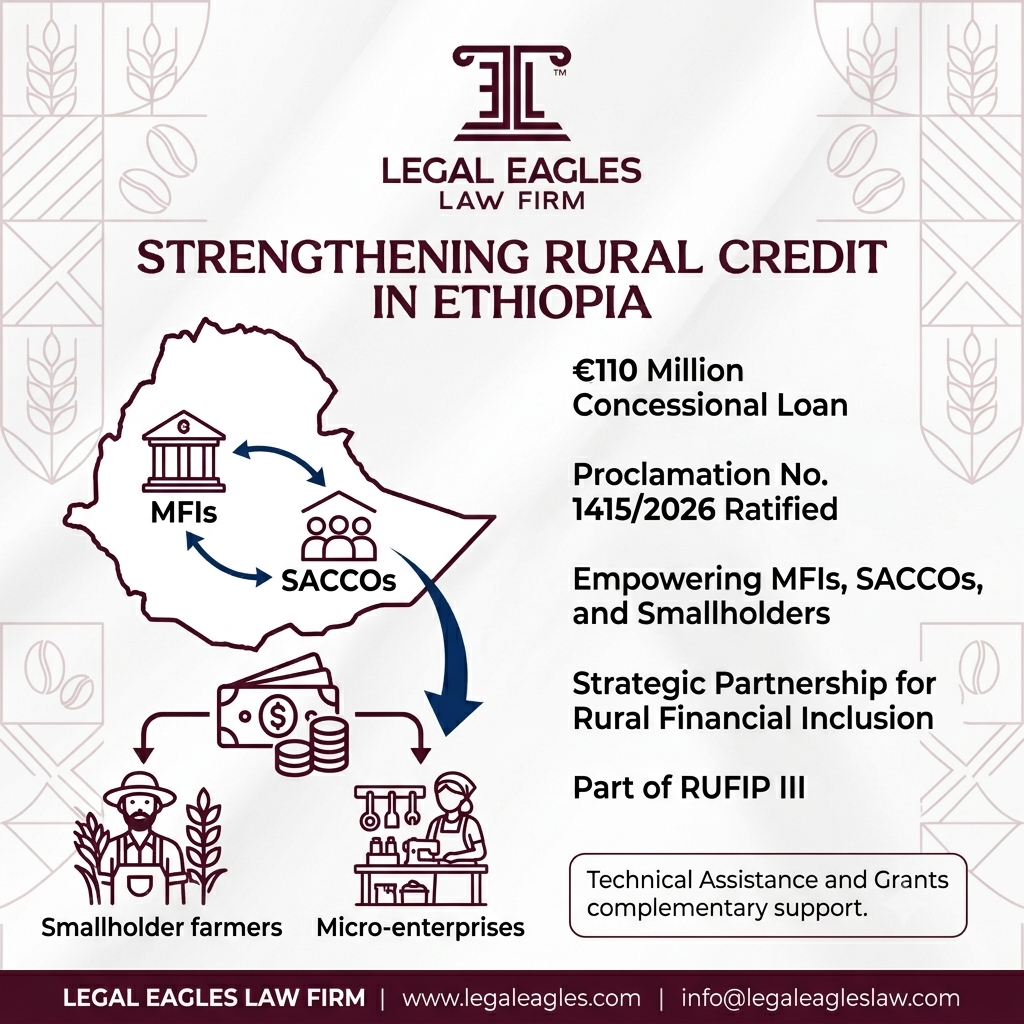
Through the formal ratification of Proclamation No. 1415/2026, Ethiopia has locked in a major €110 million (~$120 million) concessional loan agreement with the European Investment Bank (EIB). This landmark enactment injects crucial liquidity directly into the country’s rural financial system under the third phase of the Rural Financial Intermediation Programme.
Rather than sitting as capital on paper, this legislative action activates a financial engine engineered to transform how credit flows across Ethiopia’s vast agrarian economy.
The Financial Architecture: How the Capital Actually Moves
Understanding how this agreement impacts everyday business requires looking past the legal jargon of the Federal Negarit Gazette. The proclamation establishes a distinct trickle-down model designed to reach the deepest corners of the country:
- The Top-Level Guarantee: The Ministry of Finance secures and oversees the primary €110 million concessionary credit facility directly from the EIB.
- The Wholesale Engine: Capital is directed into the Development Bank of Ethiopia (DBE), acting as a central wholesale liquidity provider rather than a direct commercial retailer.
- The Grassroots Distributors: DBE on-lends these funds to licensed local Microfinance Institutions (MFIs) and Savings and Credit Cooperative Organizations (SACCOs).
- The Final Beneficiaries: Smallholders, youth-led agribusiness startups, and rural women entrepreneurs receive affordable, accessible micro-loans tailored to local conditions.
This structural approach is further amplified by a multi-donor network: a complementary $39.9 million investment from the International Fund for Agricultural Development (IFAD) and €16.76 million in European Union grants, specifically allocated to upgrade digital banking software, risk mitigation, and staff training at local cooperatives.
Why It Matters: Tackling the Rural “Credit Drought”
Agriculture and micro-enterprises drive employment for tens of millions of Ethiopians, yet high interest rates, steep collateral requirements, and strict traditional banking policies have historically left rural operators underserved.
By delivering dedicated, long-term capital to community-based financial organizations, Proclamation No. 1415/2026 addresses several key challenges:
- Climate Adaptation & Modern Farming: Farmers can now secure micro-loans for drought-tolerant seeds, solar-powered micro-irrigation, and modern fertilizers, shifting away from total reliance on unpredictable rainfall patterns.
- Cutting Post-Harvest Losses: Rural enterprises can invest in localized cold-storage facilities, modern grain silos, and processing equipment, ensuring produce reaches markets without spoiling.
- Empowering Community Businesses: Targeted financing pools focus on rural women and young entrepreneurs who frequently lack formal property deeds for collateral but maintain strong credit standing within local cooperatives.
The Bigger Picture: Rethinking Economic Inclusion
Beyond immediate liquidity, this ratification signals a broader evolution in Ethiopia’s economic policy. By strengthening rural credit cooperatives instead of relying solely on centralized state subsidies, the nation is building a durable financial market where rural businesses are treated as viable, bankable entities.
As implementation ramps up, Proclamation No. 1415/2026 stands as more than just a standard bilateral finance bill it serves as a foundational step toward unlocking the untapped commercial potential of Ethiopia’s rural heartbeat.