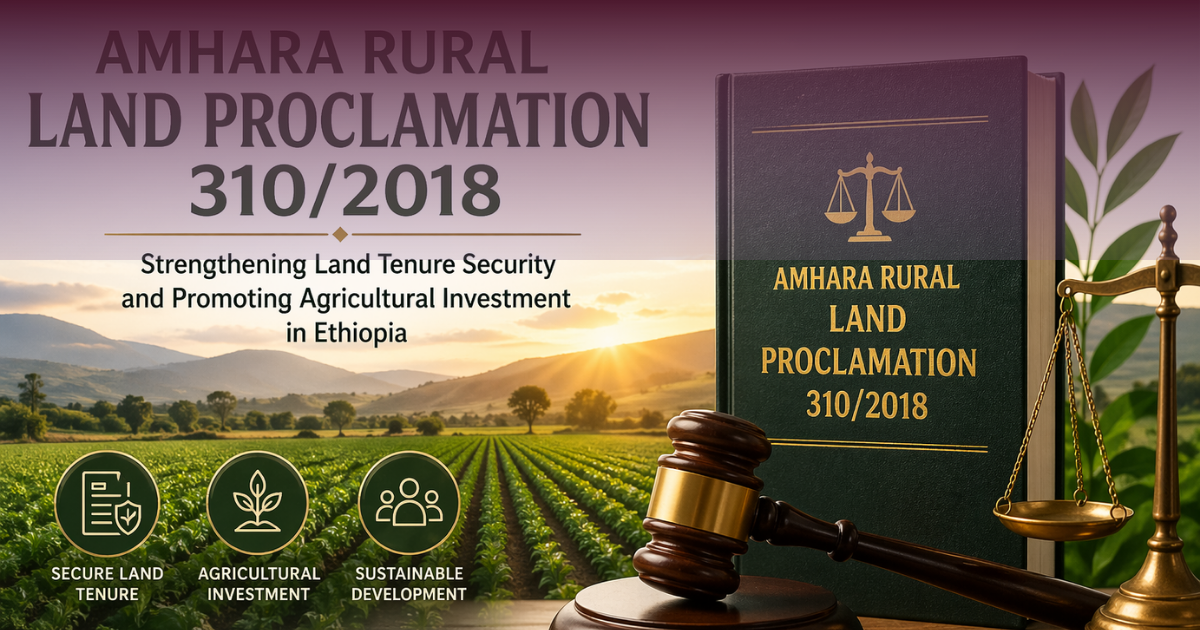
Agriculture and Investment under Amhara Rural Land Proclamation No. 310/2018: Legal and Policy Implications
Agriculture remains the backbone of Ethiopia’s economy, and in the Amhara National Regional State, its development is closely tied to land governance. The Revised Rural Land Administration and Use Proclamation No. 310/2018 were enacted to modernize land administration, enhance tenure security, and promote sustainable agricultural investment.
From a legal perspective, this proclamation represents a significant shift from traditional land management approaches toward a more structured, certificate-based, and investment-oriented framework.
1. Strengthening Rural Land Use Rights
One of the most significant legal developments under Proclamation No. 310/2018 is the reinforcement of rural land use rights.
The proclamation provides that rural landholders:
- Possess long-term and inheritable use rights
- May lease their land use rights under regulated conditions
- Are protected against arbitrary eviction, except in accordance with lawful procedures and compensation frameworks
Legal implication: This enhances tenure security, which is a foundational requirement for sustainable agricultural development and long-term investment in land improvement.
2. Land Certification and Legal Formalization
The proclamation strengthens the rural land certification system through improved registration and documentation mechanisms.
Key legal features include:
- Expansion of second-level land certification
- Improved land identification and mapping systems
- Formal recognition of landholding rights through administrative records
Legal implication: Certified landholding rights reduce disputes, strengthen evidentiary value in courts, and improve legal certainty for both farmers and investors.
3. Legal Framework for Agricultural Investment
Proclamation No. 310/2018 introduces a more regulated framework for agricultural investment in rural land.
The legal regime allows:
- Allocation of rural land for investment purposes through lease arrangements
- Regulation of large-scale agricultural projects
- Requirement of compliance with land-use planning and environmental standards
Legal implication: Agricultural investment is no longer informal or discretionary; it is governed by structured administrative procedures and regulatory oversight.
4. Environmental Protection and Sustainable Land Use
The proclamation integrates environmental considerations into rural land governance, requiring sustainable land use practices.
This includes:
- Soil and water conservation obligations
- Restrictions on practices that degrade land productivity
- Promotion of environmentally responsible agricultural activities
Legal implication: Investors and land users are subject to compliance obligations that align agricultural development with environmental sustainability principles.
5. Implementation Challenges
Despite its progressive legal framework, implementation of the proclamation faces practical challenges, including:
- Institutional capacity limitations at local administrative levels
- Land-related disputes arising from overlapping claims
- Uneven awareness of legal rights among rural landholders
- Administrative delays in land allocation for investment purposes
These challenges affect the full realization of the proclamation’s objectives.
Conclusion
Proclamation No. 310/2018 marks a significant evolution in rural land governance in the Amhara Region. It strengthens land tenure security, formalizes land administration, and creates a more predictable legal environment for agricultural investment.
For farmers, it provides enhanced protection and long-term security. For investors, it introduces clearer legal pathways for engagement in agricultural development. However, the effectiveness of this legal framework ultimately depends on consistent and transparent implementation at all levels of administration.