Can an Employee Resign Without Notice Under Ethiopian Labour Law? A Comprehensive Analysis
Sudden employee departures disrupt daily operations. They delay key client deliverables and create heavy administrative burdens. Standard HR practice mandates notice periods for smooth transitions. This allows adequate time for recruitment and business continuity.
However, question frequently arise regarding the legality of immediate resignation. Under Ethiopian law, can employees legally resign without serving a notice period?
The short answer is yes, but only under specific statutory conditions.
The governing legal framework, labour proclamation 1156/2019 establishes a clear distinction between standard (ordinary) resignation and extraordinary resignation. Understanding this distincton is vital for corporatw management, HR directors and legal risk management.
1. The Statutory Baseline: Ordinary Resignation Requires Notice
Under Ethiopian labor jurisprudence, employment relationships are founded on mutual obligation and good faith. The general principle governing voluntary resignation is set out under Article 31 of Labour Proclamation No. 1156/2019.
Statutory Obligations for Employees
- Written Notice Requirement: To end an indefinite employment contract, an employee must submit formal written notice to the employer.
- The Mandatory 30-Day Notice Period: The statutory minimum notice period is 30 days. However, contracts or collective agreements may set longer terms.
- Continued Service: During the 30-day notice period, the employment contract remains fully active. During this time, the employee must perform duties faithfully. Meanwhile, the employer must pay all regular wages and benefits.
Consequences of Unlawful Immediate Resignation
Resigning without notice and without Article 32 grounds breaks the law. Such actions constitute an unlawful breach of contract.
In such scenarios, the employer is entitled to seek legal remedies. Specifically, the employee may be held financially liable to compensate the employer for damages suffered as a direct result of the sudden departure, up to an amount equivalent to the employee’s wages for the required notice period.
2. Statutory Exceptions: Resignation without Notice (Article 32)
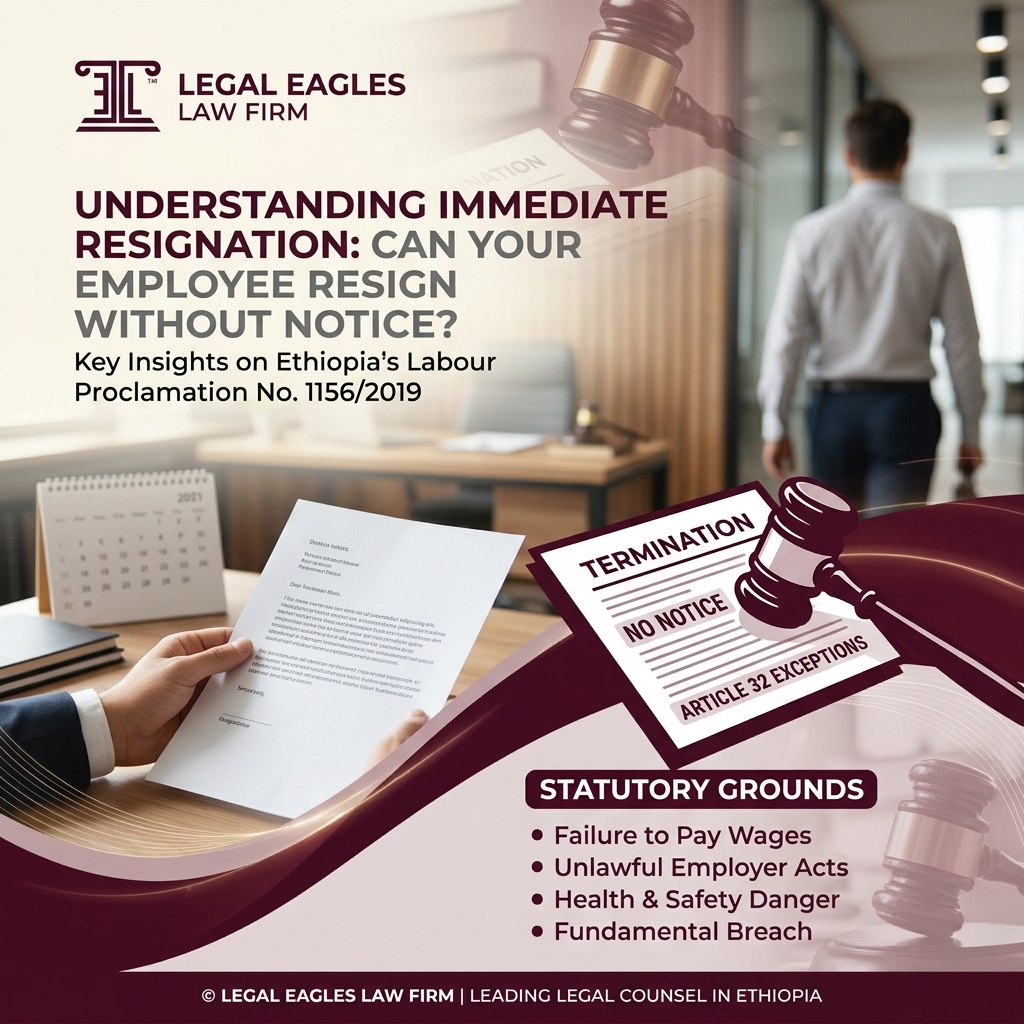
While notice is the default legal requirement, Article 32 of Labor Proclamation No. 1156/2019 creates specific statutory exceptions. These provisions permit an employee to terminate their employment contract immediately, without prior notice, when the working relationship has deteriorated due to severe employer default or misconduct.
An employee may legally effect an immediate resignation on the following statutory grounds:
A. Illegal or Criminal Acts Committed by the Employer (Article 32(1)(a))
An employee has the immediate right to resign if the employer—or an officer/representative of the undertaking—commits an act against the employee that:
- Violates human dignity or public morals;
- Constitutes an offense under the Ethiopian Criminal Code (e.g., physical assault, verbal abuse, harassment, or unlawful restraint); or
- Exposes the employee to severe psychological or physical harm.
B. Failure to Pay Wages and Mandated Entitlements (Article 32(1)(b))
Remuneration is the core obligation of an employer in an employment relationship. If an employer repeatedly fails, delays, or refuses to pay an employee’s salary, allowances, or other statutorily guaranteed monetary entitlements within the agreed timeframe, the employee is legally excused from serving a notice period.
C. Imminent Danger to Life, Health, or Safety (Article 32(1)(c))
Ethiopian labor law places a heavy duty on employers to ensure workplace safety. An employee may resign without notice if:
- The working conditions pose a direct, severe, or imminent threat to their physical health, safety, or life; and
- The employer fails or refuses to implement necessary safety measures or rectify the hazard after being formally notified of the danger.
D. Fundamental Breach of Contractual or Statutory Duties (Article 32(1)(d))
An immediate resignation is justified if the employer commits a substantial breach of explicit duties outlined in the individual employment contract, an applicable collective agreement, or relevant provisions of Labour Proclamation No. 1156/2019 (such as unilaterally altering core job terms without consent or failing to provide agreed working tools).
3. Legal Characterization & Entitlements upon Immediate Resignation
When an employee resigns without notice under valid Article 32 grounds, Ethiopian law does not treat the termination as a standard voluntary resignation. Instead, the law categorizes it as constructive dismissal a termination brought about by fault attributable to the employer.
Because the resignation is triggered by the employer’s breach, the departing employee does not forfeit their statutory rights. Subject to proving the underlying grounds, the employee remains entitled to:
- Severance Pay: Calculated pursuant to Articles 39 and 40 of the Proclamation based on years of continuous service.
- Compensation for Damages: Additional monetary compensation under Article 41 for unlawful termination caused by employer fault.
- Accrued Benefits: Full settlement of unused annual leave days, accrued wages, and any earned bonus or allowance balances.
4. Procedural Requirements & Evidentiary Burdens
Even when an employee has valid grounds to resign immediately under Article 32, strict procedural rules must be followed to maintain legal validity:
- Written Explanation: The employee must submit a written resignation letter explicitly specifying the factual and legal grounds (under Article 32) relied upon for immediate termination.
- Burden of Proof: In the event of a legal dispute before a Labour Relations Board or Court, the burden rests on the employee to substantiate that the employer’s conduct met the strict thresholds outlined in Article 32.
- Risk of Unjustified Immediate Resignation: If an employee resigns immediately citing Article 32, but fails to substantiate the claims in court, the court may reclassify the departure as an illegal resignation without notice, subjecting the employee to liability for notice-period compensation.
5. Strategic Guidance for Employers and Management
To protect against operational disruptions and mitigate litigation risks related to employee terminations, businesses should implement robust HR policies:
- Clear Employment Contracts: Ensure all employment agreements explicitly state notice period requirements and reference the provisions of Proclamation No. 1156/2019.
- Proactive Workplace Compliance: Maintain strict compliance with payroll schedules, safety protocols, and statutory working conditions to prevent employees from establishing valid Article 32 claims.
- Documented Dispute Resolution: Establish clear internal channels for employee grievances, ensuring that complaints regarding safety or unpaid benefits are documented and addressed promptly before escalations occur.
- Immediate Legal Assessment: When an employee submits an immediate resignation letter alleging employer fault, conduct a prompt internal audit and seek professional legal advice before issuing final settlement documentation or taking counter-action.