Legal Status of Migrants, IDPs, and Refugees in Ethiopia: Rights, Documentation, and Key Differences
Introduction
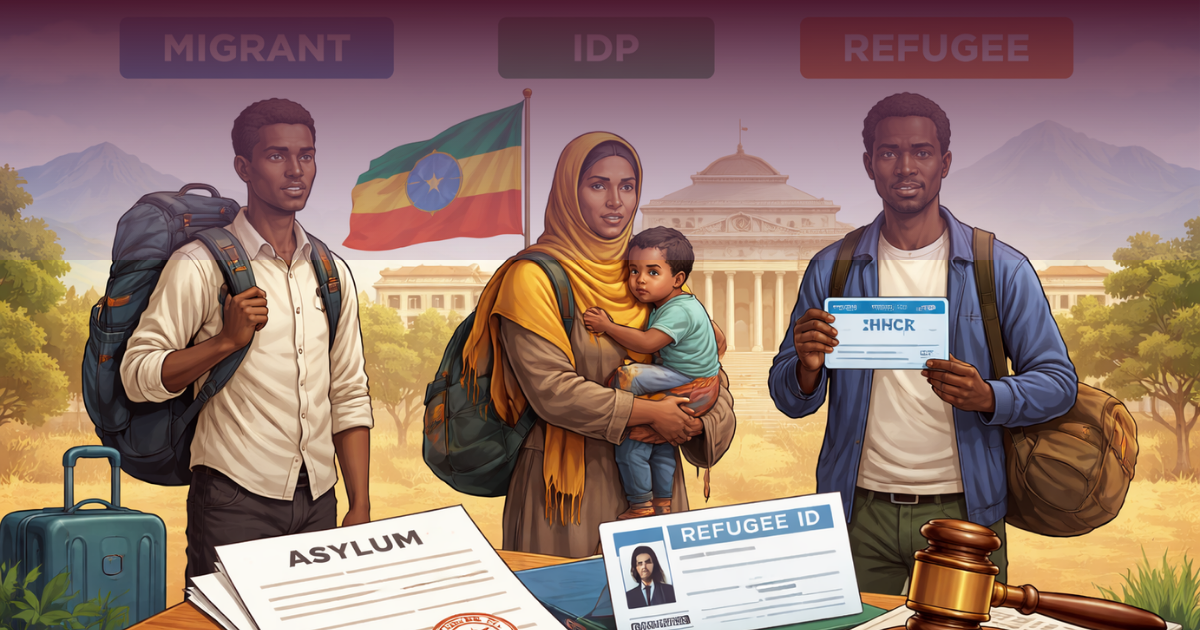
Human mobility, whether voluntary or forced, therefore raises complex legal questions. People often use terms like migrant, internally displaced person (IDP), and refugee interchangeably, yet each term carries distinct legal meanings and protections.
Understanding these differences is essential for individuals, policymakers, and investors operating in Ethiopia. This article by Legal Eagles Law Firm explains the legal status, documentation, and rights of these groups under international and Ethiopian law.
1. Migrants: A Broad Legal Category
In general, a migrant refers to any individual who moves from one place to another, either within a country or across borders, typically for economic, educational, or personal reasons.
However, unlike refugees, no single binding international legal framework governs migrants. Instead, their legal status depends on:
- National immigration laws
- Visa and residency requirements
- Bilateral or regional agreements
In Ethiopia, migrants must comply with immigration regulations, including residence permits and work authorization, depending on their purpose of stay.
2. Internally Displaced Persons (IDPs): Citizens in Displacement
Conflict, violence, or disasters force internally displaced persons (IDPs) to flee their homes, but they remain within their country’s borders.
Under the UN Guiding Principles on Internal Displacement:
- IDPs do not lose their nationality
- They remain fully entitled to constitutional protections
Legal Implications in Ethiopia
- Governments treat IDPs as citizens with full rights.
- The government bears primary responsibility for their protection
- They retain access to public services, subject to practical limitations
3. Refugees: A Distinct International Legal Status
The 1951 Refugee Convention defines a refugee legally as a person who:
- Has crossed an international border
- Has a well-founded fear of persecution
In Africa, the 1969 OAU Refugee Convention expands this definition to include people fleeing events that seriously disturb public order.
Key Legal Principle: Non-Refoulement
Refugees cannot be returned to a country where they face serious threats to life or freedom.
4. The “Yellow Card” Misconception in Ethiopia
A common misunderstanding is that refugees or migrants receive a “yellow card.”
In reality, the yellow card refers to the Ethiopian Origin ID issued under the Ethiopian Origin ID Card Directive.
Who Receives It?
- Foreign nationals of Ethiopian origin (diaspora)
What Rights Does It Provide?
- Right to reside in Ethiopia
- Access to employment without a work permit
- Investment opportunities
5. What Documents Do Refugees Receive?
Refugees are provided with specific legal documentation to formalize their status.
- Asylum Seeker Certificate
- Refugee Identification Card
- Refugee Travel Document
- Registration with UNHCR
6. Are Refugees Treated the Same as Citizens?
Refugees are not equal to citizens, but they are granted significant legal protections.
Rights Refugees Typically Enjoy
- Protection from forced return
- Access to courts and justice
- Basic healthcare and education
- Freedom of religion
Limitations Compared to Citizens
- No voting rights
- Possible restrictions on employment
- Limited property ownership rights
- Movement restrictions in certain cases
7. Ethiopia’s Progressive Refugee Framework
Ethiopia has adopted one of Africa’s more progressive refugee laws under the Ethiopian Refugee Proclamation No. 1110/2019.
Key Features
Refugees in Ethiopia may:
- Obtain work permits
- Access education systems
- Open bank accounts
- Obtain driver’s licenses
- Live outside camps under certain conditions
This marks a shift from traditional encampment policies toward greater socio-economic inclusion.
Conclusion
The legal distinctions between migrants, IDPs, and refugees are not merely academic—they determine access to rights, protection, and documentation.
In Ethiopia:
- IDPs remain fully protected citizens
- Migrants are subject to immigration law
- Refugees benefit from a specialized legal regime with increasing rights under national law
Understanding these frameworks is essential for ensuring compliance, protecting human rights, and navigating legal responsibilities.