Ethiopian Overseas Employment Law: Legal Frameworks, Compliance and Licensing
The cross-border deployment of Ethiopian labor has shifted from an informal recruitment market into a strictly regulated, state-monitored institutional sector. Ethiopia established strict statutory frameworks to facilitate cross-border labor while preventing worker exploitation.
Foreign agencies and local employers must comply with Proclamation Numbers 923/2016 and 1246/2021 to manage operational risks.
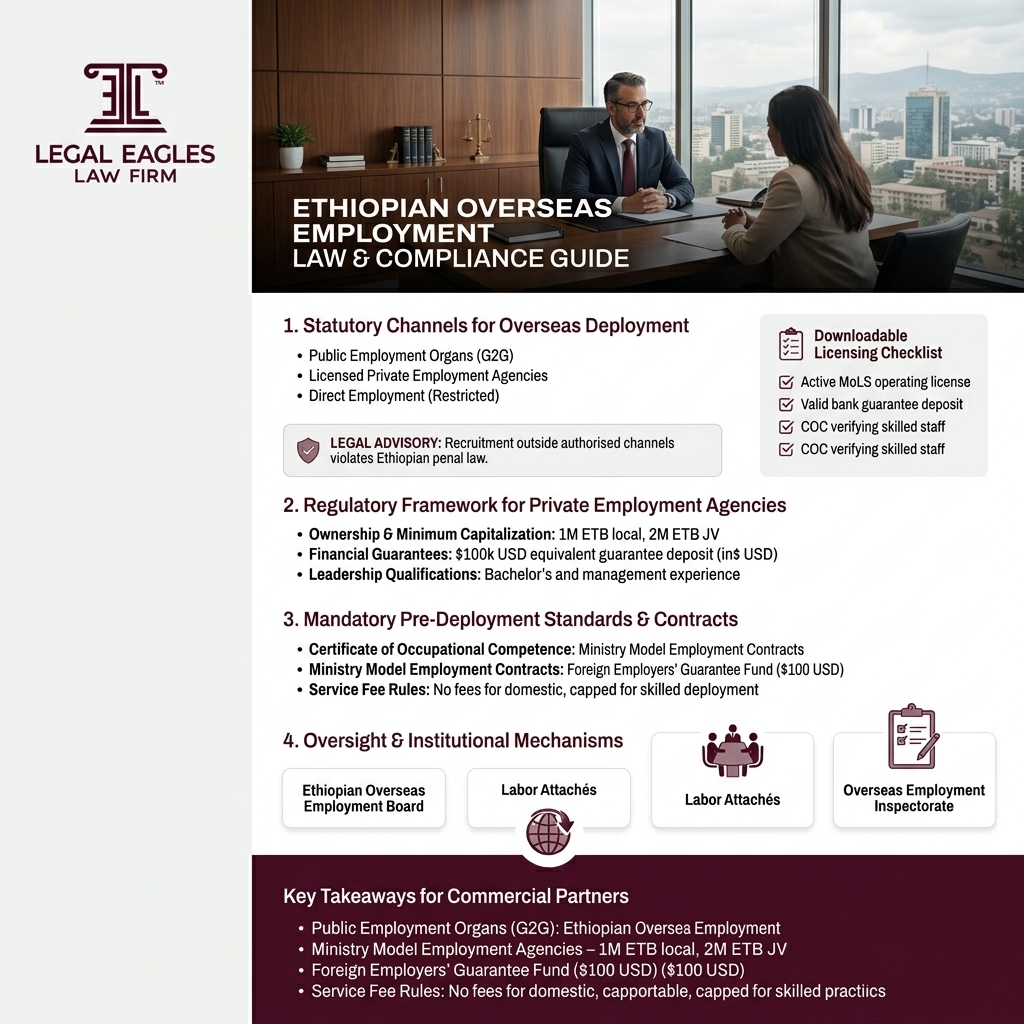
1. Statutory Channels for Overseas Deployment
Ethiopian law restricts the deployment of Ethiopian nationals for work abroad to three authorized channels:
- Government-to-Government: The Ministry of Labor and Skills directly manages bilateral placements under formal labor agreements with host nations.
- Licensed Private Employment Agencies: The Ministry of Labor and Skills accredits private commercial entities to recruit and deploy workers abroad.
- Direct Employment: The Ministry of Labor and Skills accredits private commercial entities to recruit and deploy workers abroad.
Legal Advisory: The law strictly limits direct recruitment to foreign missions, international organizations, and verified skilled specialists.
2. Regulatory Framework for Private Employment Agencies
The enactment of Amendment Proclamation Number 1246/2021 reformed the capitalization, ownership structures, and operational rules governing private recruitment entities.
Ownership & Minimum Capitalization
- Solely Ethiopian-Owned Agencies: Recruitment outside these authorized channels violates Ethiopian penal law and anti-trafficking statutes.
- Joint-Venture Structures (Skilled Manpower Recruitment Only):
- 80% Ethiopian / 20% Foreign Equity: Minimum paid-up capital of 2,000,000 Ethiopian Birr.
- 75% Ethiopian / 25% Foreign National of Ethiopian Origin: Minimum paid-up capital of 2,000,000 Ethiopian Birr.
Financial Guarantees & Management Standards
- Guarantee Account Deposits: Agencies must maintain a dedicated financial guarantee deposit in a blocked bank account to secure potential worker claims or contractual liabilities.
- Foreign Capital Contributions: Foreign partners must deposit all equity capital and financial guarantee contributions in convertible foreign currency.
- Leadership Qualifications: General Managers of private employment agencies must possess at least a Bachelor’s degree alongside verified management experience.
3. Mandatory Pre-Deployment Standards & Model Contracts
To enforce standardized protections across overseas placements, the law mandates pre-departure compliance steps:
- Certificate of Occupational Competence: Job seekers must obtain a valid certificate issued by an accredited assessment center verifying their technical skill or vocational qualification prior to deployment.
- Ministry Model Employment Contracts: All deployment contracts must strictly mirror the mandatory model contract issued by the Ministry of Labor and Skills. While employers may include clauses granting superior benefits, terms cannot derogate from minimum statutory guarantees.
- Foreign Employers’ Guarantee Fund: Foreign employers must deposit 100 US Dollars per deployed worker into a Ministry-administered guarantee fund to cover claims arising from employer defaults or contractual breaches.
- Service Fee Rules: The law strictly prohibits agencies from charging recruitment fees to domestic workers. For skilled workers, if the foreign employer does not cover the service fee, the agency may collect up to one month’s salary, payable in four installments.
4. Oversight & Institutional Mechanisms
Monitoring and enforcement throughout the deployment lifecycle are structured across specific regulatory bodies:
- Ethiopian Overseas Employment Board: Chaired by the Ministry of Labor and Skills, this inter-ministerial body coordinates policy execution, oversees host-country bilateral labor agreements, and monitors worker protection frameworks.
- Labor Attachés: Diplomatic officers posted to Ethiopian missions abroad tasked with monitoring working conditions, inspecting host employers, and assisting in dispute resolution.
- Overseas Employment Inspectorate: Specialized regulatory officers empowered to inspect local agency offices, audit recruitment documentation, and enforce statutory compliance.
Key Takeaways for Commercial Partners
International placement partners and corporate employers sourcing Ethiopian talent must verify that local partner agencies maintain valid operating licenses from the Ministry of Labor and Skills, hold active bank guarantees, and execute deployments via verified government or private agency mechanisms. Aligning cross-border recruitment operations with Proclamation Numbers 923/2016 and 1246/2021 is essential to ensure contract enforceability and mitigate operational liability.