Monopolization vs. Dominance: Analyzing Monopoly Power and Penetration Pricing Under Ethiopian Competition Law
Can an enterprise become too successful for its own good? Business leaders often ask if large market share or aggressive pricing creates legal liability under Ethiopian trade rules.
Many assume that holding a monopoly or offering loyalty rebates constitutes unfair trade competition. That assumption is wrong.
To clarify these legal boundary lines, we must examine the intersection of economic principles and Ethiopian competition law.
1. Monopoly Status vs. Monopoly Abuse: Is Being Big Illegal?
Acquiring large market share through enterprise, innovation, or superior efficiency is entirely lawful. Competition law does not penalize business success.
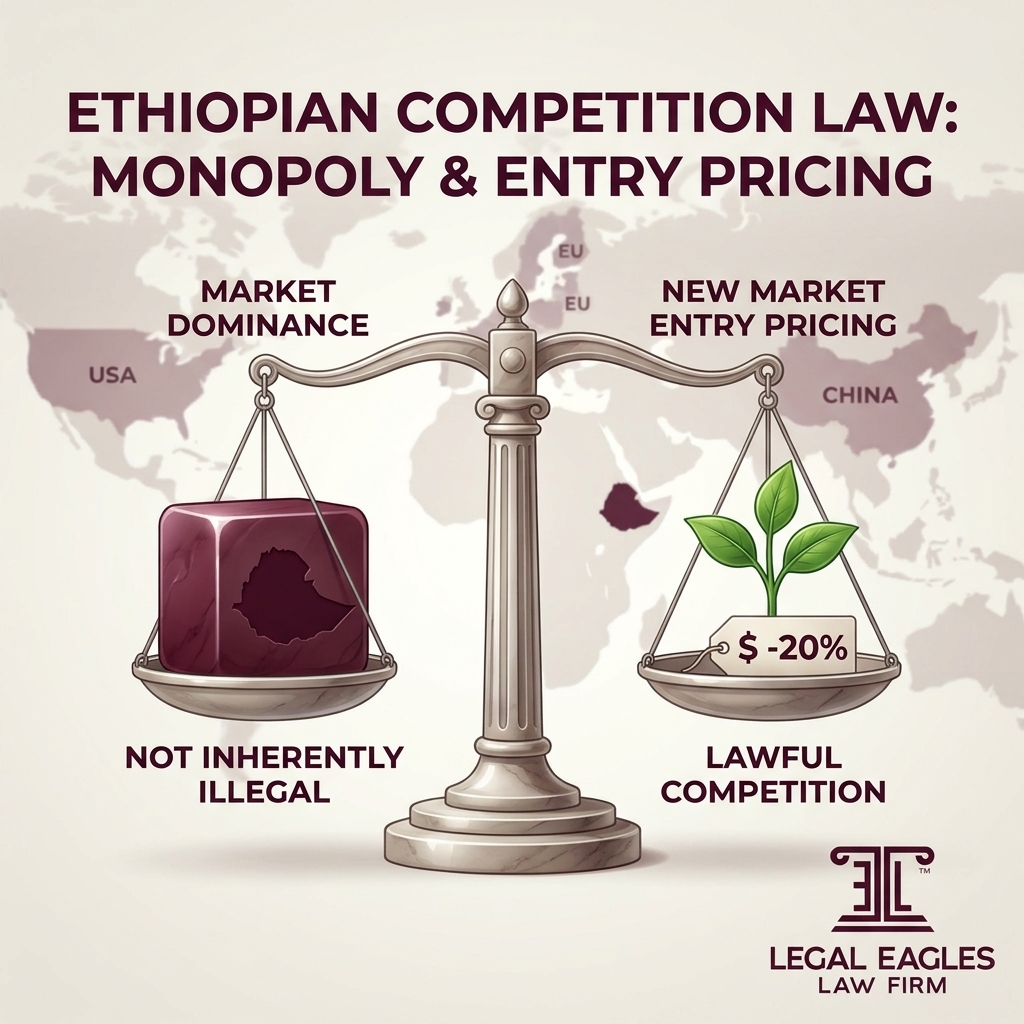
Ethiopian law reflects this foundational principle. Under Proclamation No. 813/2013, holding a dominant position or operating a monopoly is not inherently illegal.
What the Law Prohibits
Ethiopian trade law does not target market size; it targets market behavior. Article 5 of Proclamation No. 813/2013 regulates the abuse of market dominance, not the mere possession of a dominant position. An enterprise acts unlawfully only when leveraging market power to exclude rivals or exploit consumers through prohibited acts:
- Refusing to deal or supply goods without valid economic grounds.
- Imposing discriminatory conditions or tying/bundling unrelated products.
- Restricting production or technical development to artificially inflate prices.
- Directly or indirectly imposing unfair purchase or selling prices.
Without deceptive acts, unlawful collusion, or exclusionary behavior, maintaining market dominance remains completely legitimate.
2. Market Entry and Low Pricing: Penetration Pricing vs. Predatory Pricing
Offering goods at low introductory prices is a standard strategy when entering a new sector. Does this strategy constitute unfair trade competition under Ethiopian law?
Competition law distinguishes clearly between two pricing mechanisms: Penetration Pricing and Predatory Pricing.
Penetration Pricing (Pro-Competitive & Lawful)
Penetration pricing occurs when a business introduces a new product or enters a market with intentionally low initial pricing.
- Commercial Objective: Attract early adopters, establish brand awareness, and overcome entry barriers in a competitive market.
- Competition Impact: This practice enhances consumer welfare by driving down prices and compelling incumbents to innovate. Because a new entrant lacks dominant market power at entry, low introductory pricing reflects healthy market rivalry rather than an unfair trade practice.
Predatory Pricing (Anti-Competitive & Unlawful)
Predatory pricing occurs when a firm sets prices at an artificially depressed level—typically below its average variable cost—with an exclusionary intent.
- Commercial Objective: Incur deliberate short-term financial losses to force weaker competitors out of the market or deter prospective entrants, with the strategy of raising prices to monopoly levels once rivals disappear.
- Legal Benchmark: Proving predatory pricing requires establishing that prices fell below relevant cost benchmarks and that the firm possesses sufficient market power to eliminate competition and subsequently recoup its losses.
Under Proclamation No. 813/2013, setting low initial prices during market entry is a permissible business strategy. It transitions into an anti-competitive violation only if conducted by an already dominant entity seeking to foreclose market access through below-cost pricing.
3. Practical Case Study: Loyalty Programs and Fidelity Discounts (ShebaMiles)
A practical illustration of pricing strategies and promotional incentives in Ethiopia is Ethiopian Airlines and its ShebaMiles frequent flyer program.
Through ShebaMiles, passengers accrue bonus miles, tier status, and volume discounts based on travel frequency. This raises a fundamental legal question: Does a major market player commit unfair trade competition when offering loyalty rewards, bonus systems, or fidelity discounts?
The Law and Economics Perspective
From an economic standpoint, loyalty schemes and fidelity rebates are generally pro-competitive. They raise consumer retention, reduce transaction costs, stabilize demand forecasting, and reward recurring customer loyalty.
When an enterprise offers bonuses or fidelity rebates anchored in reasonable economic efficiencies such as economies of scale, lower customer acquisition costs, or operational predictability the practice serves legitimate business objectives and delivers clear consumer benefits.
The Legal Boundary under Ethiopian Competition Law
Under Proclamation No. 813/2013, granting fidelity discounts or loyalty bonuses does not automatically amount to unfair competition or abuse of dominance. However, when an enterprise holds significant market power, the distinction between a pro-competitive loyalty program and an anti-competitive market foreclosure depends on economic justification:
- Lawful Loyalty Incentives: Transparent rebate structures open to all consumers based on volume or objective criteria, supported by genuine cost savings or verifiable operational efficiencies.
- Abusive Rebate Schemes: Conditional fidelity rebates or exclusive dealing incentives designed to artificially lock buyers in, prevent competitors from gaining viable market share, or price below cost without economic justification.
For dominant firms, offering bonus programs like ShebaMiles is a valid strategy, provided the commercial structure is backed by sound economic efficiency defenses recognized under Article 5(2) of Proclamation No. 813/2013.
4. Global Perspectives: How Other Jurisdictions Handle Market Dominance and Pricing
To appreciate the trajectory of Ethiopian competition law, it is helpful to look at how major global economies balance market power, penetration pricing, and predatory conduct.
United States: High Thresholds for Predatory Claims
US antitrust law, governed principally by Section 2 of the Sherman Act, enforces a strong presumption in favor of low pricing.
- Monopoly Power: As established in United States v. Grinnell Corp., acquiring a monopoly through superior products, business acumen, or historic accident is legal.
- Predatory Pricing Test: Under the landmark Brooke Group Ltd. v. Brown & Williamson Tobacco Corp. decision, a challenger must meet a strict two-pronged standard:
- Prove prices were below an appropriate measure of cost (e.g., Average Variable Cost).
- Prove a “dangerous probability” of recoupment—that the firm will successfully raise prices to monopoly levels after driving out rivals.
- Key Takeaway: US courts almost never penalize market entry penetration pricing because new entrants lack the power to recoup predatory losses.
European Union: Protection of Market Structure
Under Article 102 of the Treaty on the Functioning of the European Union (TFEU), dominant firms owe a “special responsibility” not to allow their conduct to distort competition.
- Cost Benchmarks: Under the AKZO standard, prices below Average Variable Cost (AVC) are presumed abusive. Prices above AVC but below Average Total Cost (ATC) are abusive if intended to eliminate a competitor.
- No Recoupment Proof Required: Unlike US law, EU law does not require explicit proof that the dominant firm will recoup its losses, making enforcement against predatory pricing and conditional fidelity rebates stricter.
- Loyalty Schemes: In Intel v. Commission, the Court established that fidelity rebates offered by dominant firms face heavy scrutiny unless the firm demonstrates that an “equally efficient competitor” could still compete despite the rebate structure.
China: The Anti-Monopoly Law (AML)
Enforced by the State Administration for Market Regulation (SAMR), China’s Anti-Monopoly Law aligns closely with modern economic regulation.
- Abuse of Dominance: Article 17 of the AML prohibits abusing a dominant market position, rather than holding dominance itself.
- Justifiable Cause Exemption: Article 17(2) forbids selling below cost “without justifiable cause.” China explicitly recognizes legitimate business justifications—such as introductory penetration pricing by new entrants, promotional discounts, and seasonal clearance sales—as valid defenses.
- Platform Regulation: Chinese regulators strictly enforce rules against conditional rebates and exclusive dealing requirements (“choose one of two” mandates) that prevent merchant platforms from offering competitive prices elsewhere.