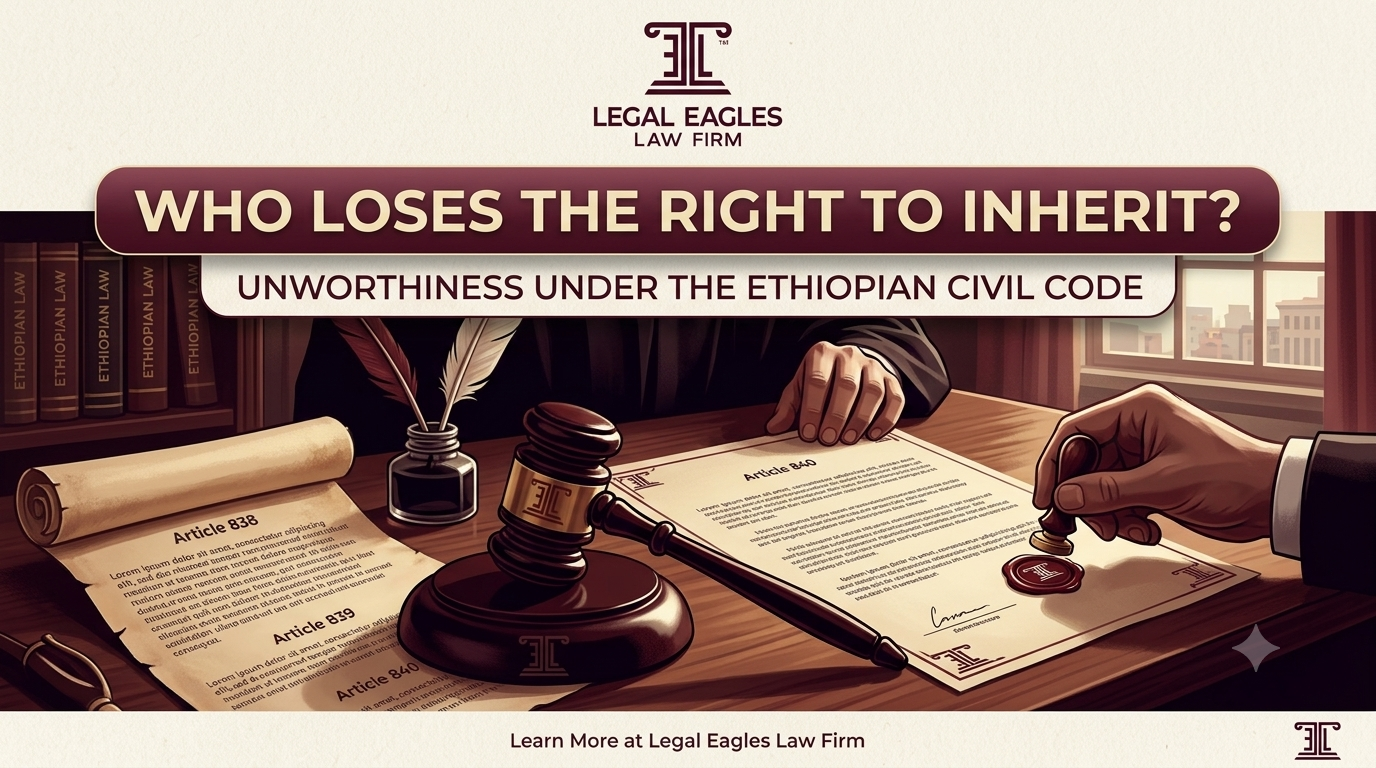
Who Loses the Right to Inherit? Understanding Unworthiness Under Ethiopian Law
Not every relative of a deceased person is automatically entitled to receive a share of their estate. Under Ethiopian succession law, certain grave actions can strip an individual of their right to succeed—even if they would otherwise be a primary heir.
This legal doctrine of unworthiness to succeed ensures that individuals cannot profit from criminal acts, deceit, or bad faith against the deceased or their family.
1. Disqualification Due to Severe Criminal Acts
Under Article 838 of the Civil Code, an heir is completely disqualified from inheriting if they are convicted of:
- Intentionally causing the death of the deceased, or of the deceased’s descendant, ascendant, or spouse.
- Attempting to murder any of the individuals listed above.
- Making a false accusation or giving false testimony that could have resulted in the death penalty or a prison sentence exceeding ten years for any of those same individuals.
The Role of Timing
Timing is critical when evaluating criminal disqualification. Under Article 839, these provisions apply strictly if the offense or attempt occurred before the death of the deceased. If the act occurs after the deceased has passed away, the law handles the matter under different legal mechanisms.
2. Interference with the Deceased’s Last Will
Losing the right to inherit is not limited to physical violence or court perjury. Bad-faith interference with a person’s final wishes carries the exact same penalty.
As outlined in Article 840, an heir forfeits their capacity to inherit if they:
- Prevent the deceased from creating, altering, or revoking a will within the final three months of their life.
- Destroy, conceal, or falsify the deceased’s will without authorization.
- Knowingly rely upon a forged or invalid will to claim an inheritance.
3. The Power of Forgiveness: How Capacity Can Be Restored
The law leaves room for reconciliation. Under Article 841, an otherwise disqualified heir may still inherit if the deceased explicitly forgave them in a valid will.
Furthermore, if the deceased knowingly granted a specific legacy to the heir after learning about the disqualifying act, that bequest remains legally valid.
4. Does Disqualification Affect Descendants?
A common misconception is that if an heir is disqualified, their children can simply step in to receive the share on their behalf.
Under Article 855, this is not permitted. When an heir is declared unworthy, their children or other descendants cannot inherit that share by representation in the deceased’s succession.
Key Takeaway
Inheritance under Ethiopian law is contingent not only on family relation, but also on basic principles of good faith and justice. Where severe wrongdoing or deliberate interference with a testaments exists, the law acts decisively to bar the offender from benefiting.