Draft Amendment to Ethiopia’s Federal Tax Administration Proclamation No. 983/2016: Modernizing Enforcement and Compliance
The Federal Tax Administration Proclamation No. 983/2016 serves as the structural bedrock for Ethiopia’s domestic tax system, governing everything from taxpayer registration to audits, administrative penalties, and the appeals framework. As the government rolls out significant updates to its substantive tax regime including the Value Added Tax Proclamation No. 1341/2024 and recent Income Tax updates modernizing the administrative machinery has become a matter of fiscal urgency.
To address prolonged dispute backlogs, improve structural enforcement, and eliminate manual inefficiencies, the Ministry of Revenues (MoR) has put forward a comprehensive draft amendment. These structural updates aim to make tax collection more transparent, fair, and modern.
1. Key Features and Institutional Updates
A. Institutional Re-designation
Reflecting systemic structural updates within the government hierarchy, the text formally updates the term “Authority”—which previously referred to the former Ethiopian Revenues and Customs Authority—to “The Ministry of Revenues” throughout the proclamation.
B. Formalization of Alternative Dispute Resolution (Tax Mediation)
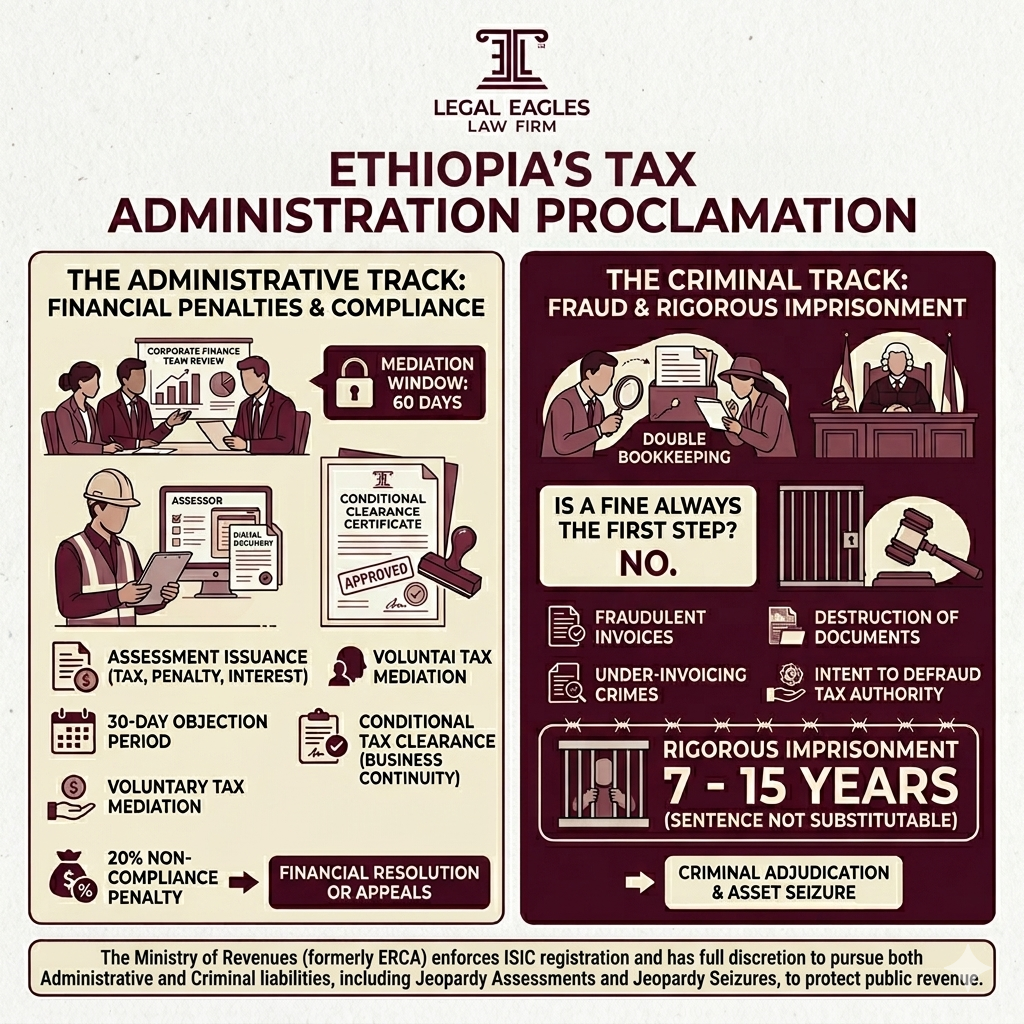
Under the existing framework, taxpayers dissatisfied with an assessment faced long delays in a backlogged formal appeals system, stalling business operations and freezing capital. The draft amendment introduces a voluntary Tax Mediation (Alternative Dispute Resolution) system. Instead of immediate litigation before the Appeals Commission or the courts, taxpayers and the ministry of revenues can resolve complex disputes through structured dialogue facilitated by a neutral, independent Mediator. To maintain momentum, the new framework strictly mandates that the mediation process must conclude within 60 days.
C. Extension of the Fraud Audit Limitation Period (10-Year Window)
In standard administrative contexts, the Ministry retains a 5-year statutory limitation period to review and adjust regular tax assessments. However, if the Ministry of revenue uncovers verified evidence pointing to intentional tax fraud, the draft amendment extends the reassessment window up to 10 years, allowing investigators to look back significantly further to recover evaded public revenue.
D. Restricting New Evidence and the 20% Compliance Penalty
To prevent taxpayers from withholding accounting records during initial field audits and surprising auditors by introducing new documentation late during an appeal, the amendment introduces a strict prohibition on the submission of new evidence during the grievance or appeal phase.
The ministry grants an exception only if the taxpayer proves that force majeure prevented them from presenting the documentation earlier. Even if accepted, failing to produce the files during the primary audit triggers an automatic administrative penalty equal to 20% of the total tax debt owed.
E. Introduction of Conditional Tax Clearance Certificates
Previously, an ongoing tax dispute often blocked a company from obtaining a clean tax clearance certificate, bringing daily business operations to a halt. The draft amendment offers a practical compromise for business continuity: if a taxpayer actively contests an assessment through the dispute channels or signs a formal installment payment arrangement, the law permits them to receive a Conditional Tax Clearance Certificate to enable business license renewals or bank loan applications.
F. Adoption of the ISIC Registration Standard
To align Ethiopia’s taxpayer tracking with international administrative practices, the ministry will now conduct taxpayer registration and classification in accordance with the International Standard Industrial Classification (ISIC), allowing officials to segment businesses into precise industrial categories.
G. Administrative Corrections of Tax Notices
The draft introduces an adaptable correction mechanism allowing the tax authority, either on its own initiative or upon a formal application by a taxpayer, to rectify and adjust an issued tax assessment notice if a clerk identifies a clear mathematical calculation error or if new, critical material evidence surfaces.
2. Sharp Escalation of Fines and Shared Executive Liability
While the draft amendment introduces operational flexibility through mediation and conditional clearances, it simultaneously sharpens enforcement measures against non-compliance, parallel cash systems, and aggressive tax avoidance:
- Doubling the Penalty for Failure to Issue Receipts: To curb parallel cash economies and ensure transactional transparency, the administrative fine for failing to issue a formal sales receipt escalates from ETB 50,000 to ETB 100,000 per unissued receipt.
- Targeting Financial Officers for Corporate Violations: Under the original framework, criminal and administrative focus rested primarily on the general manager or managing director of a corporate entity. The draft amendment expands this scope, ensuring that the law holds the Chief Financial Officer (CFO) or Head of Finance directly, jointly, and individually liable for corporate tax crimes.
- Severe Sanctions for Under-Invoicing (Double Bookkeeping): A common method of tax fraud involves issuing multiple invoices with varied pricing for a single transaction to understate gross revenue. The draft amendment specifically criminalizes this practice, assigning a mandatory fine of ETB 100,000 alongside a strict prison term of 5 to 7 years for anyone found guilty of under-invoicing.
3. Strict Criminal Liability: Bypassing the Penalty Escalator
The text of Proclamation No. 983/2016 establishes a critical baseline: no statutory rule requires a financial fine as a mandatory first step before prosecutors can pursue criminal imprisonment. The law sets up a strict dual-track system under Article 100(2). When an offense carries both administrative and criminal implications, the Ministry of Revenues holds full statutory discretion to decide whether to hold the party administratively liable or send them straight to federal prosecutors for criminal adjudication. If investigators identify an intent to defraud, dual bookkeeping, or systemic evasion, the ministry can bypass the administrative fine track entirely.
Once a case enters the federal criminal track, judicial flexibility regarding sentencing disappears:
- Rigorous Imprisonment: Serious tax offenses such as manufacturing fraudulent invoices under Article 118 or destroying corporate accounting ledgers carry mandatory minimum sentences ranging from 7 to 15 years. Because the law classifies these offenses as rigorous imprisonment, legal statutes restrict federal courts from substituting prison sentences with softer alternatives like probation, weekend sentences, or community service.
- Immediate Financial Recovery Seizures: Even while officials evaluate criminal paths, the law does not delay civil collection if the state faces a risk of asset dissipation. Under Article 41, if the authority determines tax collection is in jeopardy, they can immediately issue a property seizure order without waiting for the standard 30-day notice period. Furthermore, Article 27(5) permits jeopardy assessments to declare all taxes and associated penalties payable immediately.
Conclusion
The draft amendment to Proclamation No. 983/2016 represents a balanced but uncompromising shift in Ethiopian tax administration. By offering structured 60-day mediation windows and conditional clearances, the framework provides compliant businesses with practical tools to maintain operational momentum. However, by doubling non-issuance fines, holding finance heads criminally accountable, and enforcing rigid prison terms for double-invoicing, it leaves no room for parallel record-keeping or non-transparent accounting.