Dematerialization vs Immobilization in CSDs: Key Legal Differences
As capital markets modernize, financial regulators and corporate issuers are rapidly replacing paper-based share and bond certificates with centralized electronic book-entry systems. The Central Securities Depository (CSD) drives this transformation.
When corporate issuers transition to a central depository, they choose between two holding models: dematerialization vs immobilization. While both methods eliminate the physical movement of paper certificates during daily trading, each relies on distinct legal structures and administrative workflows.
Defining the Core Concepts
1. Immobilization
Immobilization serves as a transitional bridge between traditional paper-based markets and fully electronic systems.
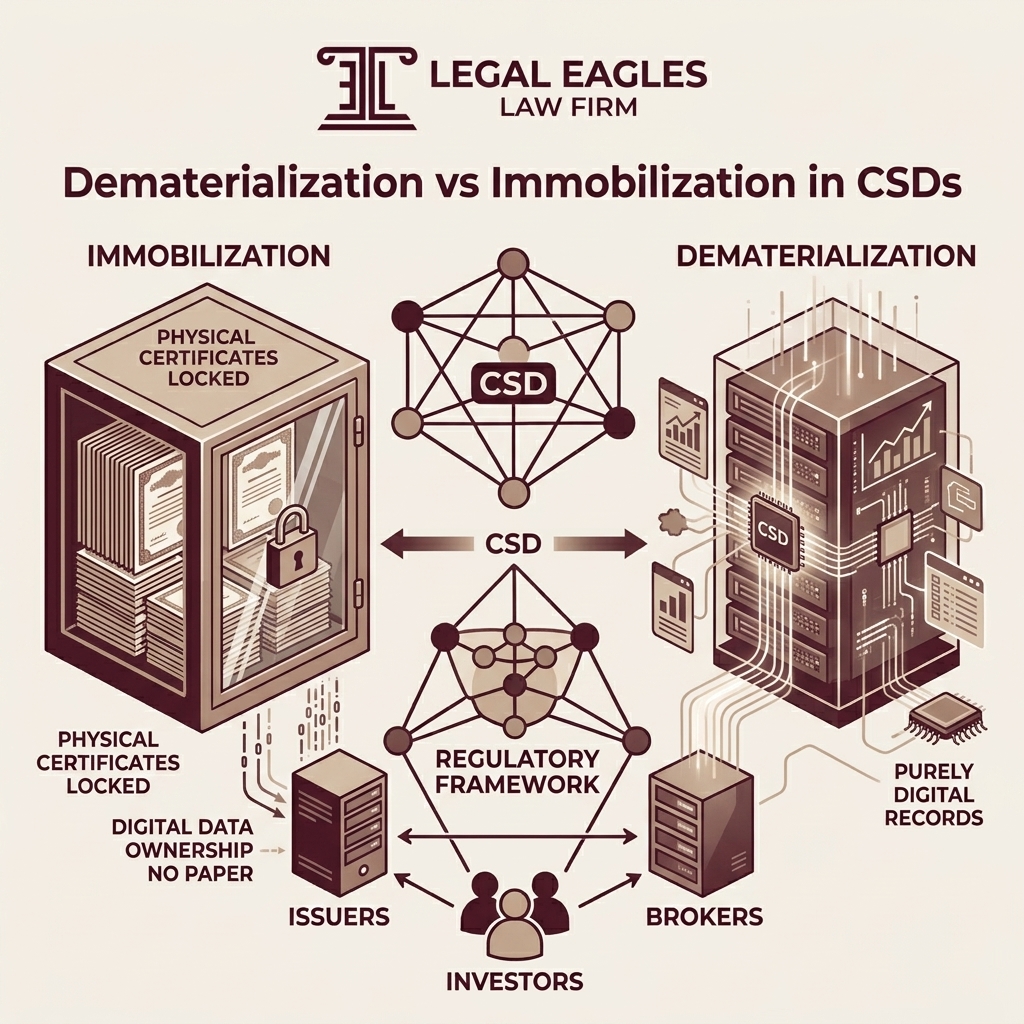
Under an immobilization model, physical paper certificates retain their legal status. However, instead of circulating among buyers and sellers, the CSD stores these paper certificates in a central vault. Ownership transfers occur electronically on the CSD’s sub-ledger, while the underlying physical instruments remain permanently locked in storage.
Modern market practice frequently executes immobilization through a Global Certificate—a single physical document that represents an entire security issuance deposited with the CSD upon launch.
2. Dematerialization
Dematerialization represents the complete digitization of corporate securities.
In a dematerialized framework, physical share or bond certificates do not exist at all. The CSD creates, records, and transfers ownership rights purely as electronic entries within its central database. The legal proof of ownership shifts entirely from physical documents to digital registration on the central ledger.
Comparative Breakdown: Dematerialization vs Immobilization
Understanding the operational and legal distinctions between both mechanisms helps corporate bodies navigate market compliance:
- Physical Status:
- Immobilization: The CSD vaults physical certificates securely in a central location.
- Dematerialization: Issuers never print physical certificates; documents do not exist.
- Legal Basis of Title:
- Immobilization: The CSD holds physical paper in trust or custody on behalf of investors.
- Dematerialization: Electronic book-entries on the CSD register establish sole proof of legal title.
- Issuance Format:
- Immobilization: Issuers rely on individual physical certificates or a single Global Certificate.
- Dematerialization: Issuers create purely digital records from inception.
- Rematerialization:
- Immobilization: Investors may request physical paper certificates back from the vault.
- Dematerialization: Applicable statutes prohibit paper certificates unless explicit regulations allow exceptions.
- Operational Workflow:
- Immobilization: Vault maintenance, security controls, and physical audits require higher operational resources.
- Dematerialization: Digital processing reduces administrative overhead and enables immediate clearing settlement.
Who Places Securities into the CSD?
Corporate bodies transitioning to a central depository must determine which entities hold legal standing to deposit or register securities within the system. Retail investors cannot access the CSD directly; they must interact through authorized market participants.
1. Corporate and Sovereign Issuers
- Dematerialized Systems: When issuing equity or debt securities, the issuing corporation or government entity registers the issuance directly into the CSD’s central registry electronically.
- Immobilized Systems: The issuer executes and delivers a Global Certificate covering the entire issue amount directly to the CSD vault.
2. CSD Participants / Depository Participants (DPs)
CSD Participants serve as the primary institutional gateway to the depository. These participants typically include:
- Commercial Banks and Custodian Banks
- Licensed Broker-Dealers and Investment Banks
- Clearing Houses
During market transitions, DPs collect physical certificates from existing shareholders and submit them to the CSD for vaulting (immobilization) or cancellation and digital entry (dematerialization).
3. Existing Shareholders (Indirectly via DPs)
Shareholders holding legacy paper certificates lodge their documents with an authorized Depository Participant. The DP verifies the physical certificate with the issuer’s registrar before transferring the securities into the shareholder’s electronic CSD sub-account.
Key Takeaways for Corporate Issuers
Transitioning to a CSD framework minimizes settlement risk, eliminates lost certificate liabilities, and improves market liquidity. Evaluating whether your operating jurisdiction utilizes an immobilized or dematerialized framework remains essential when structuring capital raises, managing shareholder registries, and maintaining regulatory compliance.