Understanding Severance Pay under Ethiopia’s Labor Proclamation No. 1156/2019
When an employment contract ends in Ethiopia, financial settlements frequently become a primary flashpoint for disputes between employers and workers. Under the Labor Proclamation No. 1156/2019, the two primary financial entitlements that arise at termination are Severance Pay and Compensation.
While these terms are often used interchangeably in casual conversation, they serve entirely different legal purposes, carry distinct statutory triggers, and utilize separate formulas. For human resource managers, legal practitioners, and employees, understanding the exact boundaries of Article 39 (Severance) is vital to mitigating litigation risks and ensuring strict statutory compliance.
1. What is Severance Pay?
Severance pay functions as a statutory social safety net. It is not designed to penalize the employer, nor is it a damages remedy for illegal actions. Rather, its legal objective is to provide a temporary financial cushion to support a qualified worker during their post-employment transition, preventing immediate economic hardship while they search for a new job.
The Entry Gates
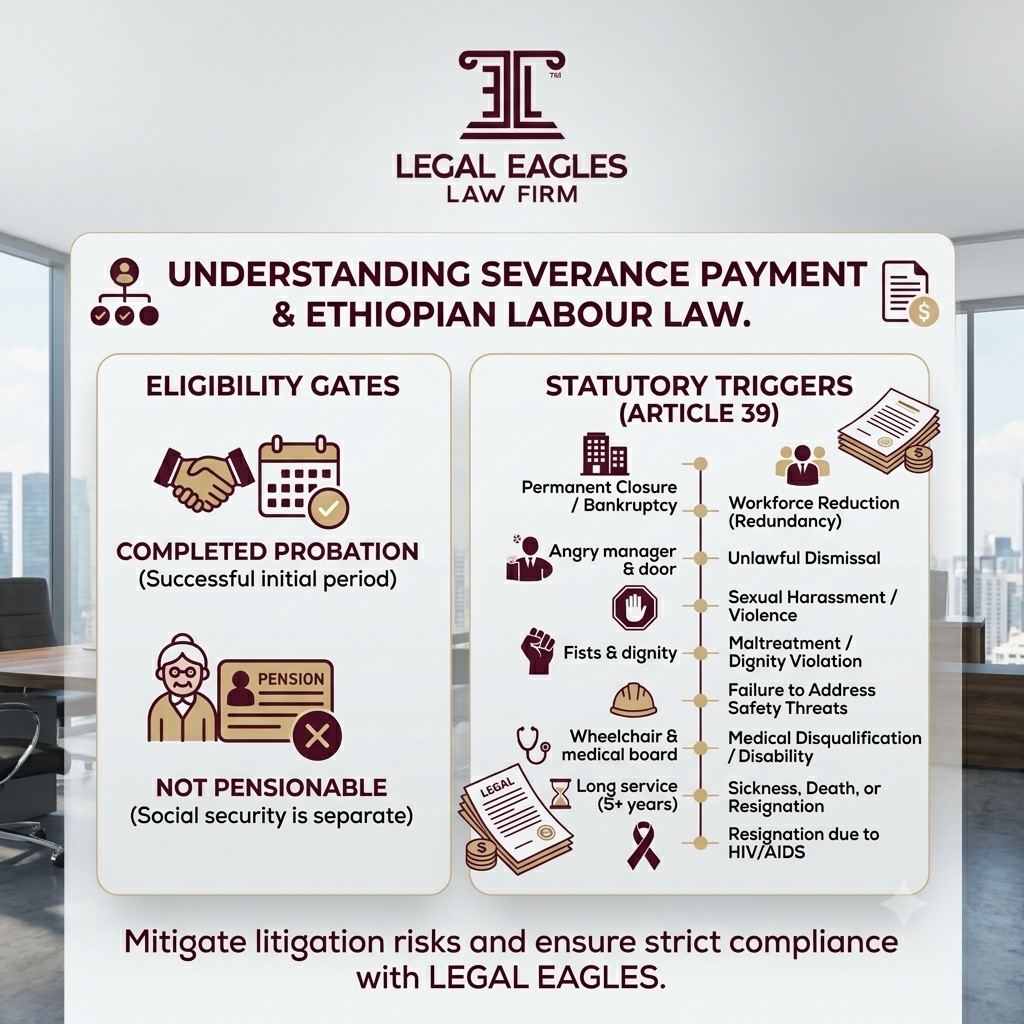
To qualify for statutory severance pay under Article 39, an employee must first pass two negative prerequisites:
- Completion of Probation: The worker must have successfully cleared their initial probationary period.
- Ineligibility for Pension: The worker must not be eligible for a pension under national social security laws. In Ethiopian labor jurisprudence, pension coverage generally extinguishes the right to receive basic statutory severance from the employer.
2. The 9 Statutory Triggers for Severance Pay
If an employee passes the initial eligibility gates, severance pay is strictly required by law if the contract is terminated under one of these nine specific scenarios outlined in Article 39(1):
A. Structural & Administrative Shutdowns
- Permanent Closure (Art. 39(1)(a)): Triggered if an undertaking permanently ceases operations due to bankruptcy or other causes. The relationship dissolves automatically, and severance must be paid out to non-pensionable staff.
- Workforce Redundancy (Art. 39(1)(c)): Triggered when an employer downsizes and lays off staff in accordance with the strict structural and reduction rules of Article 29 (e.g., due to falling profits or shifting market dynamics).
B. Employer Misconduct & Constructive Dismissal
- Unlawful Dismissal (Art. 39(1)(b)): Occurs when an employer terminates a contract outside the bounds of the law, without valid legal grounds or proper disciplinary procedures.
- Workplace Sexual Harassment or Violence (Art. 39(1)(d)): A vital provision in the newer law. If an employee resigns because they were subjected to sexual harassment or violence by management—or by a co-worker where management failed to take timely corrective action after being notified—severance is legally owed.
- Maltreatment and Dignity Violations (Art. 39(1)(e)): Triggered if an employee terminates the contract because the employer committed acts that severely impact their human dignity, morale, or constitute an offense under the Criminal Code (e.g., physical or verbal assault).
- Failure to Address Safety Threats (Art. 39(1)(f)): If an employee resigns because management was formally notified of an imminent threat to the worker’s safety or health but failed to take corrective measures.
C. Health, Life, and Tenure-Based Milestones
- Medical Disqualification (Art. 39(1)(g)): Triggered if a certified medical board officially determines that a worker suffers from a partial or total disability that leaves them unable to perform their duties.
- Long-Term Service (Art. 39(1)(h)): If a worker has provided at least five consecutive years of service, severance is triggered if they pass away (paid to dependents), leave due to long-term sickness, or choose to resign on their own initiative (provided they have no outstanding training-related service bonds).
- Resignation Due to HIV/AIDS (Art. 39(1)(i)): Triggered if a worker terminates the contract on their own initiative specifically because of complications or conditions related to living with HIV/AIDS.
Summary for Compliance
Statutory severance under Proclamation No. 1156/2019 is not an automatic payout for every workplace separation; it is a carefully regulated transition mechanism. Handling employee departures requires an absolute command of these nine distinct legal grounds. By ensuring that a termination fits precisely into one of these statutory scenarios, organizations can honor their legal duties, respect the welfare of their workforce, and systematically insulate themselves from costly labor court disputes.