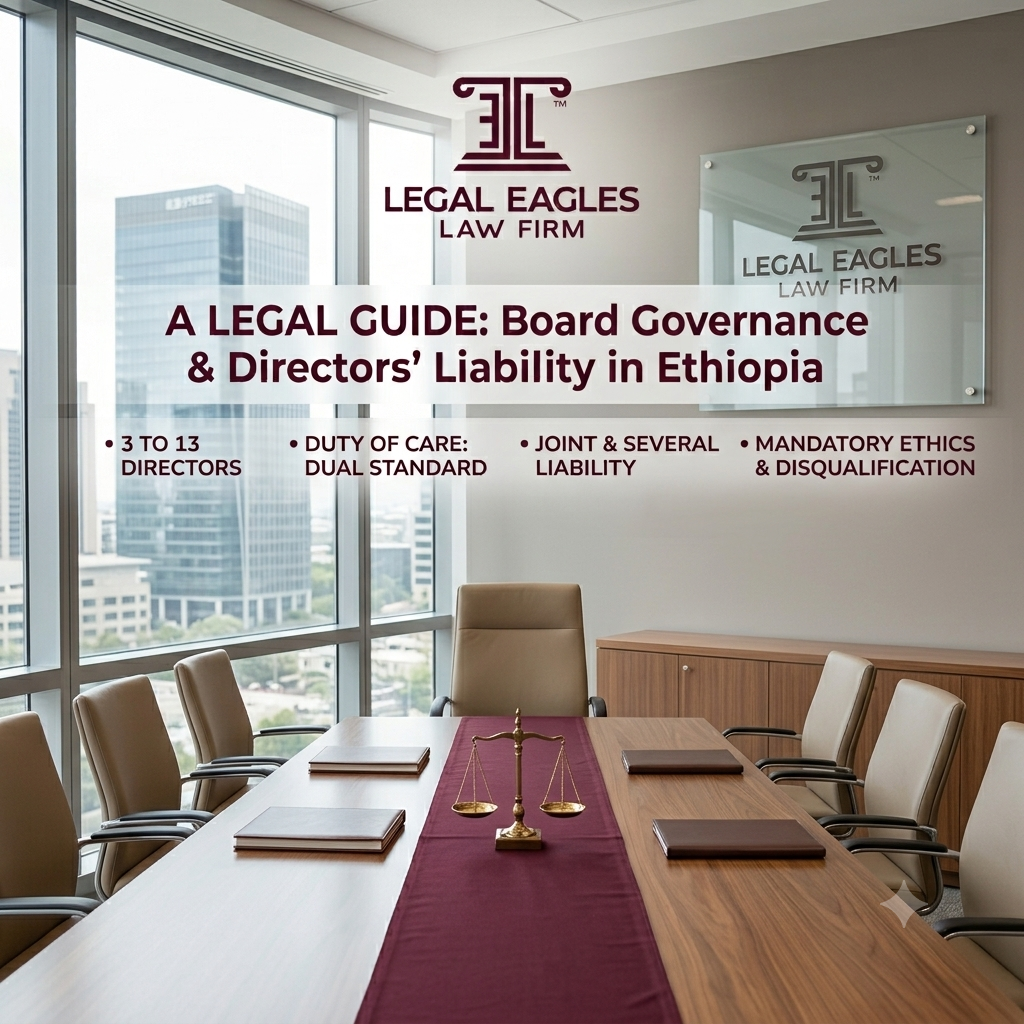
Board Governance & Directors’ Liability Under Ethiopian Law
Corporate governance serves as the structural backbone of market integrity, shareholder protection, and sustainable enterprise development. In share companies (S.C.), ownership is separate from daily management. Therefore, clear statutory rules for directors are essential to safeguard capital.
The Revised Commercial Code of Ethiopia modernized the legal framework for directors. It updated rules on powers, duties, appointments, and civil exposures. This analysis examines mandatory rules on board composition, fiduciary duties, and legal liabilities.
Part I: Board Structure, Composition & Membership Parameters
The structural configuration of a board dictates its operational capacity, representation equity, and oversight efficacy. Article 296 of the Commercial Code establishes mandatory boundaries to prevent both structural gridlock and excessive concentration of power.
1. Numerical Boundaries of Board Size (Art. 296)
- Statutory Limits: The board must consist of 3 to 13 members.
- Determination of Board Size: The exact number must be defined in the Memorandum of Association (MoA).
- Default Mechanism: If the MoA is silent, shareholders must determine the exact board size during their meeting.
- Governance Rationale: A minimum of three members prevents single-person dominance. Meanwhile, a cap of thirteen prevents administrative inefficiency and confusion.
2. Inclusion and Limits on Non-Shareholder Directors
Modern Ethiopian commercial law balances equity-owner control with professional technical competence through The One-Third Rule:
Non-Shareholder Cap: Non-shareholders may be elected to the board, but non-shareholder directors cannot exceed one-third (1/3) of total board membership.
- Strategic Implication:Companies can recruit independent industry experts or legal advisers. This increases board competence while equity owners maintain majority control.
3. Protection and Representation of Share Classes
To safeguard minority and specialized equity interests, the code strictly mandates class representation:
- Distinct share classes (e.g., ordinary vs. preferred) require special protection. Each share class must receive at least one designated board seat.
- This requirement guarantees that unique economic or voting rights attached to specific share classes are protected during high-level strategic decisions.
Part II: Fiduciary Duties & Statutory Standard of Care
Directors act as fiduciaries for the corporate entity. Articles 316 through 318 set mandatory codes of conduct. These align directorial behavior with the best interests of the company.
Core Fiduciary Mandates
- The Duty of Loyalty (Art. 316): Directors must act in good faith and prioritize company interests.
- Conflict of Interest Avoidance (Art. 320): Directors are prohibited from placing themselves in positions where personal interests conflict—or potentially conflict—with obligations owed to the company.
- Corporate Opportunities (Art. 319): Directors may not usurp business opportunities belonging to the company for personal gain or redirect them to third parties.
- Insider Information: Exploiting confidential operational data, trade secrets, or non-public financial reports for personal enrichment constitutes a severe breach of statutory loyalty.
- The Duty of Independent Judgment (Art. 317): Board decision-making must reflect independent evaluation rather than rubber-stamping external or internal agendas. A director breaches this duty if they act under the strict dictation or control of a controlling shareholder, parent company, or executive management, effectively surrendering their statutory oversight role.
- The Duty of Care and Diligence (Art. 318): Directors must exercise reasonable skill and attention in conducting company oversight. Ethiopian law evaluates compliance using a dual standard:
- The Objective Element: Evaluates whether the director acted with the level of care and skill that a reasonably prudent person would exercise when executing similar duties under comparable circumstances.
- The Subjective Element: Adjusts the benchmark upward for directors with specialized knowledge, professional qualifications, or expert backgrounds (e.g., legal, financial, or engineering expertise). An expert director will be held to the higher standard corresponding to their specialized qualifications.
Eligibility, Character & Statutory Disqualification (Art. 297)
- Fitness Standards: Candidates must possess full legal capacity, sound mental health, and high moral integrity.
- Mandatory Criminal Disqualification: Individuals convicted of financial or economic offenses—such as theft, embezzlement, breach of trust, fraudulent conversion, or money laundering—are statutorily prohibited from assuming a directorship.
- Automatic Termination: If a serving director is convicted of such an offense during their tenure, their appointment is automatically terminated by operation of law.
Part III: Civil Liability Regimes & Accountability
When board oversight fails, Articles 325 and 326 establish clear civil mechanisms to hold directors personal accountable for damages resulting from misconduct or breach of duty.
1. Joint and Several Liability (In Solidum) (Art. 325)
- Extent of Exposure: Directors are liable to the company, shareholders, and third parties for damages directly caused by failure to perform their statutory duties or exercise adequate oversight.
- Collective Liability: If multiple directors contribute to a statutory breach or failure of diligence, liability is joint and several. Claimants may enforce total recovery against any individual director or all guilty directors collectively.
Legal Exemption Threshold: A director can escape individual liability only if they can demonstrate that they dissented from the harmful action, recorded their explicit dissent in the meeting minutes, and acted without personal negligence.
2. Statutory Invalidation of Exculpatory Clauses (Art. 326)
To prevent companies from eroding these accountability standards, Ethiopian law strictly invalidates contractual protections:
Any clause in a company’s Memorandum of Association, Articles of Association, or employment/directorship contract attempting to limit, waive, or hold a director harmless from personal civil liability arising from negligence, breach of duty, or illegal acts is null and void ab initio.
This imperative rule ensures that corporate entities cannot contractually waive statutory standards of care or grant prospective immunity to directors.
Part IV: Structural Governance & Separation of Powers
A core objective of modern corporate governance is eliminating structural conflicts between executive execution and supervisory oversight.
1. Mandatory Shareholder Status for Board Chairperson (Art. 300)
Unlike general directorships which allow up to one-third non-shareholder participation, the Chairperson of the Board of Directors must be a shareholder-director.
- Non-shareholder directors are legally prohibited from holding the office of Board Chairperson.
- Governance Objective: Ensures that the top officer leading board discussions retains a direct financial and ownership stake in the enterprise, aligning leadership interests with long-term capital preservation.
2. Strict Prohibition on Dual Roles (CEO vs. Board Chair)
The Commercial Code mandates a clear operational firewall between executive leadership and board governance:
- The Prohibition: The individual serving as the General Manager (CEO) of a Share Company cannot concurrently serve as the Board Chairperson.
- Governance Objective: Merging operational management with board oversight creates an inherent conflict of interest, where the manager effectively oversees their own performance. Enforcing strict functional separation guarantees independent board oversight over operational executives.
Strategic Compliance Checklist for Corporate Boards
To ensure full compliance with the Revised Commercial Code, corporate boards, legal counsel, and company secretaries should implement the following steps:
- Board Composition Audit: Review existing corporate bylaws to verify board size falls strictly within 3–13 members and non-shareholder appointees do not exceed 1/3 of total seats.
- Class Representation Review: Confirm that all issued share classes hold at least one designated representative on the board as mandated by statutory provisions.
- Contractual Clean-up: Audit directorship agreements and constitutive bylaws to remove exculpatory or hold-harmless clauses attempting to waive liability, as these are legally unenforceable in court.
- Governance Segregation: Ensure operational boundaries are enforced so that the Chief Executive Officer/General Manager does not hold the Board Chair position, and that the Chair holds company equity.
- Dissent Minuting Protocol: Implement rigorous board minuting procedures to record individual director dissents—establishing the documented evidence required for individual liability exemption under Article 325.
How Eagle Advocates Can Support Your Board
Navigating corporate governance, statutory compliance, and directorial exposure requires proactive legal structuring. Our commercial legal team assists Share Companies, foreign investors, and executive leadership across Ethiopia with corporate governance audits, board advisory, constitutional drafting, and liability risk management.