The Mechanics of Corporate Divisions under the 2021 Commercial Code of Ethiopia
When a business entity reaches a certain level of operational complexity, or when shareholders seek to partition assets to pursue distinct commercial trajectories, a standard corporate dissolution is rarely the optimal path. Instead, sophisticated enterprises turn to the strategic restructuring mechanisms provided under the Commercial Code of Ethiopia (Proclamation No. 1243/2021).
Under Article 566 of the Commercial Code, a division of a business organization (commonly referred to as a demerger or spin-off) stands out as a highly sophisticated legal instrument. It allows for the systematic reallocation of assets and liabilities while preserving corporate value and avoiding the disruptive, value-destroying processes of standard liquidation.
1. Defining “Division” and Its Core Legal Mechanics
Under the Ethiopian corporate law framework, we do not view a division as a mere physical partitioning of assets; rather, it represents a highly regulated corporate transaction. Based on statutory guidelines, three main structural elements execute a corporate division:
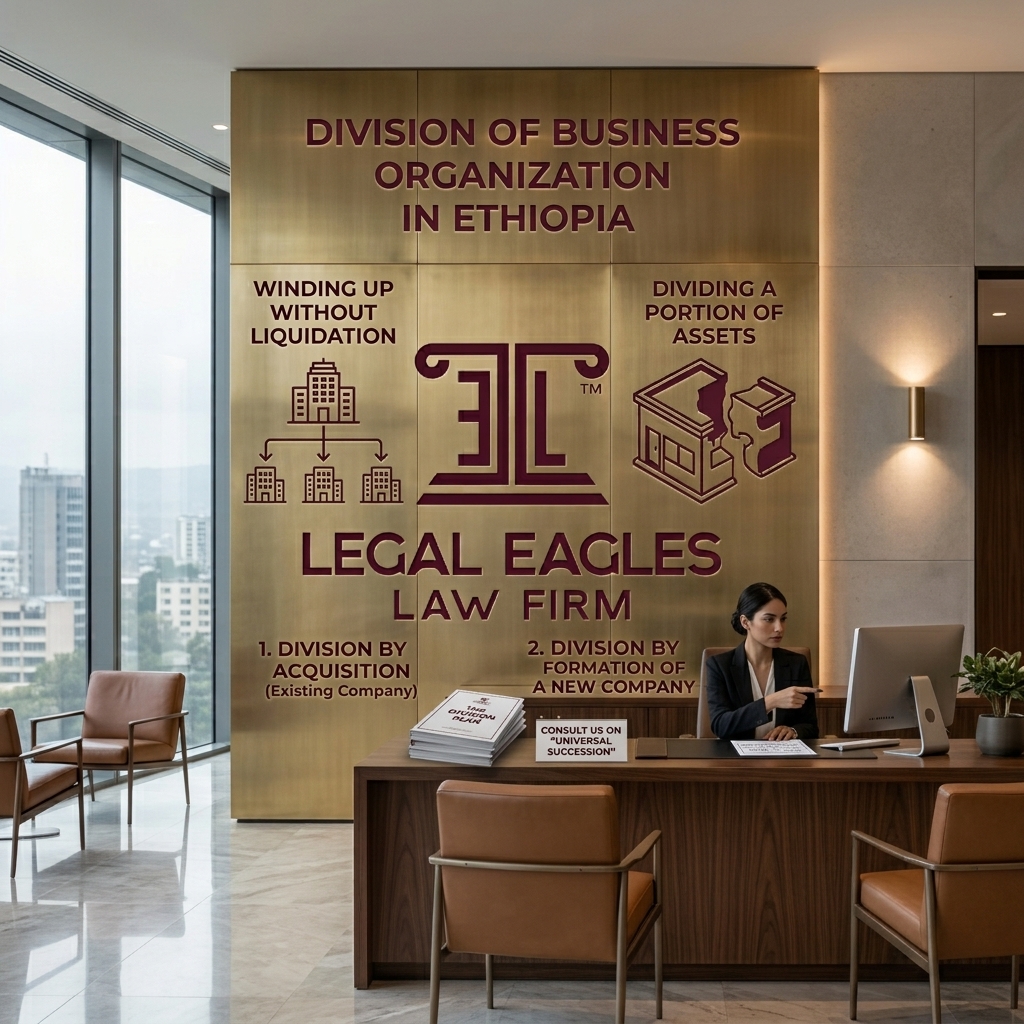
A. Winding Up Without Liquidation
In a full division, the pre-existing business organization winds up without going through the traditional, painful liquidation process. Instead, the company transfers all of its assets and liabilities in their entirety to more than one pre-existing or newly formed receiving company. The successor entities fully absorb the original entity’s balance sheet, allowing operations to continue uninterrupted.
B. Dividing a Certain Portion of Assets (Partial Division)
Under this mechanism, the original business organization remains intact and active. It executes a corporate carve-out by dividing a certain portion of its assets and liabilities (such as an independent business unit or specialized branch) and transferring them as a contribution to an existing company or one under formation.
C. Additional Payment in Cash
When companies divide their assets, the receiving entities issue shares directly to the original shareholders in exchange for their holdings. To balance any valuation disparities during this equity swap, the transaction may permit an additional payment in cash. Ethiopian law strictly regulates this cash balance payment to ensure the transaction remains a tax-efficient corporate restructuring rather than a disguised asset sale.
2. Structural Classifications: Acquisition vs. New Formation
The Commercial Code distinguishes between two primary structural methods for executing a division:
- Division by Acquisition: The dividing business organization winds up without liquidation and transfers its assets and liabilities to two or more already existing (pre-existing) business organizations.
- Division by Formation of a New Company: The dividing business organization winds up without liquidation and transfers its assets and liabilities to newly established companies that the parent company forms specifically to receive those assets.
3. The Statutory Foundation: The Division Plan
A corporate division cannot happen on a whim. Because a corporate division is a highly regulated statutory process, it requires absolute transparency. The absolute cornerstone of this transaction is the Division Plan.
- Drafting & Endorsement: When planning the merger or division of a business organization, each participating business organization must collaboratively draw up a formal plan.
- Execution: The Board of Directors (BoD) or the General Manager (GM) of each participating company must formally sign the completed plan before they submit it to the shareholders for final approval.
- Essential Disclosures: The plan serves as the definitive legal blueprint for the restructure and must explicitly state all of the formation steps for the newly structured successor organizations, ensuring complete clarity on share exchange ratios, asset valuation, and structural transitions.
4. Strategic Rationale: Why Opt for a Corporate Division?
For corporate counsel and executive boards, a division offers distinct legal, tax, and financial advantages over asset sales or corporate wind-downs:
- Ceasing Without Liquidation: It allows a pre-existing business organization to cease to exist smoothly without the need for a traditional liquidation. A standard liquidation is slow, costly, highly public, and can trigger immediate tax events and administrative scrutiny. A division allows the business to wind up cleanly while its operations continue under different corporate names.
- The Safest Way to Transfer Assets and Liabilities: In a standard asset sale, transferring individual contracts, titles, leases, and liabilities requires complex, piecemeal negotiations and third-party consents. A statutory division operates under the legal principle of universal succession. Upon registration, it is the safest, most legally secure way to transfer all of the assets and liabilities of the business organization automatically by operation of law, shielding the entire transaction from future creditor challenges.
Strategic Corporate Reorganization
Reorganizing a corporate structure under the 2021 Commercial Code involves navigating complex valuation requirements, closing books of accounts, obtaining tax clearance certificates, and managing statutory creditor notice periods.
Legal Eagles Law Firm LLP provides highly specialized corporate advisory and document drafting services to execute your corporate restructuring with absolute legal certainty. Contact our team in Addis Ababa to structure your transaction seamlessly.