Landmark Case: Registered Holder or Builder — Who Owns the House?
Introduction
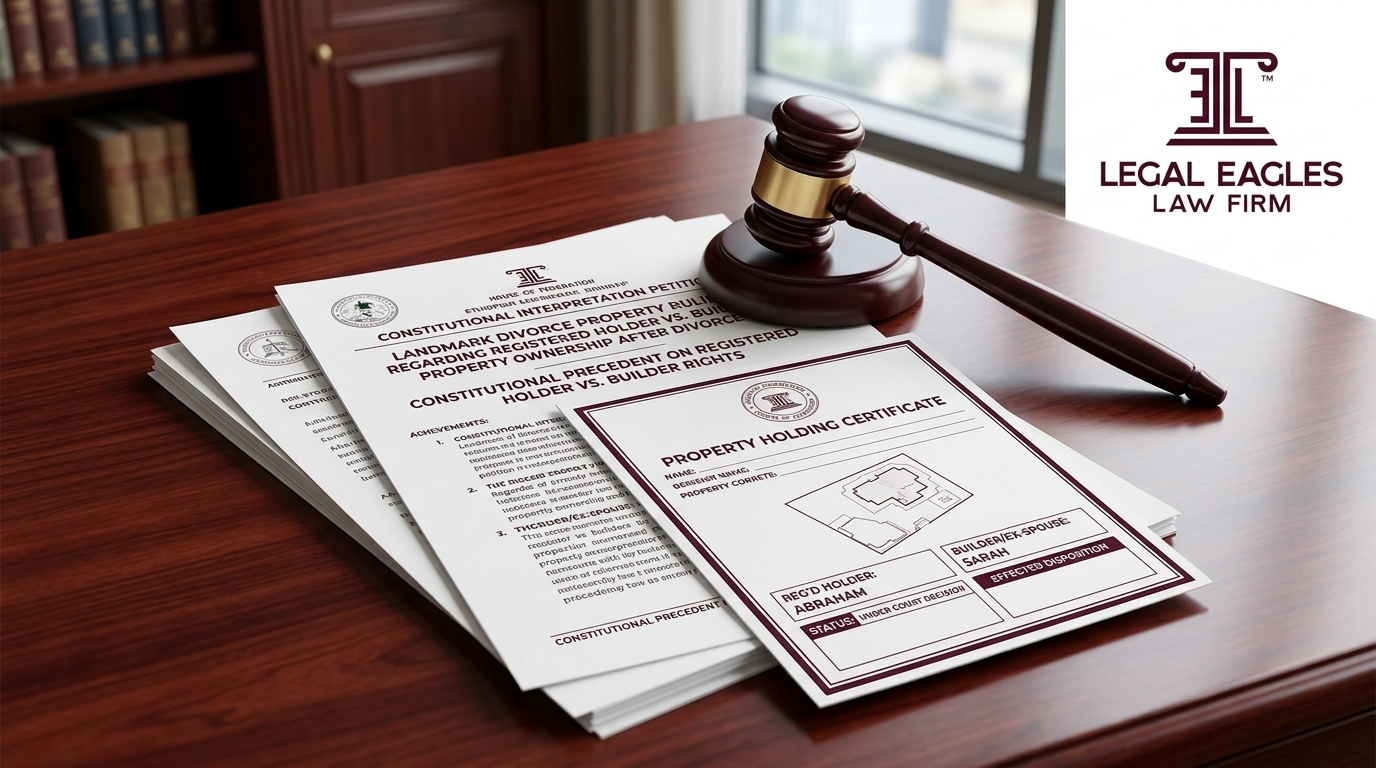
Who owns a house after a divorce? Is it the person whose name appears on the land registration? Or is it the person who paid for the construction and put in the labor? A landmark House of Federation case answered this question. The case began as an ordinary divorce property dispute. It ended as a constitutional interpretation.
1. The Parties and the Origin of the Dispute
- Applicant: the former husbanddd
- Respondent: the former wife
- Type of case: a dispute over dividing a family house after divorce
- Disputed property: a residential house with its service quarters, built on a city plot of about 200 m²
The marriage ended in divorce. The wife then sued for an equal share of the house. She argued that the couple had built it together during the marriage, so it was common property.
The husband disagreed. His mother had received the plot in 1991 E.C. She built the house while she was alive, and it was registered in her name. He argued that the house was her private property, not common property.
2. The Lower Courts’ Decisions
The city court (first instance). The land was registered in the mother’s name. Still, the court found that she had no means to build a house. It found that the husband supplied the building materials and paid for the work. It also found that the mother rented a home and had no income until her death in 2002 E.C. The house was finished in 1998 E.C., during the marriage. So the court held it was common property and ordered an equal split.
The zonal high court (appeal). The court upheld that ruling. It said registration in someone’s name does not alone prove ownership. Under Civil Code Arts. 1195 and 1196, a holding certificate creates a presumption of ownership. But the presumption is not absolute, and evidence can rebut it.
The regional and federal cassation benches. Both declined to hear the case and closed the file.
3. The Petition and the Response
The husband’s petition. He argued that the couple took the house before the marriage. He said it was registered in his late mother’s name. The tax receipts and the electricity and water connections also carried her name. He argued that the courts distorted the evidence. He also objected to the courts ordering the house to be sold at auction. In his view, this violated his constitutional property right.
The wife’s response. She argued that land belongs to the state and the people under Article 40(3) of the Constitution. She also relied on Article 40(7) and Civil Code Art. 1179(1). The couple had built the house with their own money and labor, she said. The mother never objected. So she called the courts’ decisions correct.
4. The Issue Before the Council of Constitutional Inquiry
The Council framed the question this way:
The deceased mother held an ownership document issued by a competent authority. Does it violate the applicant’s constitutional property right to treat the house on that holding as common property of the spouses?
5. The Council’s Legal Analysis and Majority Recommendation
The Council reasoned in four steps.
- Constitutional protection. Under Article 40(1) and (2), the law protects property that citizens acquire with their own capital and effort.
- The legal weight of a holding certificate (Civil Code Arts. 1195 and 1196). A person with a lawful holding certificate is presumed to own the property. The presumption falls only if someone proves that the certificate was issued unlawfully or by a body without authority. Witness testimony cannot rebut it. Two earlier House decisions had already confirmed this.
- Building on someone else’s holding. Spending money and effort on another person’s holding does not make a person the owner. A right arises only with lawful permission from the holder or the competent authority, together with a co-holding document. A contributor may claim back the money spent, as the law allows. A contributor cannot claim ownership of the holding.
- Social and economic values. The courts’ decisions ignored the social value of children helping and supporting their parents. They also weakened the predictability of the justice system.
The majority recommendation. The Council’s majority made two proposals:
- The lower courts’ decisions violate the applicant’s constitutional property right. The House should nullify them.
- The holding is registered in the mother’s name. So the house should be treated as the mother’s property.
6. The Minority Opinion
Three Council members dissented. They gave these reasons:
- The courts did not decide only on whose name the holding carried. They also examined the facts on who built the house.
- Under Civil Code Art. 1178(1), a person who builds on another’s land without the holder’s objection owns the building.
- The mother never lived in the house while she was alive. She also never claimed any right in it. The husband could not prove that his mother built it.
- The courts’ order for an equal split therefore respects the Constitution. The dispute only concerns the size of each share. Weighing evidence is the courts’ job.
7. The House of Federation’s Decision
The House of Federation reviewed the Council’s recommendation. It approved the Council’s majority proposal by a full vote. It then issued these orders:
- The House approved the Council’s recommendation that the case needs constitutional interpretation.
- The House reversed the Federal Supreme Court Cassation Bench’s decision. It directed the Federal Supreme Court to enforce the House’s decision.
- The House notified the Council of Constitutional Inquiry of its decision.
- The House notified the applicant of its decision.