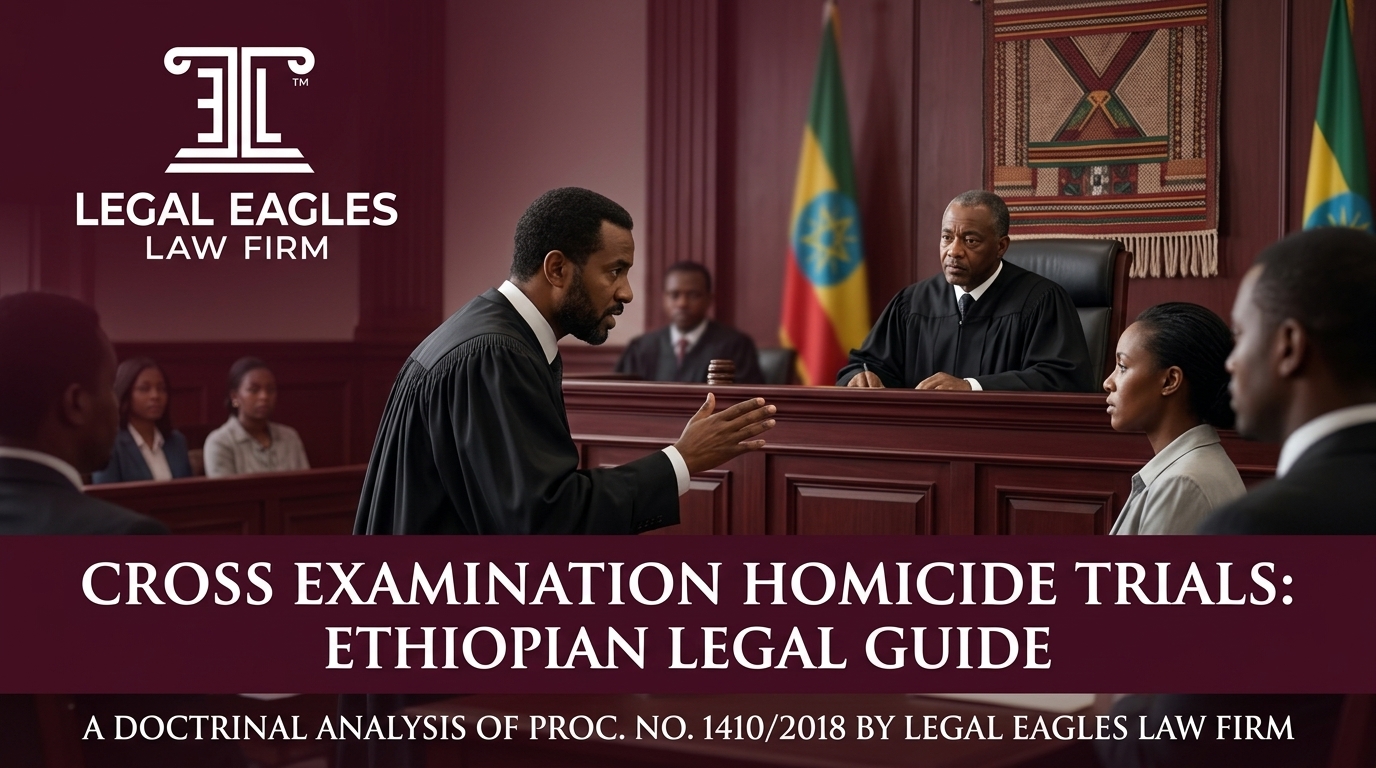
Cross-Examination Dynamics in Homicide Trials: A Prosecutorial and Defense Balance under the Ethiopian Criminal Procedure and Evidence Code
Introduction: The Structural Equilibrium of Homicide Trials
In a homicide prosecution, the administration of criminal justice reaches its highest level of gravity. The state seeks public order and penal accountability for taking human life. The defense invokes the presumption of innocence. Proclamation No. 1410/2018 uses adversarial trials to test prosecution files.
Cross-examination is the central operational instrument of this adversarial trial. It is governed by legal standards designed to balance two competing interests:
- The Prosecution’s Mandate: To prove the physical act (actus reus) and criminal intent (mens rea) beyond a reasonable doubt.
- The Defense’s Constitutional Prerogative: To test the state’s evidence, impeach witness credibility, and expose defects creating reasonable doubt.
I. Exposing Contradictions: Reconciling Pre-Trial Files with Oral Testimony
1. The Interplay Between the Police Investigation Dossier and Open-Court Testimony
Under Proclamation No. 1410/2018, criminal cases shift from police dossiers to oral court testimony.
- The Prosecution Perspective: The public prosecutor utilizes the investigation file to present a coherent, chronological narrative of the homicide. Prosecutors argue memory fades during violent trauma, and minor witness discrepancies do not impair core accusations.
- The Defense Perspective: Defense counsel examines prior inconsistent statements under statutory provisions governing witness impeachment. An eyewitness may claim the accused inflicted a fatal wound in court. If their initial police statement omitted vital details, the defense exposes this contradiction.
II. Dissecting the Prosecution’s Case: Burden of Proof, Intent, and Chain of Custody
In a murder trial, the prosecution bears the ultimate legal and persuasive burden of proof. Cross-examination serves as the instrument to probe structural weaknesses in the state’s case.
- Challenging Forensic Evidence and Chain of Custody
- The Prosecution Perspective: Prosecutors present experts and police to establish an unbroken chain of custody for physical evidence. The state maintains that standardized logging preserves the evidentiary integrity of these items.
- The Defense Perspective: Defense counsel uses cross-examination to target gaps in the handling, labeling, and storage of evidence. The defense cross-examines officers on contamination risks or procedural shortcuts to render physical evidence inadmissible.
B. Interrogating Mens Rea (Criminal Intent) and Actus Reus (Physical Act)
- The Prosecution Perspective: The state attempts to prove premeditation, intent, and direct participation using eyewitnesses and circumstances.
- The Defense Perspective: Cross-examination is deployed to test alternative legal hypotheses, such as self-defense, provocation, sudden panic, or accidental causation. Defense counsel questions the aggression sequence to show support for a lesser offense or justification.
III. Testing Witness Credibility, Perceptual Capacity, and Bias
The credibility of a witness dictates the probative value assigned to their testimony. Cross-examination systematically evaluates the psychological and environmental factors affecting perception.
- Perceptual Capacity and Environmental Realities
- Homicide incidents frequently occur under conditions of extreme chaos, high psychological stress, poor ambient lighting, or significant physical distance.
- The Defense Strategy: Counsel Uses precise questioning to expose physical impediments such as visual obstructions, adverse weather conditions, or witness intoxication that render accurate observation impossible.
- The Prosecution Strategy: Prosecutors redirect examination to establish that despite adverse conditions, fleeting glances or familiar relationships between the witness and the accused provided adequate opportunity for definitive identification.
- Motive, Animosity, and Bias
- The Defense Perspective: Investigating underlying personal, financial, or familial disputes between the witness and the accused exposes potential motives for fabrication, malicious prosecution, or false incrimination.The Prosecution Perspective: Prosecutors seek to re-establish the objective civic duty of the witness, insulating them from allegations of bias by demonstrating that they possess no personal stake in the outcome of the litigation.
IV. Trial Mechanics: Leading Questions and the Hostile Witness Framework
The procedural execution of cross-examination relies on specialized legal rules governing questioning techniques and witness classification.
- The Strategic Deployment of Leading Questions
- Definition and Function: Unlike direct examination where leading questions (questions that suggest the desired answer) are generally prohibited to prevent coaching cross-examination explicitly permits leading questions.
- The Defense Utility: Defense counsel utilizes closed, leading propositions (e.g., “Isn’t it correct that you were positioned behind a concrete barrier and could not see the doorway where the altercation occurred?”) to maintain rigid control over evasive or uncooperative witnesses. This technique boxes the witness into specific parameters, forcing direct answers that highlight contradictions with the investigative file.
- The Prosecution Counter-Strategy: Prosecutors object when defense counsel frames leading questions to mischaracterize previous testimony or introduces argumentative assertions not supported by the record.
2. Managing and Impeaching the Hostile Witness
- The Legal Standard: When a witness called during proceedings demonstrates overt antagonism, reluctance to testify truthfully, or clear alignment with opposing interests, a formal application may be made to declare the witness hostile or adverse.
- The Defense Perspective in Homicide Trials: Prosecution witnesses—such as reluctant associates of the deceased or compromised informants—frequently exhibit hostility or alter their accounts out of fear or shifting loyalties. Establishing hostility allows counsel to transcend normal examination limits, deploying prior recorded statements from the police dossier to impeach the witness’s credibility in open court and neutralize damaging, uncorroborated testimony.
Conclusion
Under the procedural framework of Proclamation No. 1410/2018, cross-examination in a homicide trial operates as an indispensable legal safeguard. By rigorously evaluating investigative dossiers, dissecting forensic chains of custody, exposing perceptual and testimonial contradictions, and expertly utilizing leading questions against hostile or biased witnesses, both prosecution and defense fulfill their respective roles in upholding the standards of substantive truth and procedural justice.