Comprehensive Guide to Suspension and Revocation of Investment Permits under Ethiopian Law
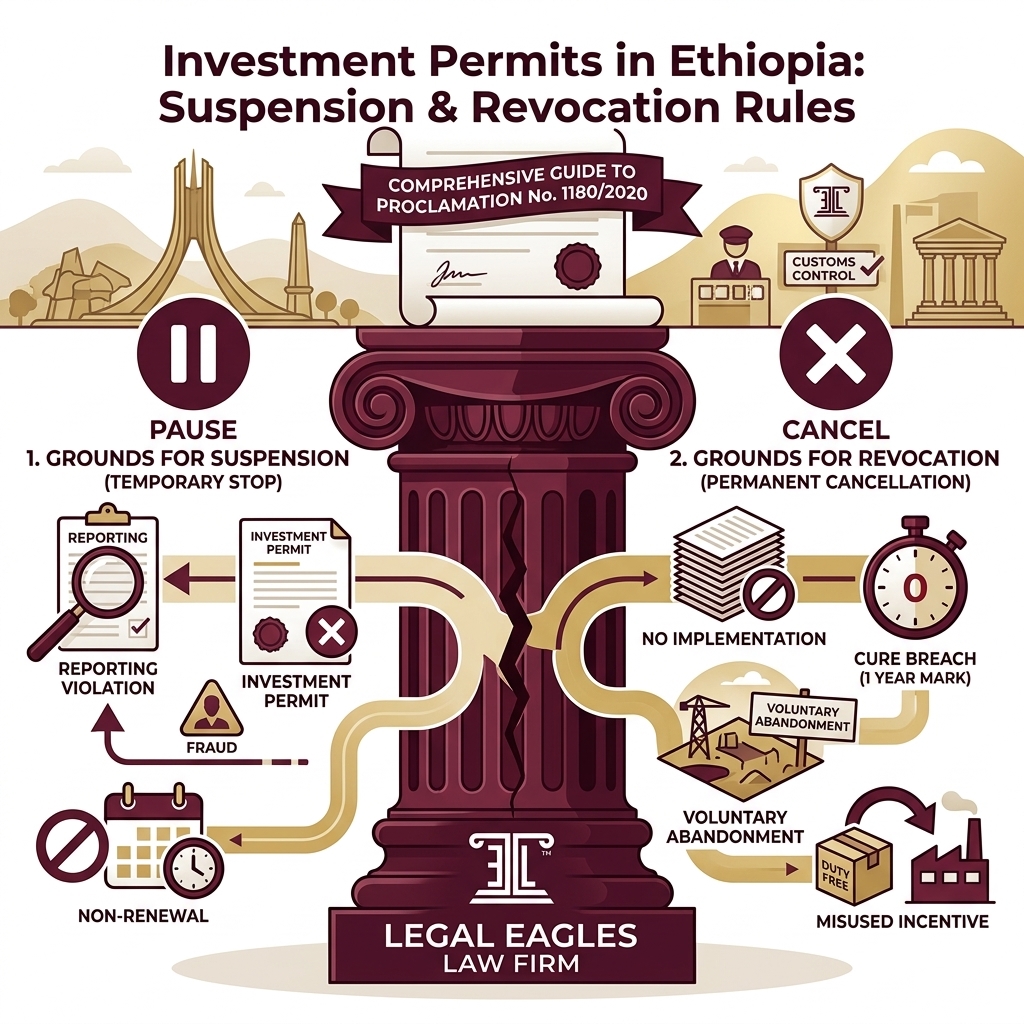
Under Article 13 of Proclamation No. 1180/2020, administrative authorities oversee all Ethiopian investment permits. The Ethiopian Investment Commission (EIC) and Regional Organs can suspend or revoke investment permits under specific conditions.
Understanding these legal grounds and post-revocation liabilities helps investors maintain compliance and protect their investments.
1. Statutory Framework and Jurisdiction
Ethiopia’s investment administration operates on a dual level divided between federal and regional bodies:
- Issuing Authority Jurisdiction: Under Article 13(6), only the issuing investment authority may suspend or revoke a permit.
- Ethiopian Investment Commission (EIC): Retains jurisdiction over foreign investments, joint ventures between foreign and domestic investors, and domestic projects eligible for federal incentives.
- Regional Investment Organs: Manage domestic investments falling under regional jurisdiction.
- Regulatory Rationale: The legal framework divides breaches into two types: remedial breaches triggering suspension, and terminal breaches leading to revocation.
2. Suspension of an Investment Permit
Nature and Purpose
Suspension is a temporary, corrective administrative measure.Suspension does not cancel an investment. It freezes operational privileges while giving the investor time to correct defaults.
Statutory Grounds for Suspension (Article 13(1))
An issuing authority may suspend an investment permit if the investor commits any of the following acts:
- Reporting Non-Compliance or Misrepresentation:
- Failing to submit mandatory project implementation reports within the prescribed timelines.
- Intentionally or negligently submitting false, inaccurate, or misleading information or documentation to investment authorities.
- Fraudulent Acquisition or Renewal:
- Securing or renewing an investment permit through fraud, deliberate misrepresentation, or falsified documentation.
- Incompatible Use of Permit:
- Conducting business activities outside the scope, sector, or specific investment objective that the authority originally approved.
- Unjustified non-renewal of an investment permit.
- Failing to renew the investment permit annually within required statutory timeframes prior to operational commencement, without demonstrating valid justification or force majeure.
- Unfeasible Project Completion:
- Initiating implementation but failing to complete the project within agreed schedules, where objective evaluation leads the authority to reasonably believe the investor will not complete the project.
- Broader Statutory & Regulatory Violations:
- Violating key provisions of Proclamation No. 1180/2020, its Council of Ministers Regulations, Directives, or other applicable federal laws.
The Statutory Grace Period & Procedure (Article 13(2))
- One-Year (1-Year) Grace Period: Upon issuing a formal suspension order, the authority grants the investor a one-year grace period from the official suspension date to implement required corrective measures.
- Curing the Default: If the investor successfully rectifies the default within this timeframe and notifies the authority, the authority lifts the suspension, restoring full operational standing.
3. Revocation of an Investment Permit
Nature and Effect
Revocation represents the total and permanent cancellation of an investment permit. It results in the immediate termination of the investor’s legal authorization to operate under the investment framework, triggering administrative liquidations and financial recovery protocols.
Statutory Grounds for Revocation (Article 13(3))
The authority will fully revoke an investment permit under any of the following circumstances:
- Failure to Commence Project Implementation:
- Failing to start physical or operational project implementation within the legally stipulated implementation timeframe following permit issuance.
- Failure to Cure Suspension Within Grace Period:
- Failing or refusing to rectify the specific defaults that caused a suspension within the mandatory one-year grace period.
- Voluntary Abandonment:
- Explicitly relinquishing, forsaking, or abandoning the project or investment activity prior to completion.
- Incentive Misuse and Illegal Asset Transfer:
- Misusing tax exemptions, duty-free privileges, or fiscal incentives granted under the law.
- Illegally selling, leasing, or transferring duty-free imported capital goods, equipment, or vehicles to unauthorized third parties without prior authorization and payment of applicable duties.
4. Legal, Financial, and Operational Consequences of Revocation
When an authority revokes a permit, severe regulatory and financial mechanisms take effect under Articles 13(4) through 13(8):
A. Immediate Loss of Privileges & Inter-Agency Notification
The revocation takes effect immediately upon decision. The issuing investment organ must formally notify key governmental stakeholders to freeze operations and privileges, including:
- Ethiopian Customs Commission (ECC)
- Ministry of Revenues (MoR)
- Ministry of Trade and Regional Integration (MoTRI)
- National Bank of Ethiopia (NBE) and commercial banking institutions
B. Mandatory Incentive Clawback (1-Month Repayment Window)
The investor must return or pay back all tax breaks, customs duty exemptions, and fiscal incentives received throughout the life of the project.
- Timeline: The investor must make full repayment to the Ministry of Revenues, Ethiopian Customs Commission, and Ministry of Finance within one (1) month of the official revocation date.
- Enforcement: Failure to repay within 30 days triggers asset attachment, seizure of imported capital goods, and administrative enforcement actions by revenue authorities.
C. One-Year Re-Application Bar for Foreign Investors
To deter speculative or non-compliant investments, Article 13(7) imposes a statutory ban on foreign investors whose permits have been revoked.
- A foreign investor subject to permit revocation cannot be issued a new investment permit in Ethiopia for one (1) year following the revocation date.
D. Preservation of Criminal and Civil Liability
Under Article 13(8), administrative measures (suspension, revocation, or financial clawbacks) are executed without prejudice to state prosecution. If the investor’s conduct involves tax evasion, customs fraud, forgery, or illegal diversion of assets, the Ethiopian government retains the full right to initiate criminal proceedings under the Criminal Code of Ethiopia.
5. Practical Risk Mitigation for Investors
To prevent administrative action under Article 13, investors operating in Ethiopia should establish clear compliance controls:
- Maintain Implementation Schedules: Keep the EIC or regional organs updated on project milestones and formally request written implementation extensions before deadlines expire.
- Timely Reporting & Annual Renewals: Submit progress reports regularly and renew investment permits within required annual timeframes until business licenses are obtained.
- Incentive Asset Management: Maintain strict inventory logs for all duty-free imported goods and avoid moving, leasing, or transferring equipment without explicit prior written approval from customs authorities.