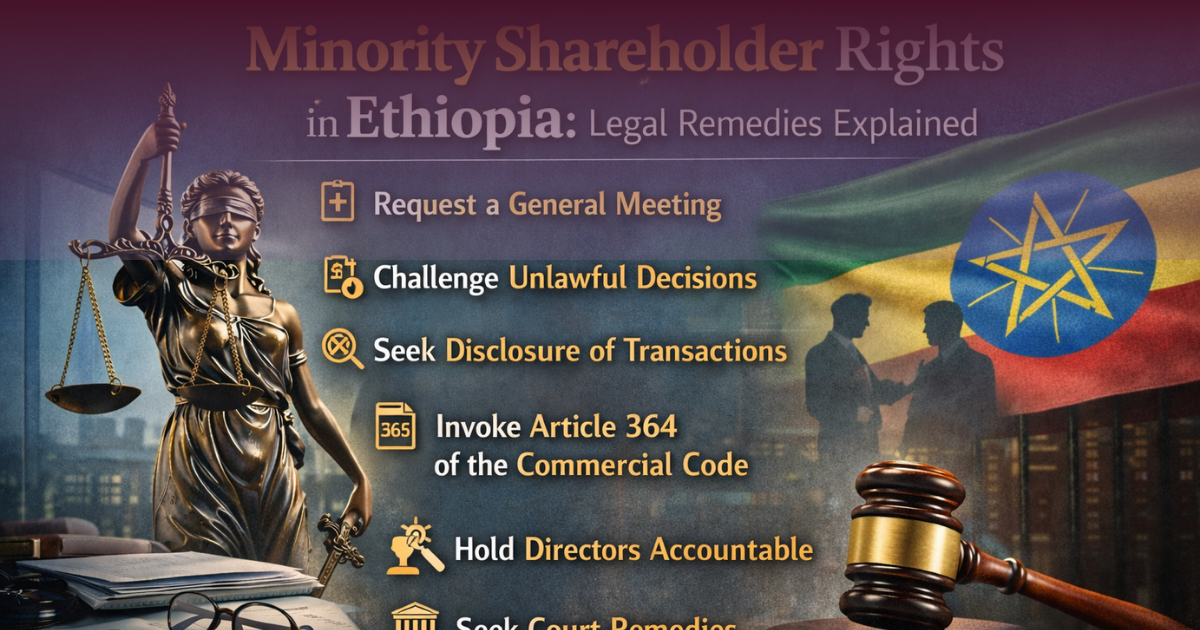
Minority Shareholder Rights in Ethiopia: What You Can Do When Directors Ignore You
Introduction
In many Ethiopian private companies, minority shareholders often feel powerless when key decisions are made behind closed doors. This is especially concerning when directors approve related-party transactions, fail to disclose conflicts of interest, or ignore shareholder concerns.
But legally, minority shareholders are not without protection.
Who is a Minority Shareholder?
A minority shareholder is any shareholder who does not have controlling power in a company. While they may lack voting dominance, Ethiopian corporate law still grants them important legal rights;
1. Right to Information
Minority shareholders have the right to:
- Access financial statements
- Review company records
- Be informed of major decisions
Lack of transparency may itself be a legal violation.
2. Right to Request a General Meeting
Minority shareholders holding the required percentage of shares have the right to request the board to convene a General Meeting of Shareholders.
If directors refuse or ignore the request, shareholders may:
- Escalate the matter legally
- Seek court intervention to compel the meeting
3. Protection Against Abuse by Directors
Directors have a fiduciary duty to act in good faith, in the best interest of the company, and without any conflicts of interest. When they engage in undisclosed related-party transactions, this may constitute a breach of duty and create grounds for personal liability.
4. Statutory Protection: Article 364 of the Commercial Code
Ethiopian law explicitly protects minority shareholders. Article 364 of the Commercial Code provides that: A general meeting cannot adopt resolutions that provide undue advantage to certain shareholders at the expense of others.
This provision is crucial because it establishes a legal limit to majority power. Even if a majority votes in favour of a decision, it cannot legally disadvantage minority shareholders.
In practice, this means:
- Transactions that favour insiders over others can be challenged
- Unfair or discriminatory resolutions may be invalidated
- Minority shareholders have a solid statutory ground to enforce their rights
5. Right to Challenge Unlawful Decisions
Minority shareholders can challenge:
- Resolutions passed without proper procedure
- Decisions involving conflicts of interest
- Acts that unfairly prejudice their interests
6. Right to Seek Judicial Remedies
Where internal remedies fail, courts can:
- Order the company to hold a meeting
- Suspend or invalidate unlawful decisions
- Hold directors accountable
This is a powerful but underutilized tool in Ethiopia.
Common Problem in Practice
A frequent issue we see: Minority shareholders request an EGM due to suspicious transactions but the board simply ignores them.
This is not just poor governance it may be legally actionable under Article 364.
Practical Steps Minority Shareholders Should Take
- Submit a formal written request for an EGM
- Document all communications with the board
- Request disclosure of the disputed transactions
- Seek legal advice early
- Escalate to court if the board remains unresponsive
Why This Matters
Strong minority protection is essential for:
- Investor confidence
- Corporate transparency
- Fair business practices
Without it, companies risk becoming vehicles for unchecked insider control.
Minority shareholders in Ethiopia are not merely passive investors. The law, including Article 364 of the Commercial Code, provides clear mechanisms to challenge abuse, demand accountability, and protect their interests.
The real issue is not the absence of right but the lack of awareness and enforcement.
How Legal Eagles Law Firm Can Help
At Legal Eagles Law Firm, we advise shareholders and investors on:
- Enforcing corporate rights
- Challenging unlawful board decisions
- Structuring governance frameworks that prevent disputes