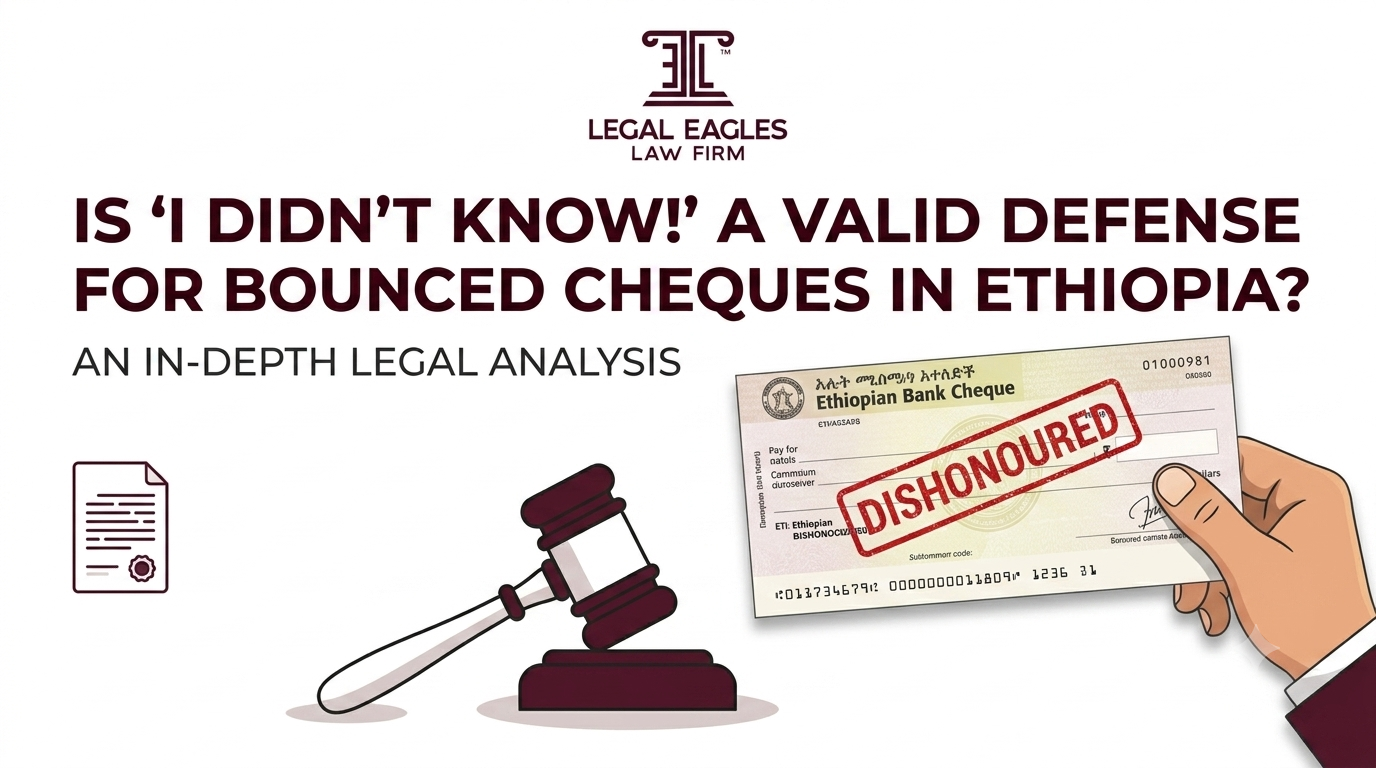
Is “I Didn’t Know!” a Valid Legal Defense for Bounced Cheques in Ethiopia?
In modern Ethiopian commercial practice, cheques are a primary engine for driving business, securing credit, and settling debts. Because of their central role in keeping the economy moving, financial and criminal law treats cheques with the utmost seriousness—effectively granting them the same trust and status as physical legal tender.
However, many entrepreneurs, managers, and individuals operate under a dangerous misconception: believing that if a cheque bounces due to an honest mistake, forgetfulness, or poor accounting, they are completely safe from police involvement and criminal prosecution.
Under Article 693 of the Criminal Code of the Federal Democratic Republic of Ethiopia (Proclamation No. 414/2004), issuing an uncovered cheque (“sans provision”) is explicitly classified as a criminal offense. The key question isn’t whether you will face legal consequences, but rather what degree of criminal severity applies to your situation.
The Legal Philosophy: Why Cheques Are Treated Like Cash
To understand why the law is so strict, you have to look at the economic purpose of negotiable instruments under the Ethiopian Commercial Code.
Unlike a mere promise to pay in a contract, a cheque is an unconditional order addressed to a bank to pay a specific sum of money on demand. When a merchant accepts a cheque in exchange for goods or services, the law presumes the transaction is as good as settled.
Why this matters: When a cheque bounces, it disrupts commercial trust, harms business liquidity, and destabilizes market confidence. Because of this, Ethiopian law uses criminal sanctions—not just civil lawsuits—to enforce financial discipline among account holders.
Breaking Down Article 693 of the Criminal Code
Ethiopian law divides the crime of issuing an uncovered cheque into two distinct frameworks, depending entirely on the drawer’s state of mind (mens rea):
1. Article 693(1) — Intentional Issuance (Fraudulent Intent)
This sub-article targets deliberate financial deception. It applies when someone issues a cheque knowing the account lacks sufficient funds, intending to mislead the recipient into a false sense of security.
- State of Mind: Fraudulent intent, bad faith, and active deception.
- Knowledge (Scienter): The drawer knows the account is empty, frozen, closed, or underfunded.
- Intent (Mens Rea): The drawer acts purposefully to acquire goods, services, or debt relief under false pretenses.
- Prosecution Focus: Proving the drawer knew the account was empty at the time of issuance.
- Key Evidence: Extended zero-balances, closed accounts, or evasive behavior.
Statutory Penalties: Because this is legally equated with serious fraud, the offender faces simple imprisonment or—in aggravated cases involving large sums or repeated offenses—rigorous imprisonment for up to 10 years, alongside mandatory fines.
2. Article 693(2) — Issuance Through Negligence (Carelessness)
This sub-article captures situations where the drawer had no desire to trick or defraud the recipient, but failed to exercise the standard prudence expected of a reasonable business person.
- State of Mind: Carelessness, oversight, and a general lack of business prudence.
- Absence of Fraudulent Intent: The drawer genuinely believed or assumed funds were available.
- Failure of Due Diligence: Neglecting to check cleared bank balances, forgetting automated debits, or failing to reconcile ledgers before signing.
- Prosecution Focus: Proving the drawer failed in their fundamental duty to verify account balances.
- Key Evidence: Recent unexpected debits, pending clearance delays, or active but poorly managed accounting ledgers.
Statutory Penalties: Recognizing the lack of malicious intent, the law mitigates the penalty to a fine or simple imprisonment not exceeding one year.
Best Practices & Key Takeaways for Businesses
1. “I Didn’t Know” Is NOT an Exculpatory Defense:
Under Ethiopian criminal jurisprudence, claiming ignorance or forgetfulness does not grant you absolute immunity. It merely reduces the charge from severe fraud (Sub-article 1) to a negligence offense (Sub-article 2).
2. Always Verify “Cleared” Funds:
A deposit notification or incoming transfer isn’t cash until it has fully cleared in your account. Always verify your actual, available balance via online banking or branch verification before signing.
3. Track Automated Standing Orders:
If your account has automated loan repayments, tax deductions, or standing service fees, maintain a strict buffer balance so automated charges never cause a newly written cheque to bounce.
4. Communicate Immediately in Case of Error:
If you discover an accounting error after issuing a cheque, notify the recipient and your bank immediately to resolve the balance before formal legal presentation and police reporting occur.