Ethio telecom, Consumer Rights, and the Question of Fair Pricing: Are Subscribers Truly Protected?
Ethio telecom remains Ethiopia’s dominant telecommunications provider, serving tens of millions of users across voice, data, and mobile financial services. As the country accelerates its digital transformation, the company plays a central role in enabling connectivity, innovation, and economic participation.
However, recent consumer concerns regarding frequent tariff adjustments, affordability of services, and perceived lack of improvement in service quality have brought renewed attention to an important legal question:
Are consumer rights in Ethiopia’s telecom sector effectively protected in practice, particularly in relation to pricing fairness, service quality, and non-discrimination?
To address this, it is necessary to examine both the regulatory framework and the practical realities of service delivery.
Key Consumer Rights
Under the Directive, consumers are entitled to:
- Access telecommunications services at reasonable and non-discriminatory prices
- Receive clear, accurate, and transparent information regarding services and tariffs
- Lodge complaints and obtain effective remedies
- Be protected from unfair or discriminatory treatment
- Enjoy continuity and reliability of service
Operators are also required to adopt internal compliance mechanisms, including Codes of Conduct, to operationalize these rights.
Ethio telecom’s Legal Obligations
As a licensed operator, Ethio telecom is bound by regulatory obligations that extend beyond commercial considerations. It must:
- Ensure service delivery aligned with quality standards
- Maintain transparency in pricing and communication
- Provide accessible complaint-handling mechanisms
- Promote affordability and universal access
This dual role as both a commercial entity and a public service provider places Ethio telecom under heightened scrutiny in matters affecting consumer welfare.
The Issue of Tariff Adjustments and Consumer Concerns
Ethio telecom has justified recent tariff adjustments on the basis of improving service quality, expanding infrastructure, and deploying advanced technologies such as 5G.
However, consumer concerns increasingly challenge this justification on two key fronts:
a. Lack of Corresponding Improvement in Service Quality
Despite price increases, many users report:
- Persistent network instability
- Inconsistent internet speeds
- On-going service disruptions
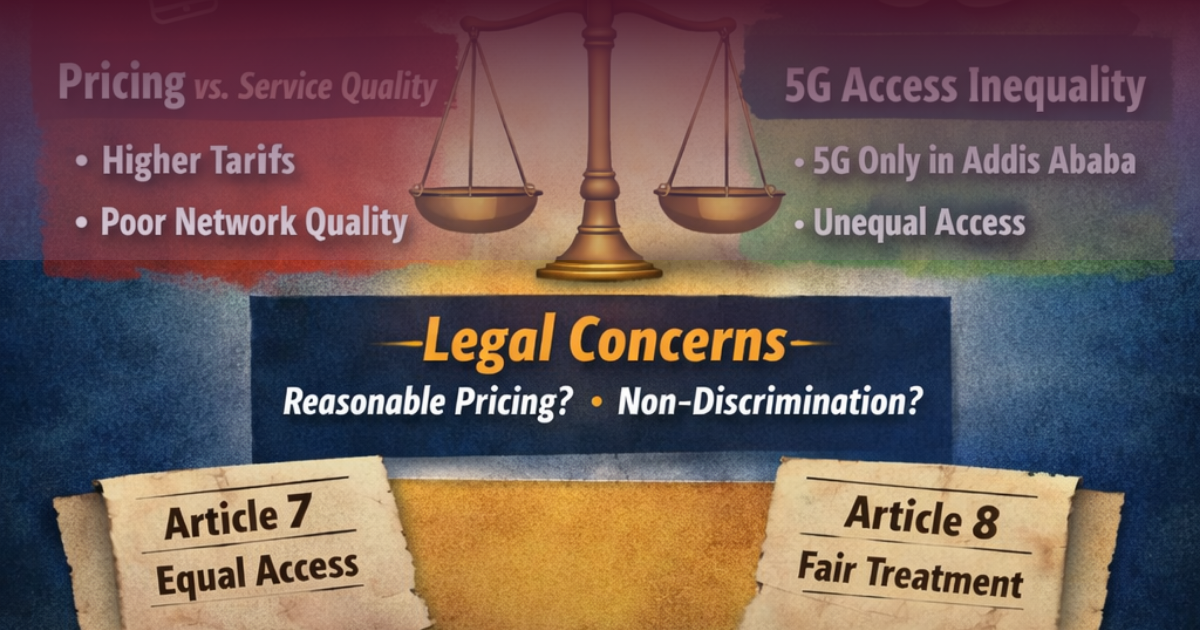
This raises a fundamental legal concern: whether tariff increases satisfy the requirement of “reasonable pricing” when service quality improvements are not clearly experienced by consumers.
Under the Directive, pricing must be not only lawful but also proportionate to the service delivered. A mismatch between cost and actual service quality may therefore weaken the legal basis for such increases.
b. Allegations of Non-Discriminatory Access Violations (Articles 7 and 8)
A more complex issue arises in relation to the rollout of 5G services.
Currently, access to 5G remains limited to selected areas, primarily within parts of Addis Ababa and a few pilot regions. While phased rollout is expected in telecommunications development, consumers argue that:
- Pricing structures do not sufficiently account for disparities in service access
- Consumers without access to upgraded services may still bear the financial impact of tariff increases
This raises concerns under Articles 7 and 8 of the Directive, which guarantee equal and non-discriminatory access to services.
The legal issue is not the existence of phased rollout, but whether:
Consumers are being unfairly burdened by pricing linked to services they cannot access, thereby creating a form of indirect discrimination.
The Legal Tension: “Reasonable Price” vs Market Reality
The central legal tension lies in balancing:
- The operator’s need for financial sustainability and infrastructure investment
- The consumer’s right to fair, transparent, and affordable services
In a market where Ethio telecom retains significant dominance, this balance becomes particularly critical. Pricing decisions, even if economically justified, must still comply with consumer protection standards.
Consumer Protection in Practice: The Gap Between Law and Experience
Despite a robust legal framework, practical challenges persist:
- Limited transparency in tariff-setting mechanisms
- Minimal public consultation prior to price adjustments
- Weak consumer bargaining power
- Limited visibility into complaint resolution processes
This creates a gap between legal protections on paper and consumer experience in practice.
Legal Analysis: A Case-Style Assessment
Issue
Whether the tariff adjustments implemented by Ethio telecom comply with the Telecommunications Consumer Rights and Protection Directive No. 832/2021, particularly in relation to:
- Reasonableness of pricing
- Transparency
- Non-discrimination under Articles 7 and 8
Rule
Under the Directive and oversight of the Ethiopian Communications Authority:
- Tariffs must be fair, reasonable, and proportionate
- Consumers must be provided with clear and transparent information
- Services must be offered on a non-discriminatory basis, with no unjustified unequal treatment
Application
- Reasonableness of Pricing
While tariff increases may be justified by investment and operational costs, their legality depends on whether consumers experience corresponding improvements in service quality.
Where such improvements are not evident, the pricing may be considered disproportionate, raising questions of compliance with the Directive.
- Unequal Access to 5G Services
The limited availability of 5G, particularly outside parts of Addis Ababa, is not inherently unlawful. However, legal concerns arise where:
- Price increases are justified by technological upgrades
- Access to those upgrades is uneven
In such cases, consumers without access may effectively subsidize services they do not receive.
- Non-Discrimination (Articles 7 and 8)
The principle of non-discrimination does not require identical service availability, but it does require fair treatment.
If uniform pricing applies despite materially different service access, this may constitute: Indirect discrimination, where consumers are unequally affected by a formally neutral pricing policy.
Conclusion
Ethio telecom retains the authority to adjust tariffs, but such adjustments must comply with:
- Reasonableness
- Transparency
- Non-discrimination
Where these standards are not fully met, tariff measures may be subject to legal and regulatory challenge.