Urban Land Leases in Addis Ababa: An Investor’s Guide
For investors looking to establish or expand operations in Ethiopia’s capital, securing government land is a foundational step. Land is strictly leased under Addis Ababa Regulation No. 162/2024.
Understanding how the city allocates this limited resource is vital for building a realistic, legally compliant project timeline. Investors generally approach land acquisition through two primary pathways: Competitive Tenders and Direct Allotments.
Pathway 1: Acquiring Land through Public Tender
The tender market is designed to be a market-driven, transparent mechanism for commercial, residential, and mixed-use developments.
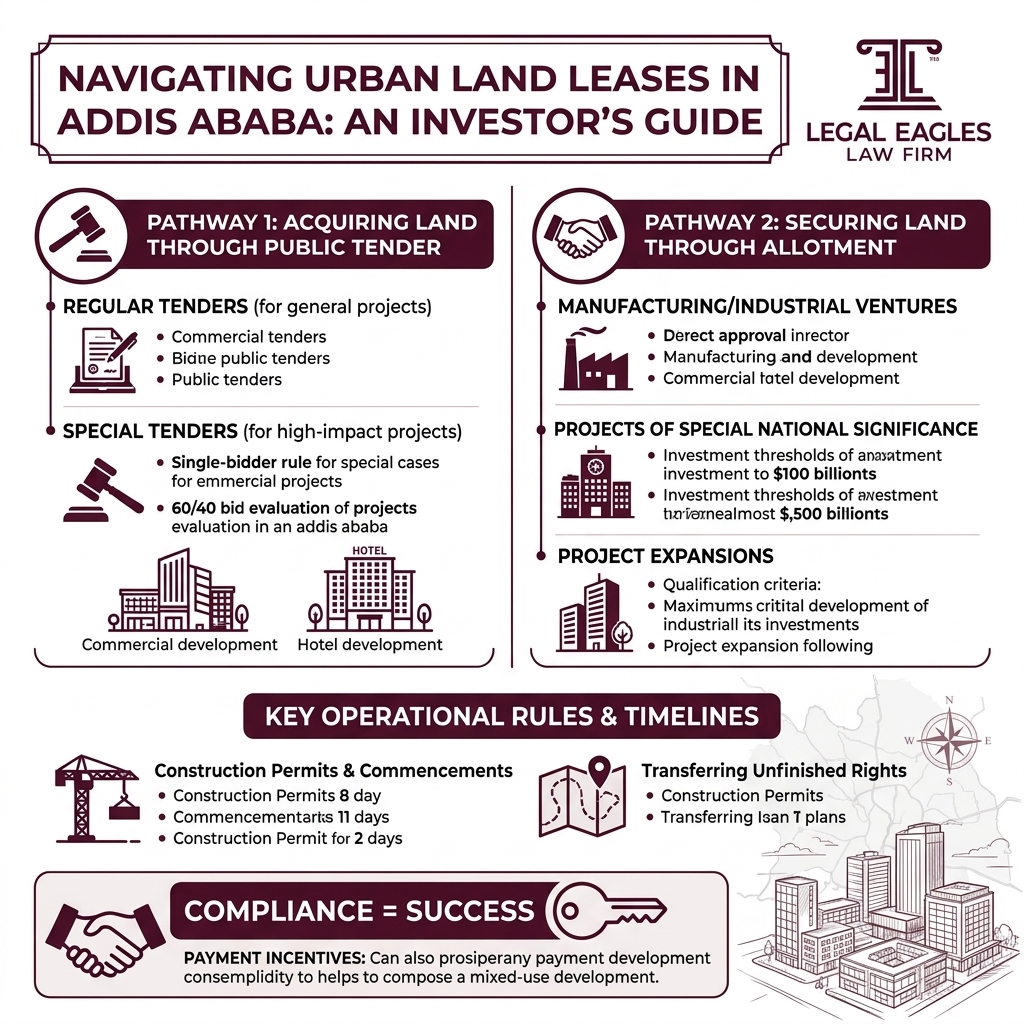
- Regular Tenders: Regular auctions need at least three bidders in the first two rounds.
- Special Tenders: Regular auctions need at least three bidders in the first two rounds. These special tenders are uniquely structured to proceed even if only a single qualified bidder participates in the first round.
- Evaluation Metrics: Special tenders target high-impact projects like major hotels, hospitals, and 1,000+ unit housing developments.
- Proving Financial Capacity: Bids are scored on proposed price (60%) and advance lease payment (40%).
Pathway 2: Securing Land through Allotment
Investors must prove financial capacity covering at least 20% of construction costs. Key sector opportunities include:
- Manufacturing and Industrial Ventures:The City Cabinet directly authorizes non-competitive allotments for strategic sectors. Industrial zones host manufacturing plots over 500 sqm. Smaller plots join mixed-use zones.
- Projects of Special National Significance: Designed for large-scale, transformative investments. Qualifying investors must meet high capital thresholds such as international companies deploying over $50 million or domestic investors committing upwards of 1.5 billion Birr. These proposals require direct application to the Mayor, thorough feasibility evaluations by the Investment Commission, and final Cabinet approval.
- Project Expansions: Existing, fully operational or 50% completed projects can apply for expansion land (up to 50% of their original footprint) provided they maintain up-to-date tax and lease compliance and submit unified architectural designs.
Key Operational Rules and Timelines for Investors
Securing the lease is only the beginning; the regulation imposes strict compliance milestones to prevent land banking:
- Construction Permits & Commencements: Once a lease contract is signed and a temporary map or certificate is issued, investors must secure construction permits within tight windows (e.g., up to 4 months for small projects, 9 months for medium, and 12 months for large projects). Construction must formally commence within designated ceilings (ranging up to 24 months for high-level structures).
- Transferring Unfinished Rights: If an investor wishes to transfer their lease rights before construction reaches the halfway mark, the transaction must navigate the Bureau’s official lease transfer pricing guidelines. Frequent, speculative transfers within short windows can trigger temporary bans from participating in future municipal land auctions.
- Payment Incentives: Investors who manage to complete their total lease payments ahead of schedule can benefit from sliding-scale financial incentives, such as a 3% reduction if paid off within the first year of contract finalization.