Understanding Cheques Under Ethiopian Law
Legal Requirements, Penalties, and Practical Implications
Businesses and individuals widely use cheques in commercial transactions in Ethiopia. However, Ethiopian law strictly regulates their issuance and use to maintain trust in the financial system and prevent fraud.
The Commercial Code of Ethiopia and the National Bank of Ethiopia Cheque Account Operation Directive No. 190/2021 govern cheque transactions in Ethiopia. The National Bank of Ethiopia issued this directive.
These laws and directives establish the rules for issuing cheques, outline the obligations of account holders, and impose penalties for dishonoured or “bounced” cheques.
Below are the key legal rules every business owner and individual should understand
1. Mandatory Requirements for Issuing a Cheque
Under Ethiopian law, a cheque must satisfy several legal requirements to be valid.
Presence of Sufficient Funds
The drawer must maintain sufficient funds (cover) in the account when issuing the cheque and when the payee presents it for payment.
Authorized Signature
The account holder must sign the cheque according to the bank’s authorized signature mandate.
Formal Requirements
A valid cheque must contain:
- An unconditional order to pay
- A specific sum of money
- The name of the bank (drawee)
- The signature of the drawer
Time Limit for Presentation
The payee must present the cheque for payment within six months from the date written on it.
Proper Handling of Cheque Books
Account holders must store cheque books securely. If a customer fails to safeguard cheque leaves and someone misuses them, the bank will not bear responsibility for the payment.
2. Legal Consequences of Bounced Cheques
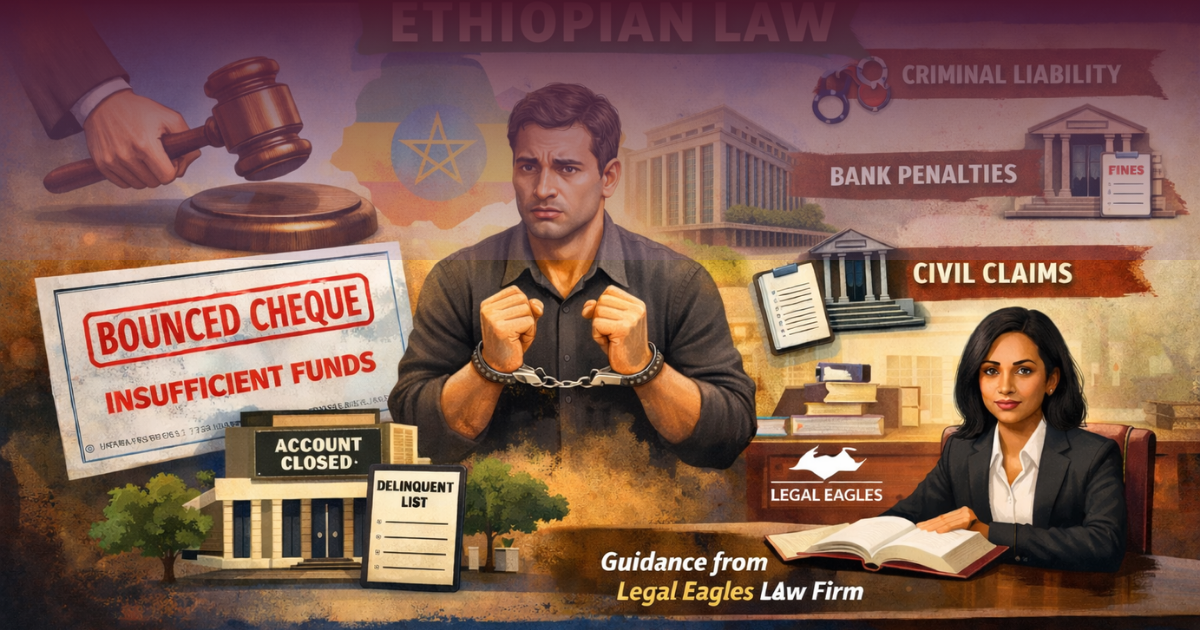
When a cheque is returned unpaid due to insufficient funds, Ethiopian law imposes criminal, administrative, and civil consequences.
2.1 Criminal Liability
Issuing a cheque without sufficient funds can constitute a criminal offence under:
- Article 827 and 854 of the Commercial Code
- Article 693 of the Criminal Code of Ethiopia
If the act is intentional, the drawer may face imprisonment and fines.
2.2 Administrative Penalties (Banking Sanctions)
The National Bank of Ethiopia directive establishes a graduated penalty system.
First Dishonoured Cheque
- The bank records the incident in a Dishonoured Cheque Register.
- Outgoing debit transactions from the account may be blocked until the cheque is settled.
Second Dishonoured Cheque (within 12 months)
- The bank imposes a 3% penalty on the cheque amount, capped at 25,000 Birr.
Third Dishonoured Cheque
- The bank closes the account.
- The drawer’s name is circulated in the Delinquent List to all banks in Ethiopia.
- The drawer may be prohibited from opening or operating a current account.
A further 5% penalty may be imposed, capped at 50,000 Birr.
2.3 Civil Liability
In addition to criminal and administrative penalties, the holder of the cheque may file a civil claim against the drawer to recover the unpaid amount.
3. Stop-Payment Orders
Banks generally do not accept stop-payment orders if the purpose is to avoid liability for issuing a bad cheque.
A stop-payment order is only accepted if the drawer proves that the cheque was:
- Lost, or
- Stolen
In such cases, the drawer must submit police evidence within 15 working days.
4. Cheques Used as Guarantees
Legally, a cheque is intended to serve as a payment instrument, not as collateral or a guarantee.
However, in practice, cheques are often used as security for obligations in Ethiopia.
The Federal Supreme Court Cassation Bench has clarified that:
- A cheque issued as a guarantee can still create criminal liability if it bounces.
- The drawer must prove that the cheque was issued based on specific contractual arrangements, usually supported by written agreements.
Witness testimony alone may not be sufficient.
5. Post-Dated Cheques
A post-dated cheque is a cheque written with a future date.
In principle:
- The payee should not present the cheque before the date written on it.
Nevertheless, post-dated cheques are frequently used in business transactions as a mechanism to secure future payment.
6. Summary of Legal Penalties
The legal consequences of issuing a cheque without sufficient funds depend on the circumstances.
Intentional Dishonour
- May result in imprisonment of up to 10 years in serious cases.
- Courts may also impose financial penalties.
Negligent Dishonour
- May result in a fine or imprisonment of up to one year.
Legal Assistance in Cheque Bounce Cases
Cheque disputes can quickly escalate into criminal proceedings, civil claims, and banking sanctions. Early legal intervention is often essential.
At Legal Eagles Law Firm, we assist clients in cheque-related matters by:
- Preparing and sending mandatory legal notices
- Filing civil or criminal cases
- Representing clients during court proceedings
- Negotiating settlement and repayment arrangements
If you are facing a cheque dispute or a bounced cheque issue, obtaining legal advice early can help protect your rights and financial interests.