Conversion of a Sole Proprietorship into a Private Limited Company (PLC) in Ethiopia
In Ethiopia, commercial law and tax and registration authorities jointly regulate the conversion of a sole proprietorship into a Private Limited Company (PLC). While the Commercial Code of Ethiopia under Article 538 expressly permits conversion into a one-member PLC, the process applied by authorities remains procedurally conservative. Understanding this interaction is critical for legal and business compliance.
Legal Framework: Article 538 of the Commercial Code
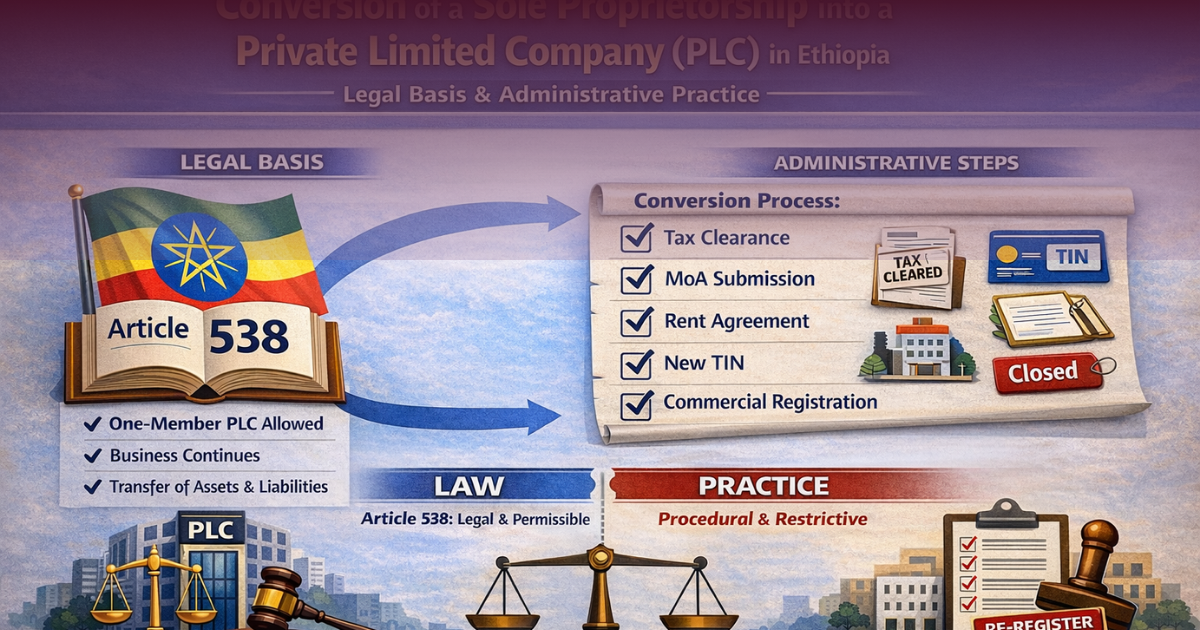
Article 538 recognizes the formation of a one-member private limited company by conversion from a sole proprietorship. From a company-law perspective, this means:
- Conversion is a change of legal form, not liquidation;
- The business may continue in a corporate form;
- The sole proprietor may transfer the assets and liabilities to the PLC in accordance with the law.
Accordingly, conversion under Article 538 is not a theoretical concept. The law establishes this mechanism to facilitate business formalization and growth.
Administrative Practice Applied by Authorities
Despite this statutory recognition, Ethiopian authorities particularly the FDRE Ministry of Revenues apply procedures that closely resemble closure and re-registration. In practice, authorities require the following steps:
- Closure of the Sole Proprietorship
The sole proprietorship must obtain tax clearance, confirming settlement of all tax obligations. - Submission of the PLC’s Memorandum of Association (MoA)
The newly formed PLC must duly register and submit its Memorandum of Association (MoA). - Premises Documentation
A valid rent contract and proof of rent payment in the name of the PLC must be provided. - Issuance of a New TIN
The PLC must obtain a new Tax Identification Number because the tax law treats it as a separate taxable person. - Fresh Commercial Registration
The PLC must complete commercial registration in its name, including trade name registration where applicable. - Finalization of Stock and Liabilities of the Sole Proprietorship
Any stock, assets, or liabilities registered under the sole proprietorship must be closed. Authorities require that the sole proprietorship ends with no outstanding fiscal exposure.
Law vs. Practice: The Current Legal Reality
The Ethiopian system currently operates under a hybrid model:
- Normatively, conversion from a sole proprietorship to a one-member PLC is lawful under Article 538;
- Procedurally, conversion is implemented through steps that resemble dissolution and re-establishment.
This means Article 538 is legally operative, but its execution is procedurally restrictive rather than seamless.
Conclusion
The conversion of a sole proprietorship into a PLC in Ethiopia is both legally recognized and practically constrained. Article 538 of the Commercial Code provides a clear legal basis for conversion, while administrative practice imposes closure-style procedures to ensure tax compliance. Until harmonized implementing regulations are issued, business owners must comply with both the Commercial Code and the requirements of the Ministry of Revenues.
For practitioners and investors, the key takeaway is clear: conversion is lawful, but it must be carefully managed to satisfy administrative practice