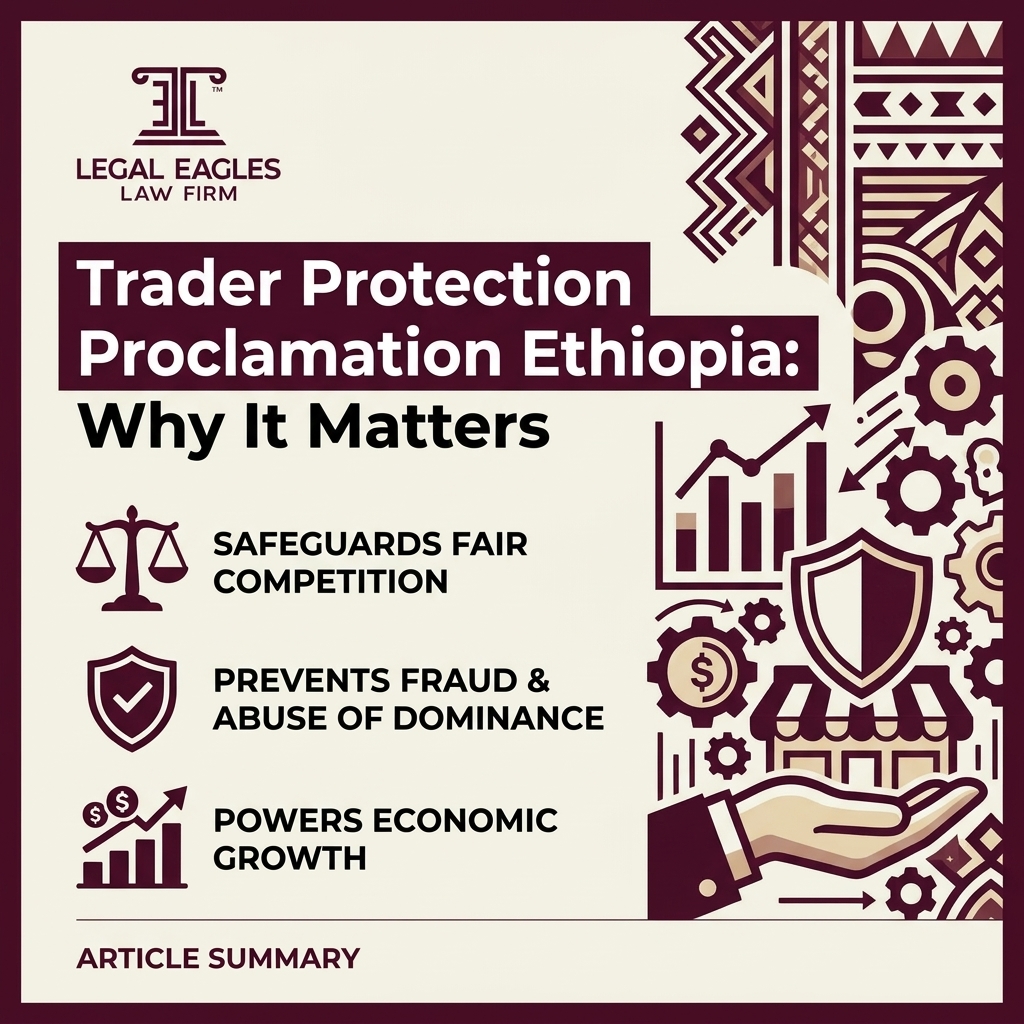
Why Protecting Traders Matters: Unpacking Ethiopia’s Proclamation No. 813/2013
When we discuss market regulation, public conversation almost immediately shifts toward consumer protection ensuring fair prices, safe products, and accurate labeling. While protecting consumers is vital, it represents only half of the regulatory equation.
Under Ethiopia’s Trade Competition and Consumers Protection Proclamation No. 813/2013, protecting the business community from small-scale enterprise operators to large commercial entities is recognized as an indispensable foundation for economic development and market integrity.
Why is trader protection so critical under the Proclamation, and what does it mean for Ethiopia’s free-market economy?
1. Leveling the Playing Field against Unfair Competition
A business invests substantial time, financial capital, and goodwill to establish its market presence. When dishonest competitors resort to deceptive tactics, ethical traders bear the loss.
Article 8 of Proclamation No. 813/2013 shields legitimate businesses by banning acts of unfair competition:
- Preventing Business Disparagement: Stopping competitors from spreading false claims designed to tarnish another enterprise’s commercial reputation.
- Prohibiting Market Confusion & Imitation: Outlawing deceptive practices that mimic a competitor’s trade name, product packaging, or branding to sidetrack loyal customers.
- Commercial Deception: Eliminating pass-off tactics and counterfeit distribution that undermine honest traders.
2. Preventing Abuse of Market Dominance
In an unregulated market, dominant commercial entities can easily leverage their financial weight to squeeze smaller competitors and new entrants out of the market.
Under Articles 5 and 6, the Proclamation shields vulnerable traders from predatory abuse by prohibiting dominant entities from:
- Deliberately withholding supply or hoarding essential goods to starve out smaller rivals.
- Enforcing restrictive exclusive distribution arrangements or imposing unjustifiable resale price maintenance.
- Imposing mandatory “tying arrangements” that force distributors to carry undesired goods to get access to market staples.
3. Dismantling Cartels & Anti-Competitive Collusion
Independent traders cannot survive in a market rigged by backroom deals. Article 7 targets horizontal and vertical collusive agreements such as price-fixing, market partitioning, and bid-rigging.
By penalizing cartel activities, the Proclamation guarantees that market success depends on merit, pricing efficiency, and quality rather than illicit coordination between dominant players.
4. Development Capital Investment & Economic Growth
As explicitly stated in Article 3, a primary objective of the statutory framework is to accelerate national economic development by establishing a conducive, competitive free market.
Entrepreneurs will only commit long-term capital, innovate, and expand employment when they are confident that:
- Market entry is free from artificial or unlawful barriers.
- Commercial contracts will be respected.
- Systemic fraud will be actively investigated and penalized by regulatory authorities.
5. Ensuring Direct Civil Remedies for Victimized Businesses
Protection without legal enforceability is meaningless. Article 38 endows the Trade Competition and Consumers Protection Authority with specialized adjudicative powers to evaluate commercial disputes.
Victimized traders are provided direct administrative channels to claim financial compensation and seek injunctive relief against offending competitors, avoiding the long delays often associated with general civil litigation.
Key Takeaway
Protecting traders isn’t about giving businesses a free pass it is about creating a predictable, transparent ecosystem where honest businesses can thrive, compete fairly, and fuel economic expansion. When we protect the trader, we protect the market itself.