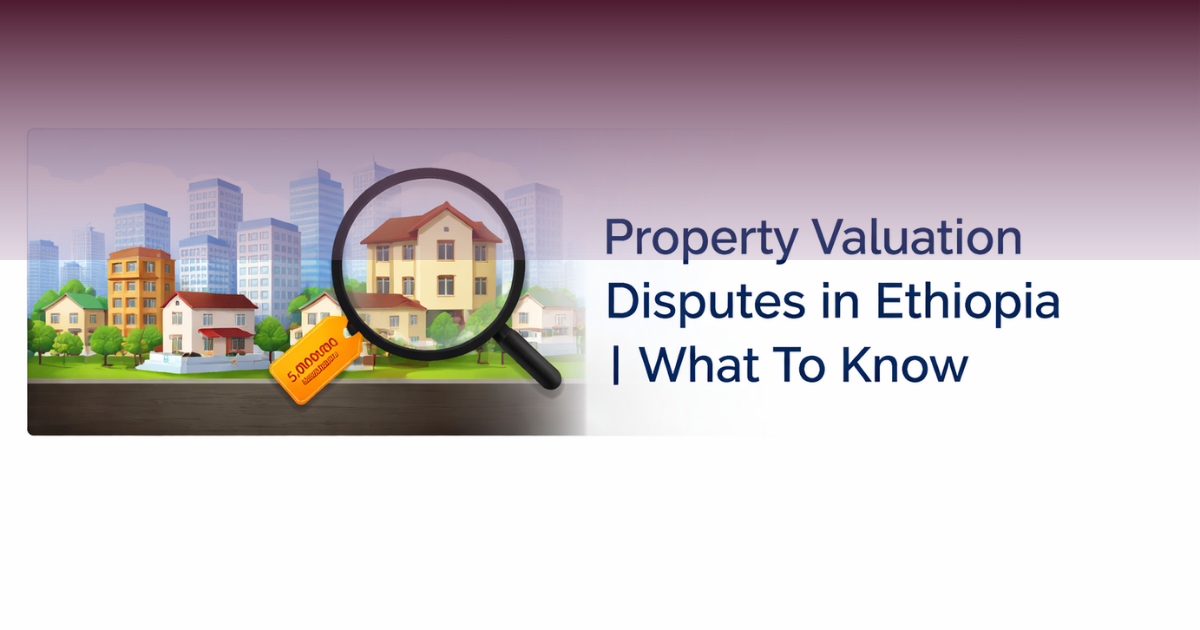
When Property Values Are Wrong: Understanding Property Valuation Disputes under Ethiopia’s Property Tax Proclamation No. 1365/2025
Imagine owning a modest house in Addis Ababa. It’s older, needs repairs, and hasn’t changed much in years. Then one day, you receive a property tax assessment and your property is valued as if it were a newly built modern home. Your tax bill jumps, and you are left asking: “How did they even come up with this number?”
This scenario is becoming increasingly common under Property Tax Proclamation No. 1365/2025, which introduced a market-based valuation system in Ethiopia. In simple terms, your property is now taxed based on what it is estimated to be worth in the market, rather than just its size or classification. Authorities consider factors such as the location of your property, the size of your land and building, the type of property (residential, commercial, or other), improvements made over time, and the prices of similar properties nearby.
On paper, this approach sounds fair, but in practice, valuation is not always accurate and fairness is not always guaranteed.
Where Things Go Wrong
Valuation is not an exact science. In a developing real estate market like Ethiopia’s, there are numerous challenges that can lead to disputes.
“My Property Is Overvalued”
One of the most frequent concerns is overvaluation. Many property owners discover that the value assigned to their property does not reflect its true condition or market worth. This often occurs because valuators rely on generalized data or assumptions rather than examining the specific realities of each property.
For example, a property may be assessed based on nearby high-end developments, even if it does not share the same level of construction, finishing, or overall quality. Rapidly developing areas with luxury buildings can skew perceived property values, causing older or modest homes to be taxed disproportionately.
In other cases, valuations may be based on out-dated or limited market data. Ethiopia’s real estate market is still evolving, and up-to-date information is not always readily available. When valuators depend on incomplete or inaccurate data, the resulting value may fail to reflect the current market.
Additionally, some valuations are shaped by assumptions that do not match reality, such as potential income generation, usability, or property condition. In truth, a property may have structural issues, limited access, or other constraints that significantly reduce its value. Ultimately, not all properties are equal. Overlooking these differences can place unfair financial burdens on property owners, forcing them to pay taxes based on inflated valuations.
“They Didn’t Consider the Condition”
Another common issue arises when the actual condition of a property is ignored. Physical state and usability play a central role in determining market value, yet they are often overlooked.
Many properties have structural problems, such as cracks, weak foundations, or unfinished sections, which reduce their worth. Others suffer from aging infrastructure out-dated plumbing, electrical systems, or general wear and tear. Some properties also face practical limitations, like poor road access, limited parking, or inconvenient layouts that affect usability and desirability.
When these factors are disregarded, valuations become inflated and unrealistic, resulting in higher taxes that do not reflect the true state of the property. Ignoring these realities places an unfair burden on property owners who are forced to pay for value their property does not genuinely hold.
“My Neighbour Pays Less for a Similar Property”
Inconsistent valuation is also a significant concern. Two similar properties in the same area can end up with very different assessed values and tax obligations. Such discrepancies can understandably frustrate property owners and raise serious legal questions.
These differences often result from inconsistent methods, incomplete data, or subjective judgment in the assessment process. When similar properties are treated differently without clear justification, it undermines trust in the system and strengthens the case for a valuation dispute.
What Can You Do About It?
Many property owners are unaware of their rights: under the proclamation, you can challenge your property valuation. You have the right to:
- Ask how your property was valued
- Request supporting information
- Object if the valuation is incorrect
- Appeal decisions if the issue is not resolved
You are not expected to simply accept the figure provided.
Why Taking Action Early Matters
Even a small overvaluation can have long-term consequences, including higher annual taxes, financial pressure, and cumulative losses over time. The sooner you identify and address an incorrect valuation, the easier it is to correct and minimize financial impact.
A Practical Mind-set for Property Owners
Instead of viewing the valuation as just another tax, it helps to think of it this way:
- Your property now has an official, government-assessed value.
- That value directly affects your financial obligations.
Conclusion
Property Tax Proclamation No. 1365/2025 is a major step in modernizing Ethiopia’s tax system. But it also introduces a responsibility for property owners: to understand, question, and, when necessary, challenge valuations. Fair taxation depends on accurate valuation and accuracy is something every property owner deserves.