Sovereignty in the Skies: How National Carbon Taxes Are Reshaping International Aviation
Global efforts to decarbonize transport are accelerating. Consequently, a new frontier in aviation policy is emerging: national carbon pricing for international flights. Under these growing regulatory frameworks, host countries exercise their sovereign rights. They levy direct carbon taxes on foreign carriers operating within their airspace.
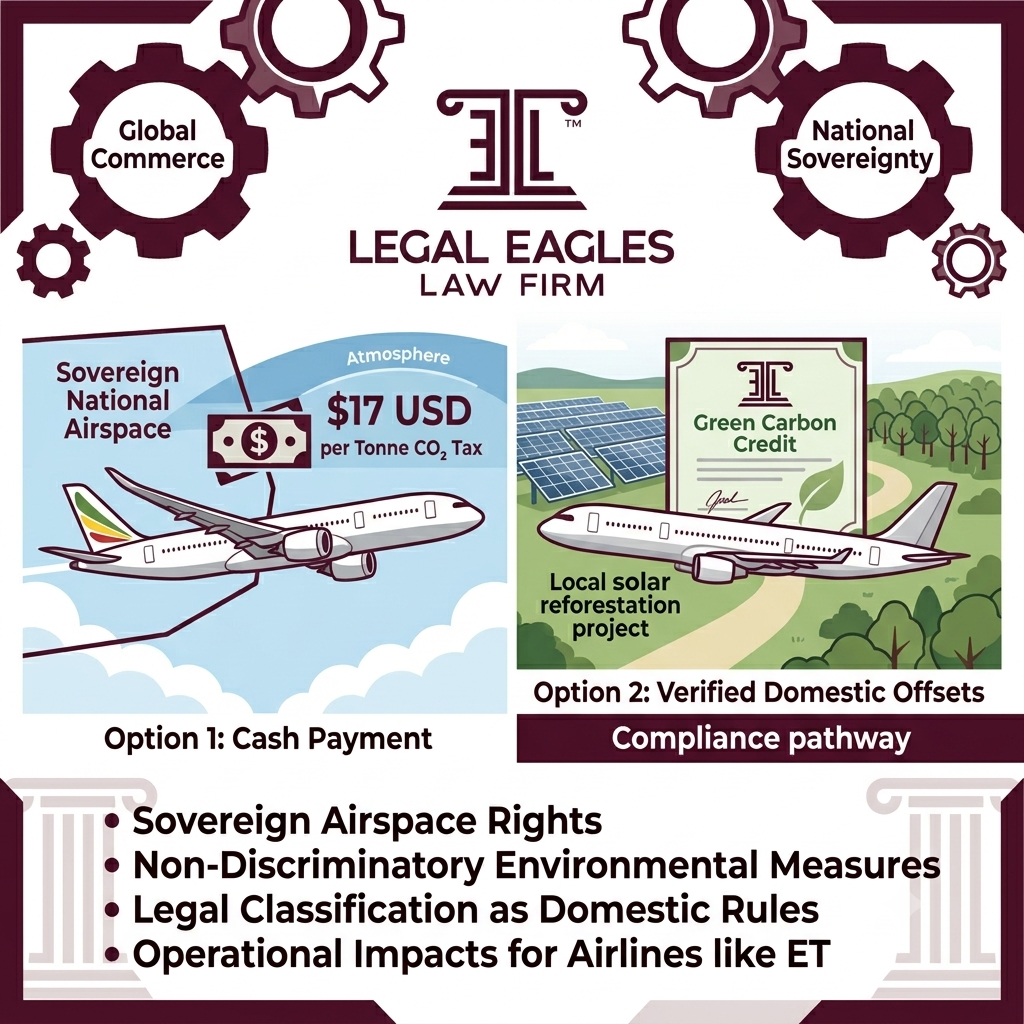
Consider a policy scenario facing major long-haul operators like Ethiopian Airlines (ET). Host nations assess a fee of $17 USD per tonne of CO₂ emitted within their boundaries. This rule applies to every flight entering or departing state airspace.
International carriers face two clear compliance choices to satisfy this mandate. They can pay the financial liability directly in cash to national authorities. Alternatively, they can purchase verified domestic offset credits equal to their localized emissions footprint.
Key Highlights of the Dual-Compliance Rule
- Tax Rate: $17.00 USD per metric tonne CO2 emitted within national airspace.
- Jurisdictional Scope: Applies strictly to international commercial flights operating inside the host nation’s territorial boundary.
- Pathway 1 (Cash Settlement): Direct cash payment paid into host nation environmental funds.
- Pathway 2 (Domestic Offsets): Purchasing certified carbon credits originating from local projects, channeling capital directly into host country green initiatives.
How the $17/Tonne Carbon Rule Works in Practice
Unlike flat departure passenger taxes, a boundary-bound carbon levy directly tracks fuel burn and environmental output. Airlines monitor the precise fuel consumed during each flight segment. This measurement starts when an aircraft enters host airspace—or pushes back from the gate. Monitoring ends when the plane clears territorial limits.
By offering a dual-settlement option (cash vs. offsets), regulating nations create operational flexibility:
- Direct Cash Compliance: Direct payments allow swift compliance with zero administrative friction.
- Local Carbon Market Boost: Buying domestic carbon offsets directly funds local green projects inside the host country. These include reforestation, renewable energy, and climate adaptation initiatives.
The Legal Grounding: Sovereignty and Territorial Airspace
A core question surrounding these unilateral measures is whether individual nations have the legal authority to tax international air traffic.
Under international aviation law, states maintain complete sovereignty over the airspace above their territory. This principle is anchored in the 1944 Chicago Convention. Meanwhile, international bodies like ICAO promote uniform global standards through CORSIA. However, individual states retain full domestic authority to enforce national environmental protection laws within their borders.
These $17/tonne carbon rules strictly target emissions generated within national boundaries. Therefore, authorities legally classify them as domestic environmental measures. Regulators apply these rules non-discriminatorily to all carriers—domestic and foreign alike.
What This Means for Carriers Like Ethiopian Airlines (ET)
For major international carriers connecting regional and global hubs, localized carbon pricing adds operational and financial layers to fleet management:
- Route Efficiency & Flight Planning: Flight planning software must factor local carbon costs into trajectory calculations. Adjusting altitude or flight paths to optimize fuel burn inside higher-tax airspace yields direct financial savings.
- Fleet Modernization Advantage: Airlines operating younger, fuel-efficient fleets—such as ET’s modern widebodies—pay significantly less per flight-mile than operators flying older, more carbon-intensive aircraft.
- Cost Absorption vs. Ticket Pass-Through: Airlines must balance whether to absorb the $17/tonne cost operationally or incorporate it into ticket prices as an environmental surcharge.
Unilateral Measures vs. Global Frameworks
The rise of national carbon taxes reflects a growing impatience with global consensus-building. While global frameworks aim for a single worldwide standard, localized carbon pricing allows individual countries to generate immediate climate finance and accelerate decarbonization within their borders.
As more nations adopt national carbon pricing rules for international transport, airlines will increasingly navigate a patchwork of sovereign environmental regulations—making fuel efficiency and local offset partnerships central to standard flight operations.