Innovation or Infraction: Ethiopia’s Fin-tech Regulations
The fintech landscape in Ethiopia is at a crossroads. While the National Bank of Ethiopia (NBE) and the Ethiopian Capital Market Authority (ECMA) are opening doors for digital transformation, recent enforcement actions have sent a clear message: innovation without authorization carries heavy legal risks.
For entrepreneurs and investors, the line between a “disruptive start-up” and a “regulated entity” is often thin. Understanding where you stand is not just a business necessity it is a legal safeguard.
1. The Power and Limits of the “Regulatory Sandbox”
The Ethiopian government has introduced “Regulatory Sandboxes” to allow fintechs to test their products in a live, but controlled, environment.
- The Intent: A legal “safe zone” where the NBE or ECMA relaxes certain requirements so you can prove your technology works.
- The Trap: Many start-ups mistakenly believe that being “innovative” gives them an automatic pass to operate. You must be formally admitted into the sandbox. Operating outside of it while providing financial services (like payment aggregation or lending) is considered a violation of the Banking Business Proclamation. A “sandbox” is a controlled experiment, not a loophole for unlicensed activity.
2. Criminal Liability: Exploring the High Stakes of Article 106
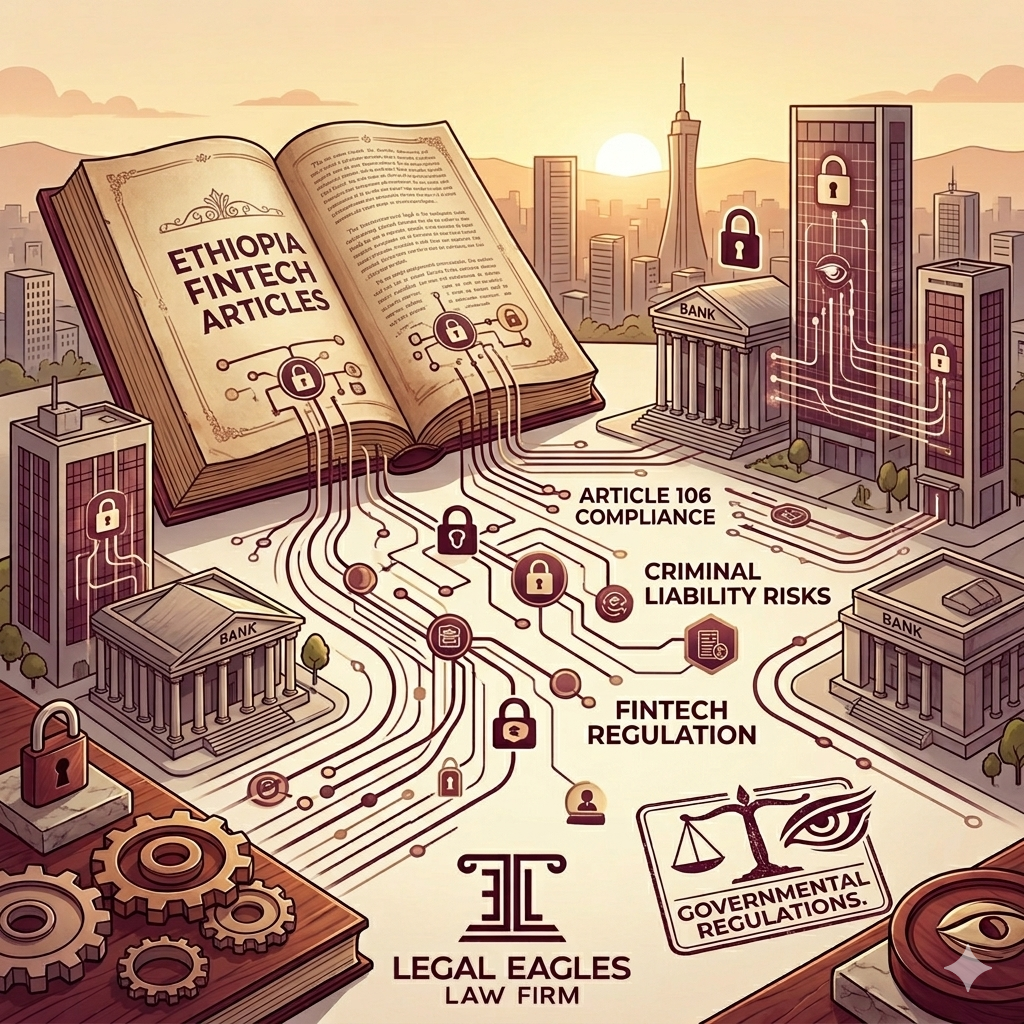
There is a common misconception that operating a fintech platform without the proper paperwork is merely an administrative oversight. However, Article 106 of the Capital Market Proclamation (No. 1248/2021) elevates certain actions into the realm of criminal law.
While a Regulatory Sandbox allows for flexibility in testing business models, it does not provide immunity for deceptive practices. The law draws a firm line at the point where innovation becomes exploitation:
- Market Manipulation & Deception: Under Article 106, “Market Manipulation” and “Deceptive Statements” are federal crimes. If a platform provides misleading information regarding its licensing status or the safety of its investment products to entice the public, it is no longer a regulatory matter it is a criminal one.
- The Intent Factor: The law focuses on the dissemination of false or misleading information that is likely to induce others to purchase securities. In the context of recent fintech investment crackdowns, the charge often shifts from “unlicensed operation” to “fraudulent inducement” when users are promised returns that the platform has no legal capacity to provide.
- Severe Penalties: Article 106 is a powerful deterrent. Convictions can lead to Rigorous Imprisonment (typically ranging from 3 to 10 years) and substantial Judicial Fines aimed at stripping illicit profits.
3. Fintech vs. Traditional Investment: The License Gap
The most dangerous area for startups is the “License Gap”—a misunderstanding of whether a platform is a technology provider, a payment processor, or a financial intermediary. In Ethiopia, these are governed by different laws and different regulators.
The Payment Aggregator (NBE Jurisdiction)
Many fintechs begin as “Payment Aggregators” or “Payment System Operators” under Directive No. ONPS/09/2023. Their role is strictly functional: providing the digital pipes to move money.
The Limit: An aggregator license does not give you the right to hold user funds for long periods or promise interest. If an aggregator offers “savings goals” with returns, they have crossed into banking territory without a license.
The Investment Platform (ECMA Jurisdiction)
Once a platform starts offering “wealth creation” or pooling funds, it enters the realm of traditional investment.
The New Frontier: With the finalized Collective Investment Scheme (CIS) Directive (2026), the ECMA now has a clear framework for mutual funds, money market funds, and real estate investment funds. The Risk: Operating a “crowdfunding” or “pooled investment” app with only a general tech business license is a major compliance gap. Without an ECMA license as a fund manager or investment advisor, you cannot legally broker securities or manage portfolios
4. How to Stay Compliant
To ensure your fin-tech venture remains on the right side of the law, we recommend three immediate steps:
- Determine Your Jurisdiction: Does your service move money (NBE) or manage wealth (ECMA)?
- Audit Your Marketing: Avoid “guaranteed returns” language, which can be flagged as fraudulent or deceptive under Article 106.
- Formalize Your Entry: Apply for the Regulatory Sandbox or a full license before going live with public funds.
In the eyes of the law, innovation is never a license for misrepresentation.