Foreign Work Permits & Employment Contracts in Ethiopia: A Compliance Guide for Employers
Ethiopia continues to attract foreign investment across key sectors. However, strict compliance with local labor laws remains paramount. Hiring foreign workers without government approval risks severe penalties. These include heavy fines, canceled contracts, or revoked licenses.
A foreign work permit and an employment contract link directly to one another. Understanding this connection ensures compliance under Ethiopian labor law.
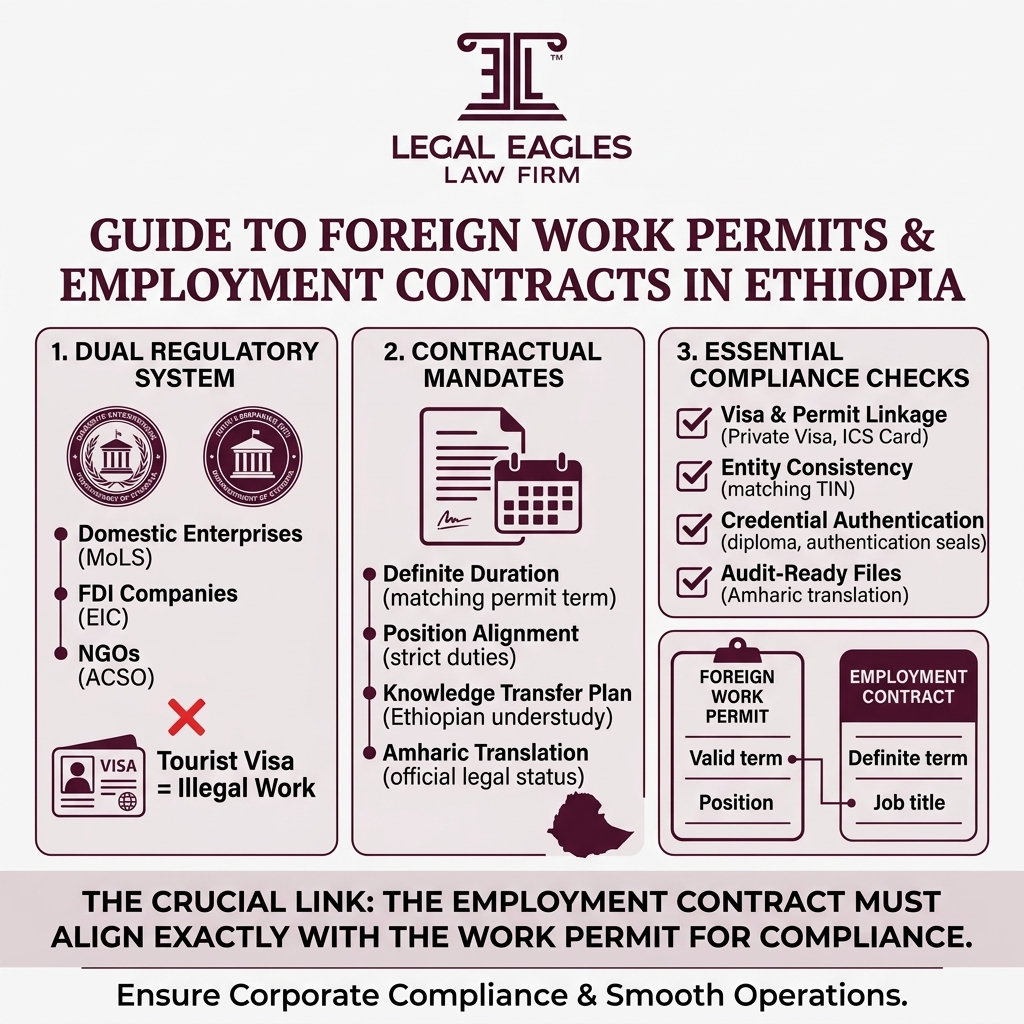
1. The Dual Regulatory System: MoLS vs. EIC
Ethiopia does not centralize foreign work permit processing under a single authority. Jurisdiction depends directly on the legal structure of the employing entity:
- Domestic Enterprises: Administered by the Ministry of Labor and Skills (MoLS) through its national digital service platform.
- Foreign Direct Investments (FDI): Processed through the Ethiopian Investment Commission (EIC) under its delegated mandate for foreign-invested companies.
- Non-Governmental Organizations: Handled by the Authority for Civil Society Organizations (ACSO) in coordination with MoLS.
Key Rule: A foreign national cannot legally perform work on a Tourist Visa. Workers must enter Ethiopia on an employer-sponsored Private Work Visa (NV). They can then convert it to a Work Permit and Residence Card.
2. Contractual Mandates Under Labor Proclamation No. 1156/2019
Labor Proclamation No. 1156/2019 governs the employment relationship between an employer and an expatriate worker. While local contracts default to an indefinite duration, expatriate contracts carry specific statutory rules:
- Definite Duration: Foreign employment contracts are strictly time-bound. They typically run for 1 to 3 years, matching the permit duration.
- Position Alignment: The contract job title must strictly match the position approved in the work permit application. Assigning an expatriate to duties outside the approved scope constitutes a regulatory violation.
- Understudy & Knowledge Transfer Requirement: Work permits for non-management foreign workers require the employer to assign a local Ethiopian counterpart. Employers must submit a clear knowledge-transfer schedule showing how they will build local capacity.
- Language Requirements: Authorized translators must execute or translate into Amharic any contracts submitted to labor authorities or courts.
3. Core Compliance & Audit Checks for Employers
To ensure your foreign workforce files are audit-ready, verify the following core alignment points:
- Visa and Permit Linkage: Ensure the employee holds a valid Private Business Visa, a Work Permit, and an ICS Residence Permit.
- Corporate Entity Consistency: Verify that the company name and TIN on the permit match the contracting entity exactly. Companies cannot share foreign workers across parent or affiliate entities without explicit secondment approvals.
- Credential Authentication: The issuing country, the local Ethiopian embassy, and MoFA must authenticate all foreign degrees and credentials.
- Filing & Documentation: Keep official receipt numbers, approved forms, and translated contracts in the worker’s permanent HR file.
Conclusion
Managing foreign workforce compliance in Ethiopia requires aligning operational hiring needs with statutory directives. Companies secure smooth operations by getting permits early, signing aligned contracts, and maintaining understudy programs.