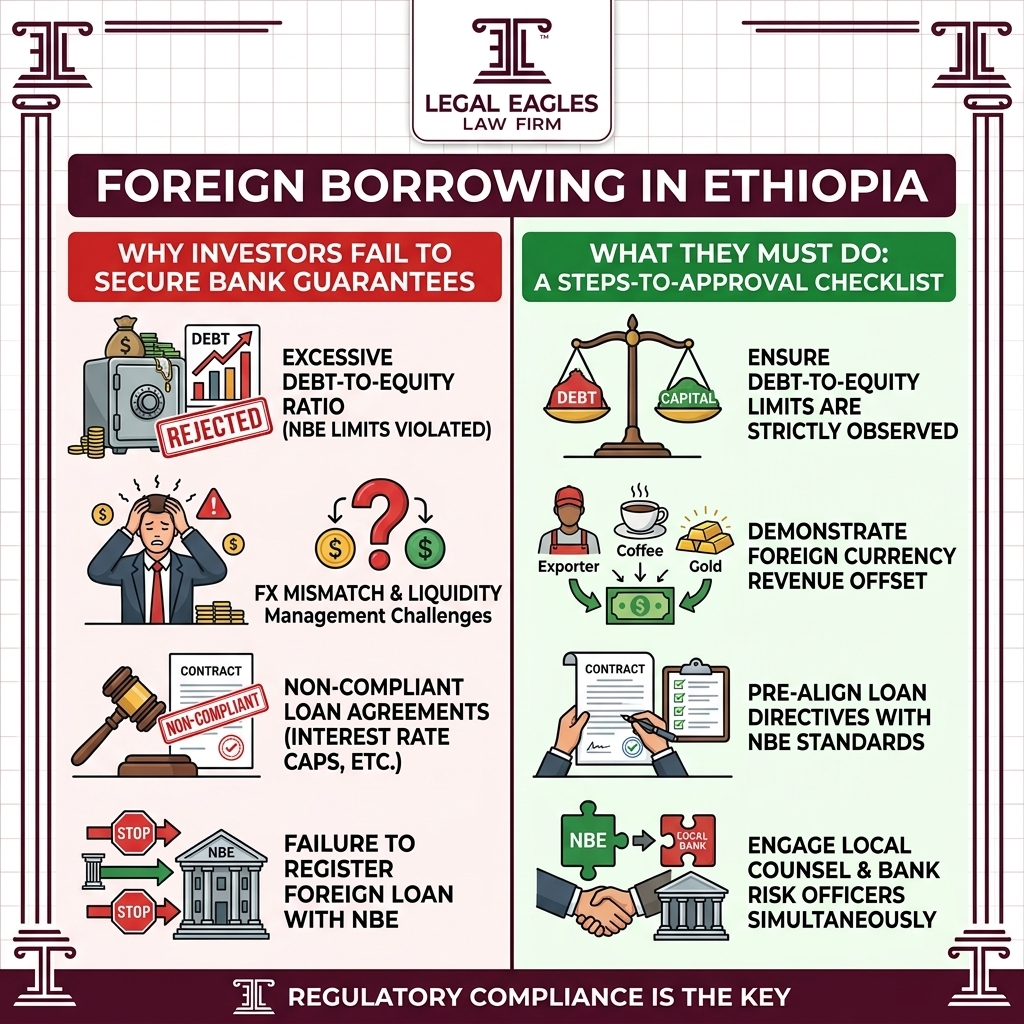
Unlocking Offshore Debt in Ethiopia: Beyond the Bank Guarantee Dilemma
For foreign-invested enterprises in Ethiopia, securing an external debt facility is only half the battle. The critical bottleneck emerges when international lenders require local commercial bank guarantees or enforceable security packages to disburse funds.
NBE Directive No. FXD/01/2024 permits foreign borrowing. However, commercial banks face strict limits on foreign guarantees. Understanding these regulatory mechanics and structural alternatives is essential to converting approved foreign debt into usable local capital.
Why the Traditional “Bank Guarantee” Path Stalls
When foreign lenders demand a local bank guarantee, negotiations in Addis Ababa frequently grind to a halt. Local commercial risk committees hesitate for three primary legal reasons:
1. Guarantee Exposure Caps under NBE Directive FXD/04/2026
Under Directive No. FXD/04/2026, bank guarantees for private loans are capped at 10% of total capital. Foreign loan guarantees create active credit risks. Therefore, they fall under Single Borrower Limits. Banks are reluctant to exhaust their single-borrower exposure ceilings on contingent FX liabilities.
2. Mandatory Debt-to-Equity Ceilings
Foreign loan applications must comply strictly with mandatory debt-to-equity leverage ratios. Excessive leverage prevents local commercial banks from lawfully registering the loan or issuing guarantees.
3. Non-Compliant Commercial Loan Terms
NBE directives regulate key commercial terms for external debt, including interest rate caps, management fee limits, and mandatory grace periods. Banks will refuse guarantees if credit agreements contain non-compliant interest terms, fees, or dispute clauses.
Strategic Alternatives: Structuring Viable Local Security Packages
To overcome guarantee deadlocks, project sponsors and international lenders should utilize direct collateral mechanisms permitted under Ethiopian law:
A. Movable Assets under Proclamation No. 1147/2019
Lenders can structure alternative security packages under the Movable Property Security Right Proclamation No. 1147/2019. Local security trustees can register machinery, inventory, accounts, and receivables in the electronic Collateral Registry System. This creates a legally binding priority right without forcing local banks to issue off-balance-sheet FX guarantees.
B. Leasehold Land Mortgages under the Civil Code and Investment Proclamation
Investors may also grant real estate mortgages over industrial building structures and urban land leaseholds. This gives lenders enforceable real-estate collateral without relying on off-balance-sheet bank guarantees.
C. Offshore Parent Guarantees and Share Pledges
Where local guarantees are unviable due to the 10% capital exposure limit, facilities can be secured via parent company guarantees executed outside Ethiopia or share pledges over the offshore parent company holding the Ethiopian subsidiary. This bypasses local FX guarantee bottlenecks while providing recourse at the holding entity level.
D. Delegated Commercial Bank Loan Registration
Under Directive No. FXD/04/2026, commercial banks now handle the approval, registration, and debt service processing of foreign loans directly, provided the borrower presents a signed undertaking confirming debt-to-equity compliance. Ensuring compliance at the bank level from day one guarantees statutory access to foreign exchange queues for loan repayments.
Moving Foreign Debt from Agreement to Disbursement
Securing foreign debt in Ethiopia is rarely a matter of creditworthiness alone it requires structural alignment with current NBE directives and commercial security laws. By designing bankable collateral packages and auditing loan terms prior to execution, foreign investors can prevent deal delays and successfully secure offshore growth capital.