Ethiopia’s Pardon Directive: What Directive No. 1133/2026 Means for Convicts and Their Families
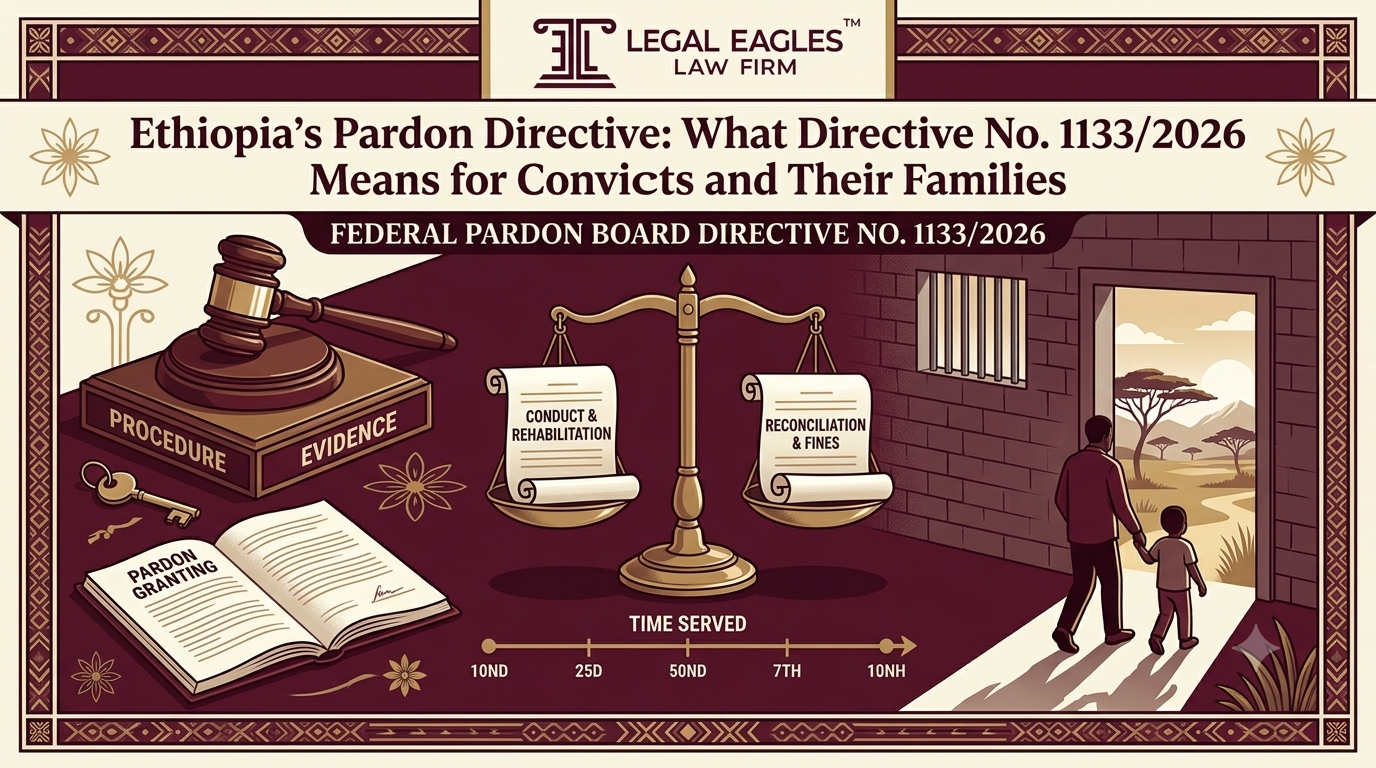
Every year, thousands of Ethiopian families wonder whether a loved one behind bars still has a legal path back home. Ethiopians call that path a pardon, and in April 2026, the Federal Pardon Board rewrote the rules that govern it. Directive No. 1133/2026 replaces the previous framework, Directive No. 966/2023, closing gaps that had made the pardon process unpredictable for convicts, families, lawyers, and prison administrators alike.
Enacting Article 28(2) of the Pardon Granting and Implementation Procedure Proclamation No. 840/2014, the Board designed the new Directive to clarify three core points: who can apply, what evidence they must bring, and how the Board decides.
Who Can Apply, and Where
Under Article 5, a Federal Government convict meaning anyone sentenced by a Federal Court, held in a federal prison, sentenced by a Regional Court exercising federal jurisdiction, or convicted by a Military Court may apply for a pardon in one of two ways, depending on location:
- If held in a Federal Prisons Commission facility, the request goes directly to the Board’s Secretariat.
- If held in a regional prison, the request goes to the Regional Pardon Board Secretariat, which forwards a positive recommendation up to the Federal Secretariat.
The convict does not have to act alone. A close relative, a representative, or a lawyer may submit the request on the convict’s behalf. The Directive also allows the Ministry of Justice, the Federal Prisons Commission, or a Regional Pardon Board to proactively identify convicts who deserve consideration, even without a formal application (Article 5(8)).
How Long Must a Prisoner Serve First?
Article 7 sets out the baseline eligibility rules:
- A convict serving a life sentence must complete 15 years before applying.
- A convict serving up to 25 years must complete at least one-third of the sentence.
- The applicant must not be a recidivist.
But these thresholds shift sharply for certain categories of crime. Article 7(2) lists offenses including corruption, human trafficking, terrorism, currency counterfeiting, drug trafficking, crimes against critical infrastructure, grave treason, tax fraud, money laundering, kidnapping, aggravated murder, and crimes against the constitutional order — where a prisoner must serve half the sentence and demonstrate good conduct before even applying.
At the other end, Article 7(3) recognizes vulnerability. Elderly prisoners (women over 55, men over 60), juveniles under 18, mothers who entered prison pregnant or with a child under two, and prisoners with disabilities may apply after serving only a quarter of a sentence of up to three years and if more than one of these conditions applies, after just one-fifth of a sentence of up to five years.
Applying Outside the Normal Timeline
Article 8 recognizes that justice cannot always wait for a countdown clock to finish. Applicants can submit a pardon request at any time, regardless of how much of the sentence remains, where:
- A prisoner serving up to five years has met university entrance requirements;
- A medical board confirms the prisoner has a serious illness incompatible with continued detention;
- A medical board confirms a child living with the prisoner, or a pregnant prisoner, faces a serious health problem; or
- The Board Chairperson determines that granting the request would serve the proper administration of justice.
Fines, Reconciliation, and the Human Side of Pardon
Two conditions run through the Directive as recurring themes: financial accountability and reconciliation.
Under Article 9, a prisoner must show proof that they paid any fine alongside the sentence or, if the court converted the fine into labor, that they completed the required labor.
Under Articles 10 and 11, prisoners convicted of homicide, attempted homicide, bodily harm, aggravated robbery causing serious harm or death, or arson causing serious harm or death must show evidence of reconciliation with the victim or the victim’s close relatives or proof of a genuine, documented attempt that failed for reasons beyond their control. Reconciliation must generally happen directly with the victim if the victim is alive and reachable; otherwise, it happens with a close relative or legal guardian. Notably, the Directive recognizes reconciliation carried out through tribal or community-level systems, provided the victim or their relatives consent (Article 11(3)).
When a convict commits a crime against women or children, the Board retains authority to scrutinize the case closely, regardless of whether the parties reconciled (Article 10(4)). And for the most serious political offenses armed rebellion, incitement of civil war, or crimes against the constitutional order the Directive requires written confirmation from the President or regional Head of Government that release serves regional peace, alongside elder-led reconciliation (Article 10(5)).
Conditional Pardons
Not every pardon is unconditional. Article 13 allows the Board to recommend a pardon tied to specific obligations for example, to let a prisoner pursue higher education after qualifying, or to practice a special professional skill. These conditional pardons carry strict time limits, require the beneficiary to report back to the Secretariat by a set date, and allow the Board to revoke the pardon if the person commits another intentional crime within five years. For foreign nationals without a residence permit, the Board may condition a pardon on deportation or return to their home country.
What the Board Sends to the President
If a request meets the criteria, the Board does not decide alone — it prepares a detailed recommendation for the President of the Federal Democratic Republic of Ethiopia. Article 16 requires this recommendation to include the convict’s identity and circumstances, the crime and its consequences, sentence details, time already served, fine and reconciliation status, medical evidence, and the prison’s own opinion on the convict’s rehabilitation. This must reach the President within 15 working days of the Board’s decision.
Correcting Mistakes and Revoking Pardons
The Directive also builds in safeguards. Article 23 of Proclamation No. 840/2014 already governs pardon revocations through a full set of grounds. Article 17 of the Directive adds two further grounds: the Board can revoke a pardon if a fundamental error occurred (such as mistaken identity) or if the beneficiary violates their pardon conditions. The Board Chairperson alone can correct simple clerical errors, such as a misspelled name or wrong address, without reconvening the full Board (Article 18).
Why This Matters
Directive No. 1133/2026 does not change who has the constitutional power to grant a pardon that remains with the President, acting on the Board’s recommendation under Proclamation No. 840/2014. What it changes is the roadmap: clearer timelines, clearer evidence requirements, and clearer distinctions between ordinary offenses and the most serious crimes against people, property, and the state.
For convicts, families, and legal practitioners navigating this process, the message is straightforward: eligibility now depends less on hope and more on documentation — time served, fines paid, reconciliation pursued, and conduct proven.