Euthanasia vs. Ventilator Withdrawal: Understanding Ethiopia’s Health Law (Proclamation No. 1362/2017)
When a patient is on mechanical life support, families, healthcare providers, and the public often confuse two critical concepts: euthanasia and the withdrawal of artificial respiration.
While both involve life support systems, Ethiopian law draws a sharp, unambiguous line between them. Under the Health Service Administration and Control Proclamation No. 1362/2017, these are not two sides of the same coin—they are entirely different legal and medical scenarios.
Here is a breakdown of what Articles 13(3) and 14 actually provide, and why distinguishing between them is crucial.
1. Article 13(3): Euthanasia Is Absolutely Prohibited
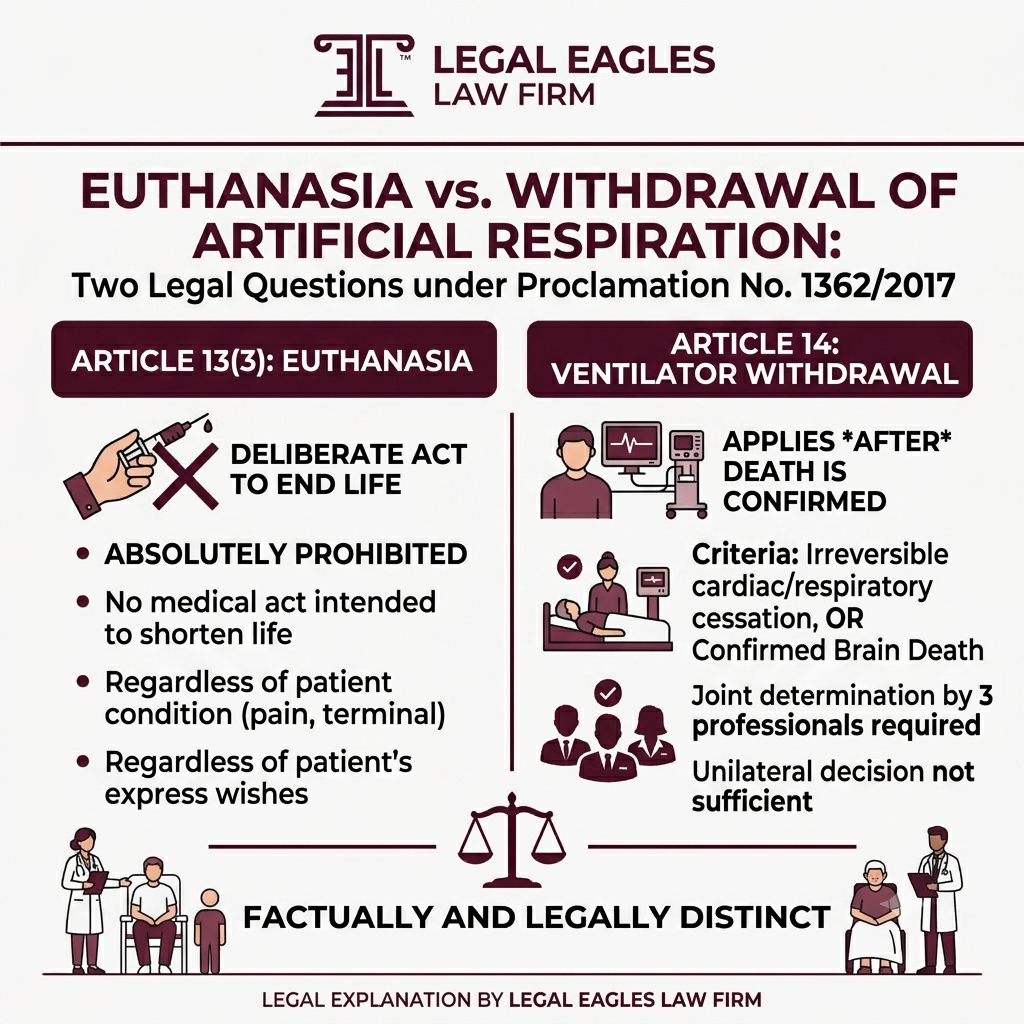
Article 13(3) addresses living patients and imposes a categorical ban on any medical act intended to deliberately hasten death.
The statutory prohibition is absolute. The law provides no exceptions, specifies no qualifying conditions, and makes no distinctions based on patient status or suffering.
Key Practical Implications:
- No Deliberate Hastening of Death: No healthcare professional, family member, or third party may perform an act intended to shorten a patient’s life.
- Severity Is Irrelevant: This rule applies regardless of how severe, painful, terminal, or irreversible the patient’s medical condition may be.
- Patient Consent Does Not Alter the Law: Even if a patient explicitly requests to end their life, their consent does not create a legal exception under this provision.
Bottom Line: Article 13(3) applies to living patients. It forbids taking any action to cause or bring about death.
2. Article 14: Ventilator Withdrawal Applies After Death Is Confirmed
Article 14 does not permit ending the life of a living person. Instead, it governs a narrow, specific situation: a patient who has already been legally and medically determined to be dead, but whose physical body is being artificially sustained by mechanical equipment (such as a ventilator).
Under Article 14, discontinuing life support is permitted only when death has been established through one of two criteria:
- Irreversible Cessation of Cardiac & Respiratory Function: The heart and lungs have stopped functioning and cannot resume naturally.
- Confirmed Brain Death: Total and irreversible loss of all brain functions.
The 3-Professional Safeguard
To prevent abuse or premature decision-making, Article 14 establishes a strict procedural safeguard: a single individual cannot make this decision alone. Equipment may only be withdrawn after three concerned healthcare professionals jointly agree on the determination of death.
Bottom Line: Article 14 applies to a deceased individual. It regulates stopping machines artificially moving air or blood through a body after death has already occurred.
Key Differences at a Glance
Article 13(3) — Euthanasia
- Patient Status: Applies to a living patient.
- Legal Stance: Strictly prohibited in all circumstances, without exception.
- Core Purpose: Prevents taking any deliberate action to bring about or hasten death.
- Authority: Cannot be authorized or performed by anyone under any circumstances.
Article 14 — Withdrawal of Artificial Support
- Patient Status: Applies only after medical confirmation of death.
- Legal Stance: Permitted under strict procedural safeguards.
- Core Purpose: Discontinues mechanical equipment maintaining bodily processes after clinical death has occurred.
- Authority: Requires the joint agreement of three healthcare professionals.
Why This Distinction Matters
Confusing these two provisions can lead to significant ethical and legal misunderstandings for medical staff, grieving families, and legal practitioners:
- Protecting Living Patients: Article 13(3) ensures that every living patient receives legal protection against intentional termination of life, regardless of their medical prognosis.
- Preventing Prolonged Mechanical Sustenance: Article 14 establishes a clear, regulated legal path to turn off artificial machinery once clinical death has occurred, preventing indefinite mechanical maintenance while requiring a three-doctor consensus to protect patient integrity.
Understanding Proclamation No. 1362/2017 requires recognizing that Article 14 is not an “exception” to Article 13(3). Article 13(3) protects the living; Article 14 provides the legal standard for managing medical machinery after life has ended.