Can a Shareholder Be Forced Out of a Company in Ethiopia? The Legal Grounds for Involuntary Exit
When an entrepreneur invests in a company, they receive equity a constitutionally protected property right. Ethiopian corporate governance rules are clear. The law prohibits companies from removing a shareholder or stripping their shares arbitrarily. Directors cannot delete an owner from the registry behind closed doors.
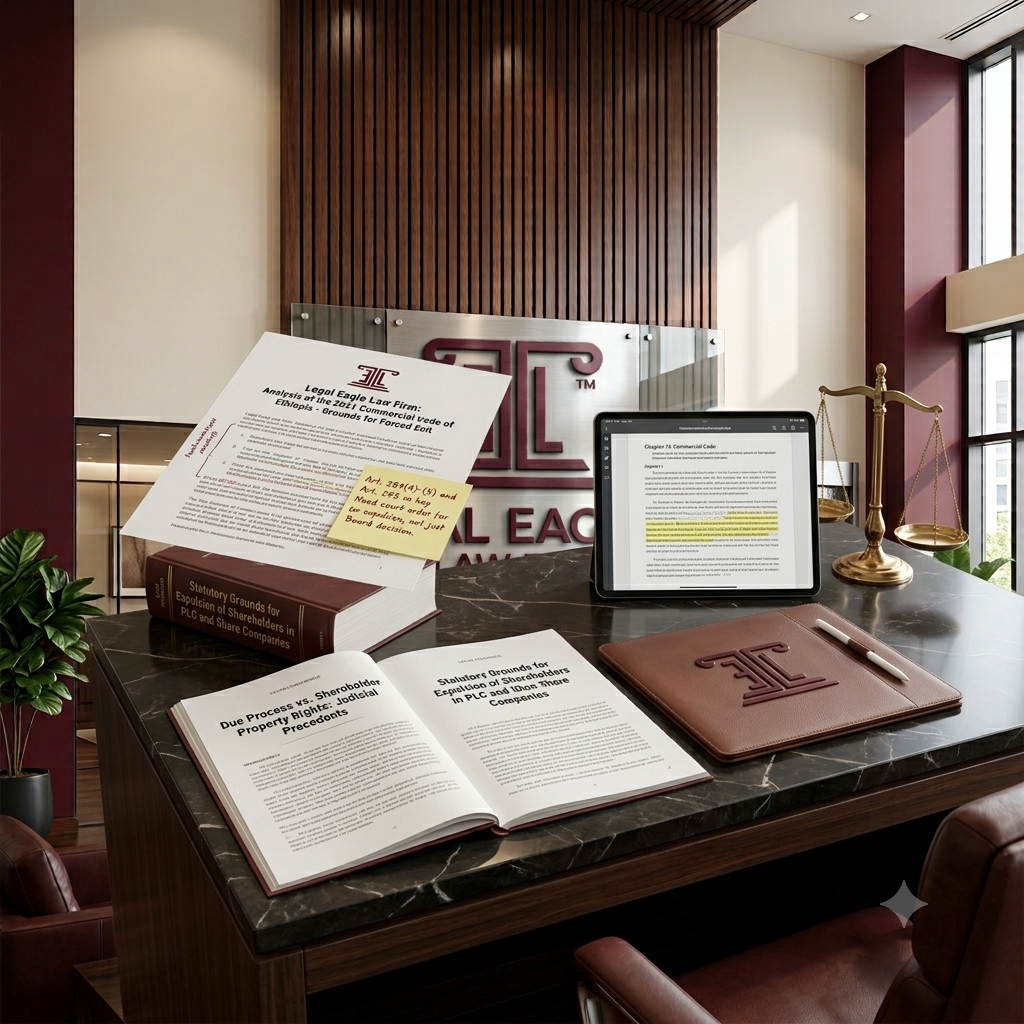
However, corporate friction, contractual defaults, and structural M&A changes happen. The 2021 Commercial Code of Ethiopia protects capital integrity and prevents corporate paralysis. It establishes three distinct legal paths that strip ownership by law. Below, we outline how this involuntary exit occurs, its triggers, and its exact statutory grounds.
Here is exactly how an involuntary exit occurs, the reasons behind it, and the precise statutory grounds under the revised Code.
1. The Financial Exit: Automatic Share Forfeiture
The most common involuntary exit has nothing to do with disputes. Lawsuits are also unnecessary. Instead, it is a direct consequence of failing to fulfill their financial contract with the company.
Upon establishing a Share Company (S.C.), subscribers can pay a fraction of the share value upfront. The law sets this minimum at 25%. Subscribers promise to pay the remaining balance when the Board makes a ‘call on capital.’
The Mechanism & Legal Ground:
If a shareholder fails to pay the remaining capital balance on the due date, the company does not need to take them to court. Instead, the Board activates an administrative process under Article 289 of the Commercial Code:
- The Notice: The Company issues a formal written warning demanding payment.
- The Auction: If 15 days pass from the date of the notice and the capital is still unpaid, the company gains the legal right to offer those delinquent shares for sale at a public auction (Article 289(4)).
- The Forfeiture: If the public auction fails to yield a buyer for the shares, the Board can formally decide to forfeit the shares entirely, keeping any amounts the shareholder had previously paid up as a penalty (Article 289(5)).
Crucial Note: The loss of rights happens even before the auction. From the exact moment a shareholder defaults on a capital call, they automatically lose their voting rights in all general meetings (Article 289(7)).
2. The Structural Exit: The 90% “Squeeze-Out” Rule
The 2021 Commercial Code introduced a modern chapter explicitly governing Groups of Companies (Parent-Subsidiary relationships). Within this framework sits a powerful corporate weapon designed to prevent tiny minority factions from blocking massive corporate restructurings, mergers, or takeovers.
The Mechanism & Legal Ground:
Under Article 558 (Right to Squeeze-out), if a single dominant shareholder or a parent holding company manages to acquire 90% or more of the total shares in a subsidiary company, they hold the legal right to buy out the remaining minority.
- How it Works: The 90% majority owner can formally exercise a squeeze-out right. Once activated, the clause legally compels the remaining minority owners to exit the company and surrender their shares. They cannot legally block the buyout.
- The Safeguard: Price protects the minority, not presence. The dominant owner must pay them “fair market value.” Mirroring this power, Article 562 (Right to Sell-Out) gives the minority the exact opposite right allowing them to force the 90% parent company to buy them out if they feel trapped.
3. The Judicial Exit: Expulsion for Serious Cause
A Private Limited Company (PLC) is fundamentally different from a public Share Company. A PLC is a hybrid corporate entity where the personal relationships, trust, and active cooperation between members are vital to the business’s survival.
When a member commits fraud, breaches their fiduciary duties, or acts in a way that completely paralyzes operations, the other members cannot simply vote to fire them. They must use the courts.
The Mechanism & Legal Ground:
The code addresses this through a multi-step legal bridge. While Article 531 allows a member to ask the court to dissolve the entire company for “good cause,” destroying a healthy business because of one bad actor is highly inefficient.
To solve this, the court invokes the general partnership rules incorporated into the PLC framework via Article 533:
- The Legal Ground: Article 243 (Expulsion of a Partner) explicitly states that if remaining members request the dissolution of an organization due to a single member’s severe fault, the court may order that member’s expulsion instead of dissolution.
- The Valuation: The court forcefully cuts the problematic member out of the business structure, values their equity stake as of the day of expulsion, and mandates that the remaining members or the company pay out their monetary worth.
Thus, The Commercial Code strictly mandates formal legal notices and due process across all three paths:
- Forfeiture requires an explicit 15-day warning timeline (Art. 289).
- Squeeze-outs require formal transactional notifications and legal windows (Art. 558).
- PLC expulsions require a full, contested judicial lawsuit where the target has the right to defend themselves (Art. 243).
If a company or a group of directors attempts to secretly delete a shareholder from the share registry without following these exact statutory mechanisms, the removal constitutes a severe violation of corporate law. The affected investor can immediately file suit to declare the action null and void, reinstate their shares, and claim significant damages.