Directive No. 1030/2024: A Framework for Public Capital Raising in Ethiopia
For decades, a company looking to raise capital from the Ethiopian public had no dedicated rulebook to follow. That changed with the establishment of the Ethiopian Capital Markets Authority (ECMA) and, more concretely, with the Public Offering and Trading of Securities Directive No. 1030/2024, issued in November 2024 under the Capital Market Proclamation No. 1248/2021. It now stands as the primary operational rulebook for anyone who wants to raise capital from the public through shares, debt securities, or other instruments in Ethiopia shaping who may raise capital, how they may do it, what they must disclose, and what happens when they get it wrong.
Registration Is the Starting Point
The Directive sets a simple but strict core rule: companies cannot offer, sell, list, quote, or trade any security on an exchange or over the counter without registering it with the Authority first. This blanket prohibition applies equally to private companies opening up to public investment and to public enterprises owned by the federal or regional governments.
Not every issuance needs to go through this process. The Directive exempts certain securities from registration altogether, including those guaranteed by the Federal Government, those offered outside Ethiopia, and importantly for smaller businesses securities offered through private placement, small offerings, or offerings limited to qualified investors, giving companies a lighter-touch path to raise money without the full weight of public registration, provided they stay within the limits set.
Who Can Raise Capital from the Public
Not every entity qualifies to make a public offer. The Issuer must be a share company under the Commercial Code, a company still under formation meeting the Directive’s requirements, a statutory body empowered by law to issue its own securities, a multilateral agency, or another entity approved by the Authority. Every issuer must also meet baseline governance standards, hold audited financial statements to the prescribed standard, be solvent, and issue freely transferable securities.
Getting Through the Registration Statement
Once an issuer confirms it is eligible, the real work begins: preparing a Registration Statement a letter from a duly authorized officer or Transaction Advisor, a prospectus or other offer document, and substantial supporting information, including commercial registration and licence copies, incorporation documents, board and shareholder resolutions, up to three years of audited annual reports, a valuation report, and summaries of material contracts. Applicants must submit their filings in Amharic or English, attach certified translations for other languages, and include proof of fee payment.
Central to this process is the Transaction Advisor, whose role the Directive treats as more than a formality. Where the issuer is a company still under formation, the Advisor must confirm to the Authority, at least every three months and again once registration is complete, that it has diligently carried out its responsibilities. Only prospectus-exempt offers can dispense with this appointment.
Two supporting documents draw particular scrutiny. Where proceeds will finance a specific project, a Feasibility Report identifying the preparing expert and their qualifications must accompany the application. Every registration statement must also feature an independent legal opinion. This opinion confirms that the issuer holds proper authorization, complies with capital structure laws, maintains required licenses, owns major assets, and executes valid underwriter contracts. If the Authority doubts a valuation report’s accuracy, it may require a second valuation, at the issuer’s expense.
Shelf Registration: Raising Capital in Stages
For established issuers, the Directive offers a more efficient alternative to registering afresh each time: Shelf Registration, which lets a qualifying issuer register a large capital-raising program once and draw on it in stages, rather than repeating the full process for every tranche.
The ECMA sets strict eligibility limits: issuers must maintain a three-year exchange listing, report disclosures on time, avoid loan defaults in the prior twelve months, and observe all capital market laws. The total value of a shelf offer must be at least Birr 5,000,000,000 (five billion). Once approved, a Shelf Registration remains valid for three years without renewal options, although statutory bodies and multilateral agencies hold indefinite validity unless the Authority specifies otherwise. This gives large, repeat issuers a faster route to subsequent offerings without sacrificing the Authority’s oversight.
The Prospectus: Ethiopia’s Core Disclosure Document
For most public offers, a prospectus approved by the Authority is non-negotiable: no one may sell, offer, or solicit the sale of securities to the public without one, unless the offer qualifies for an exemption from that obligation or the securities are exempt from registration.
Prospectus exemptions apply more narrowly than registration exemptions, protecting investors when issuers convert shares into a previously registered class, distribute free bonus shares to existing shareholders, or allocate shares to current employees. Even without a full prospectus, the issuer’s chosen offer document must avoid untrue, misleading, or materially incomplete information.Following approval, the issuer must publish the prospectus on its website within thirty calendar days and at least ten days before opening the offer. The issuer must host the file in an accessible, downloadable, and unalterable section for at least ten years.
Issuers must also publish an Abridged Prospectus in English and Amharic, summarizing historical financials, the shareholding and debt structure, key facts about the issuer and securities, and critically the risks of investing. The prospectus front page must display mandatory legal notices confirming compliance with the Proclamation and ECMA directives, security registration, and advisory guidance. Additionally, the issuer and senior officers must explicitly accept full responsibility for all disclosed facts.
The Authority strictly controls public offer advertising. Issuers cannot run an advertisement without prior ECMA clearance, and every ad must mention the prospectus location. Issuers must submit materials at least three business days prior to release, allowing the Authority time to require changes.
Closing the Loop: Allotment and Deregistration
The Directive does not stop regulating an offer once subscriptions come in. Issuers must file an Allotment Report, and within five business days of its approval, publish a summary of the results on their website. For exchange-listed securities, the Authority can delay the official listing date up to thirty business days after approval to maintain a final window of oversight. he Authority cancels unsubscribed securities from the registration record and coordinates their matching removal from the Central Securities Depository.
Raising Capital without Full Registration
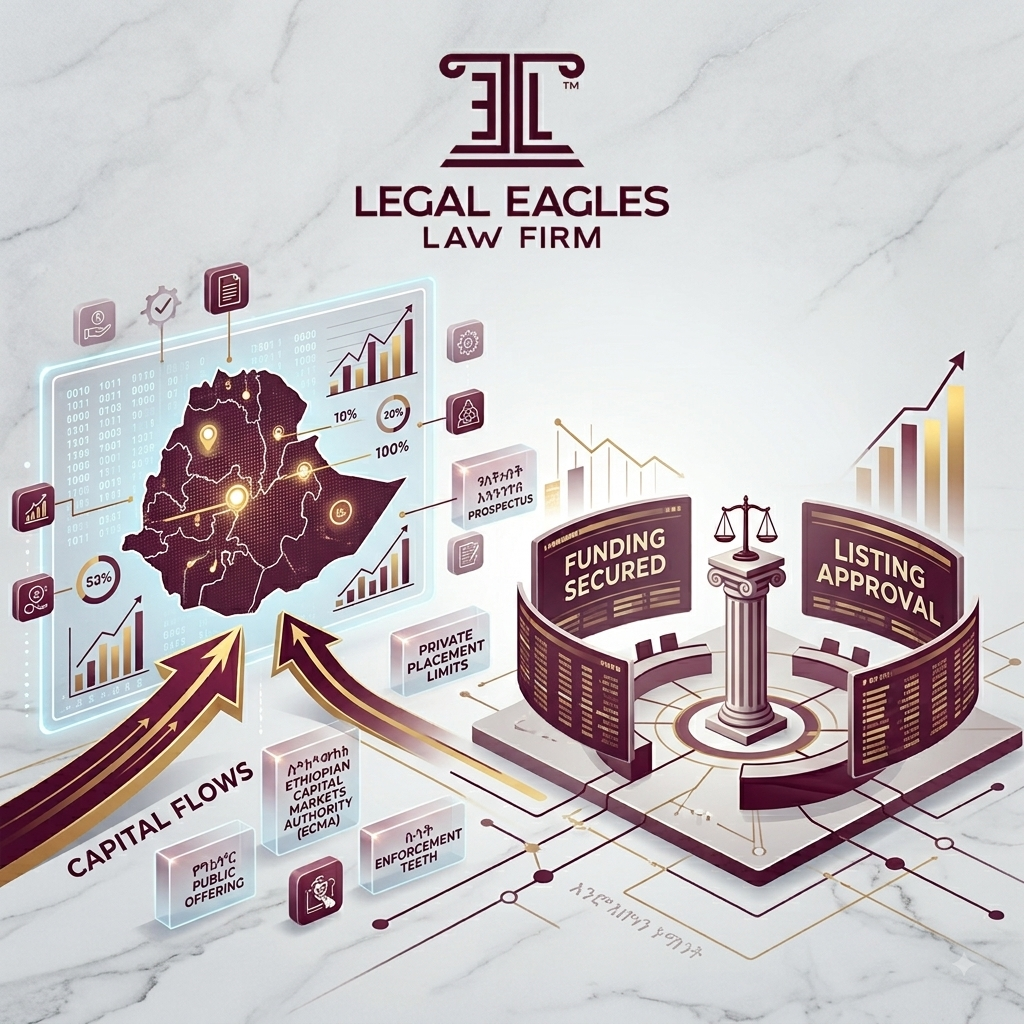
Recognizing that not every company needs, or can afford, the full public offering process, the Directive carves out three exempt routes, each with its own guardrails. Private placement allows an issuer to raise up to Birr 100,000,000 from fifty or fewer predetermined investors, provided the company never advertises the offer. The Directive caps qualified investor offers at 100 participants unless the ECMA grants a higher limit. Issuers must verify each investor’s status and secure signed risk acceptance statements. Small offerings let an issuer raise up to Birr 10,000,000 without registration or public advertising, though buyers face transfer restrictions unless they qualify as accredited investors or register the shares later.
Any issuer relying on one of these three exemptions must still notify the Authority within ten business days of closing the offer, disclosing who invested, how much each investor put in, and the total amount raised.
Where the Securities Trade Once Issued
Registration and disclosure are only half the picture. Investors and brokers can trade publicly offered or publicly held securities exclusively through a licensed securities exchange or a recognized over-the-counter market. Exchanges cannot suspend or delist a security without the Authority’s prior approval, and both the issuer and the exchange must publicly announce any suspension or delisting on their respective websites.
Enforcement Has Real Teeth
The Directive backs all of this with a graduated enforcement toolkit. For non-compliance, the Authority can issue public or private warnings, impose fines, suspend or revoke a security’s registration, restrain an issuer from making public offers, suspend trading, order corrective action, or blacklist an issuer, its senior management, or anyone else responsible. Separate provisions penalize unauthorized publications, unauthorized market activity, and late filing of offer-related and ongoing disclosure documents.
Why This Matters for Businesses and Investors
Directive No. 1030/2024 gives Ethiopia its first coherent framework governing how companies raise public money and how regulations safeguard capital moving through the market. For growing businesses, it sets out a real, if demanding, road-map to public capital and cheaper alternatives for those not yet ready for a full public offering. For investors, it means any security legitimately offered has passed through a process designed to catch inflated claims before money changes hands. This Directive remains a key document for any company, advisor, or investor to understand before raising or committing capital.