
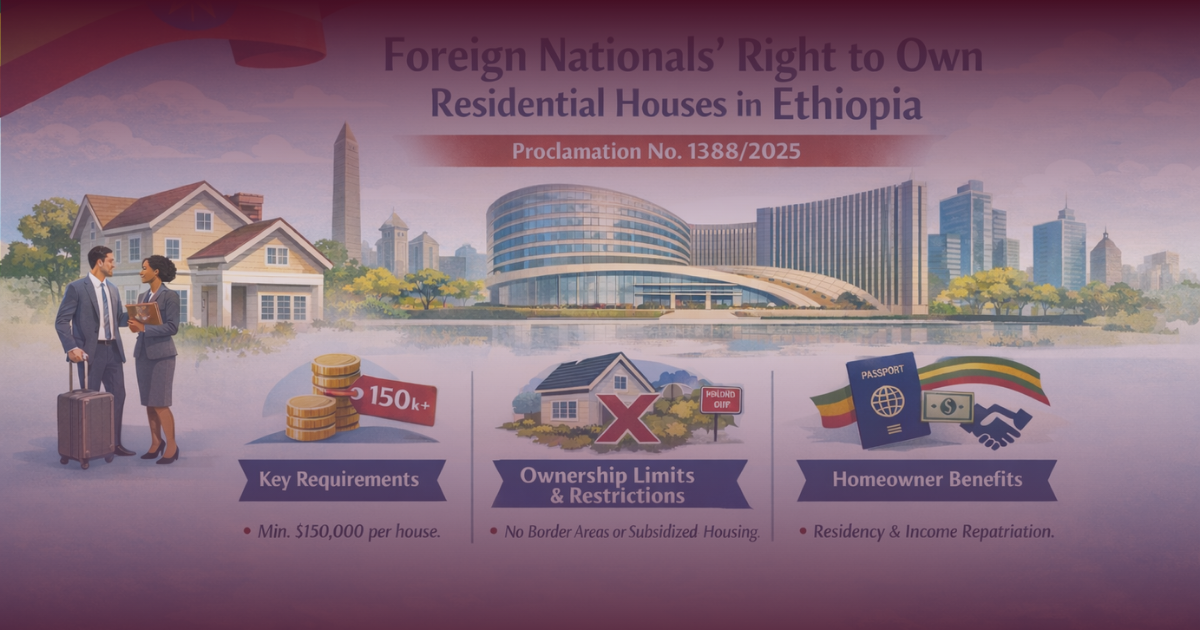
Foreign Nationals’ Right to Own Residential Houses in Ethiopia under Proclamation No. 1388/2025
Proclamation No. 1388/2025 introduced a new legal framework governing foreign nationals’ right to own residential houses in Ethiopia. The law clearly sets out the rights, conditions, and restrictions under which foreign nationals may acquire residential property.
As a result, understanding these legal requirements is essential for compliance and for making informed property decisions under Ethiopian law. In addition, we have attached the full PDF of Proclamation No. 1388/2025. This helps readers review the official legal text directly.
Who Can Own Property in Ethiopia?
Proclamation No. 1388/2025 defines foreign nationals as individuals who do not hold Ethiopian citizenship. However, the law also recognizes that certain categories of foreigners such as permanent residents or holders of investment permits may face additional regulatory requirements.
Moreover, in such cases, eligibility therefore depends not only on nationality status but also on full compliance with all applicable regulations.
What Property Can Foreign Nationals Own in Ethiopia?
Moreover, foreign nationals may own residential houses constructed on leased government land. However, direct ownership of land remains prohibited under Ethiopian law.
In addition, the law permits ownership strictly for personal residential purposes. Consequently, foreign nationals must clearly understand the limited scope of eligible properties.
Ownership Conditions and Financial Requirements
To qualify for residential property ownership in Ethiopia, foreign nationals must satisfy specific financial conditions. These conditions include:
- A minimum purchase price of USD 150,000 per residential house
- A limit on the number of houses a single foreign buyer may own
- The authority of the relevant Ministry to revise financial thresholds and regulatory requirements when necessary
Therefore, foreign buyers must continuously comply with updated directives and regulatory changes.
Restrictions and Prohibitions
Despite the expanded rights, the law imposes several important restrictions on foreign nationals’ property ownership in Ethiopia:
- Prohibition on ownership of subsidized condominium housing
- Restrictions on properties located in border areas or sensitive zones
- A ban on local bank financing, requiring transactions to be conducted in foreign currency
- A prohibition on using residential houses for commercial purposes
The law imposes these restrictions to protect national interests while allowing controlled access to property ownership.
Rights and Benefits for Foreign Homeowners
Under the legal framework, foreign homeowners enjoy several rights, including:
- Eligibility for residence permits and visas linked to property ownership
- The right to transfer rental income abroad
- Property rights comparable to those of Ethiopian citizens, subject to statutory limitations
Accordingly, the law seeks to balance access to ownership with appropriate regulation.
Obligations of Foreign Homeowners
Foreign nationals who own residential houses in Ethiopia must meet the following obligations:
- Payment of property purchases exclusively in foreign currency
- Timely settlement of government lease fees
- Full compliance with Ethiopian property, tax, and regulatory laws
Failure to meet these obligations may lead to legal or administrative consequences.
Application and Certification Process
To lawfully acquire residential property, foreign nationals must follow a formal process. This process includes:
- Submitting an application to the Ministry of Urban Development and Construction
- Verifying financial eligibility and regulatory compliance
- Obtaining an ownership certificate confirming adherence to Proclamation No. 1388/2025
Only after completing these steps does the law recognize ownership.
Reciprocity and Legal Effect
The proclamation also considers reciprocity arrangements. Accordingly, Ethiopian nationals may benefit from similar property ownership rights in foreign jurisdictions where reciprocal agreements exist.
Practical Takeaways for the Public
In summary:
- Foreign nationals may legally own residential houses in Ethiopia under regulated conditions
- Strict financial, administrative, and geographic rules apply
- Foreign property transactions require professional legal guidance
Proclamation No. 1388/2025 represents a major development in Ethiopia’s property law regime. Staying informed ensures secure, compliant, and well-structured property ownership for foreign buyers and investors.




Fantastic goods from you, man. I’ve keep in mind your stuff prior
to and you are simply too great. I actually like what you’ve received here, certainly like what you’re stating and
the best way wherein you say it. You make it enjoyable and you still take care of
to keep it smart. I can not wait to learn far more from you.
That is really a great web site.
Thank you for your kind words! We truly appreciate your support and are glad you find our content valuable. Stay tuned for more insights.