A Guided Brief for Reduced Workers: An Analysis of Cassation File No. 215086 (Haile Hotel and Resort Batu Branch v. Almaz Deriba et al.)
A practical guide for employees, with a note for employers, on termination after a business disruption under Ethiopian Labour Proclamation No. 1156/2019
The short answer
Many workers assume that if an employer repairs the damage, reopens, and rehires some staff, the earlier dismissal must have been unlawful. In File No. 215086, the Federal Supreme Court Cassation Bench said it is not that simple. The facts judge a termination as they stood on the day it happened, not by what the employer did afterward. The key question is whether normal operations could reasonably have resumed within 90 days.
This guide explains what that means for workers and what to do if you have been terminated. It also includes a short section for employers.
What happened in this case
After the civil unrest following the killing of artist Hachalu Hundessa, Haile Hotel and Resort (Batu Branch) suffered looting and fire damage and stopped operating. It terminated 26 workers, saying the damage, over 47 million ETB, made normal operations impossible.
The workers sued, arguing they were dismissed without proper notice. They pointed out that the hotel later renovated, reopened within a few months, and reinstated 14 of their colleagues through a reconciliation agreement.
Three lower courts (the Adami Tulu Woreda Court, the East Shewa Zone High Court, and the Oromia Supreme Court Cassation Bench) sided with the workers. They reasoned that because the hotel reopened, the closure was only temporary and the terminations were unlawful. The Woreda Court awarded 633,642.27 ETB in entitlements plus court costs.
The Federal Supreme Court Cassation Bench reversed these rulings and sent the case back to the Woreda Court. The lower courts had judged the case in hindsight and had not examined how serious the disruption was when the terminations took place.
What this means for workers: a later reopening helps your argument but does not win the case on its own. You need evidence about the situation at the time you were terminated.
Know your rights: three legal pathways
Proclamation No. 1156/2019 treats a business interruption in one of three ways. Knowing which one your employer is relying on is the first step in protecting yourself.
1. Temporary suspension (Arts. 17–22)
- If force majeure stops the business from operating, fully or partly, for more than 10 consecutive days, your contract is not automatically terminated (Art. 18(5)).
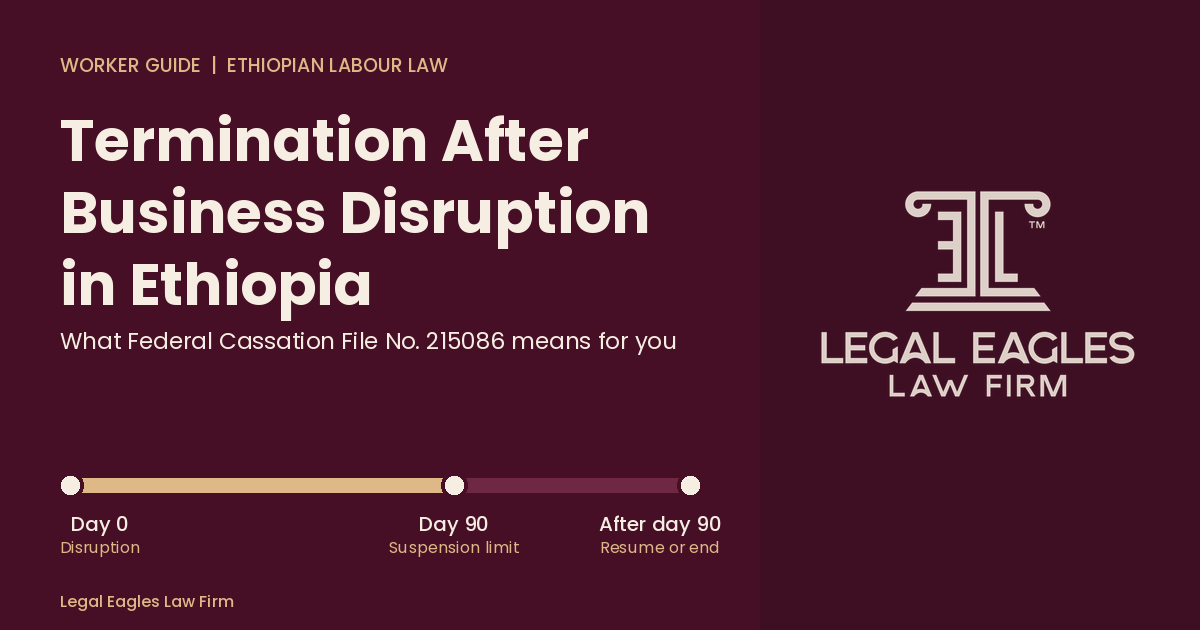
- After notifying the labour authority, the employer may suspend work and wages for up to 90 days.
- If the authority finds that work cannot resume within that period, the contract ends and you are entitled to statutory payments (Art. 21(2); Arts. 39 and 44).
2. Permanent closure (Art. 24(4))
- If the business permanently ceases operations, whether through bankruptcy or any other cause, contracts end by operation of law.
3. Termination on operational or organizational grounds (Art. 28(3) (a))
- An employer may terminate with notice when operational or organizational reasons directly and permanently halt the specific work you do.
What the Cassation Bench’s reasoning means in practice
- Timing matters. The court asks whether there were sufficient grounds on the day the contract ended. A later reopening or settlement does not by itself prove a termination was unlawful.
- The 90-day benchmark applies even if the suspension procedure was never followed. Courts apply Articles 18(5) and 21 by analogy (mutatis mutandis) and ask whether normal operations could reasonably have resumed within 90 days.
- If recovery within 90 days was realistic, an immediate termination is improper. The employer should have used suspension instead.
- If recovery would take substantially longer, the Bench said that requiring an employer with no revenue and no usable premises to pay wages indefinitely runs against Article 54(1) and the productivity aims of the Proclamation.
- Evidence decides the case. Courts must frame concrete issues about how long the disruption was expected to last and weigh objective evidence, such as government damage assessments and expert testimony. Broad assumptions about whether a closure was “temporary” or “permanent” are not enough.
- Notice and payments are still required. Even a justified termination requires proper notice (Art. 35) and payment of severance and terminal benefits (Arts. 39 and 44).
Practical action guide: if you have been terminated
- Secure your documents immediately. Collect your employment contract, recent pay slips, termination notice, posted workplace announcements, and bank transfer records.
- Record the termination date and the stated ground. Note whether your employer cited force majeure suspension (Arts. 18–21), permanent closure (Art. 24(4)), or operational reduction with notice (Art. 28(3) (a)). The date matters because your case is judged as of that day.
- Check your final payout and notice. Confirm that any payment at termination is itemized. A routine salary deposit does not replace notice pay (Art. 35), severance pay (Art. 39), or compensation for unused annual leave.
- Gather evidence of the business’s actual condition. Document how severe the halt really was, any government or labour office inspection findings, and whether specific departments kept operating or reopened within 90 days. Photos, messages, and the names of colleagues who can confirm what happened all help.
- Act promptly. Labour claims are subject to time limits, so seek advice before signing any waiver or settlement agreement. Signing may give up rights you cannot get back.
A note for employers
This decision gives employers room to justify a crisis-driven termination, but only with proof. If your business is hit by a disruption:
- Document the crisis as it happens. Damage assessments, insurance reports, and expert opinions on the recovery timeline are your strongest evidence.
- Use the suspension procedure where recovery looks realistic within 90 days. Notify the labour authority rather than terminating immediately.
- Do not skip the basics. Even a justified termination requires proper notice and statutory payments.
- Think carefully about later reinstatement or settlements. The Bench held these do not automatically make an earlier termination unlawful, but they will be raised against you, and clear records of your reasoning at the time will matter.
Case details
- Court: Federal Supreme Court of Ethiopia, Cassation Bench
- File No.: 215086 (lower files: Adami Tulu Woreda Court No. 38084; East Shewa Zone High Court No. 62280; Oromia Supreme Court Cassation No. 376870)
- Decision date: Tir 27, 2014 E.C. (February 4, 2022)
- Parties: Haile Hotel and Resort Batu Branch (applicant) v. Almaz Deriba et al. (26 employees, respondents)
- Main provisions: Labour Proclamation No. 1156/2019, Arts. 12(1), 17–22, 18(5), 21(2), 24(4), 28(1)(a), 28(3)(a), 35, 39, 44, 54(1); Civil Procedure Code, Arts. 246–248, 251–252, 258–260, 343(1), 348(1); Civil Code, Art. 2001