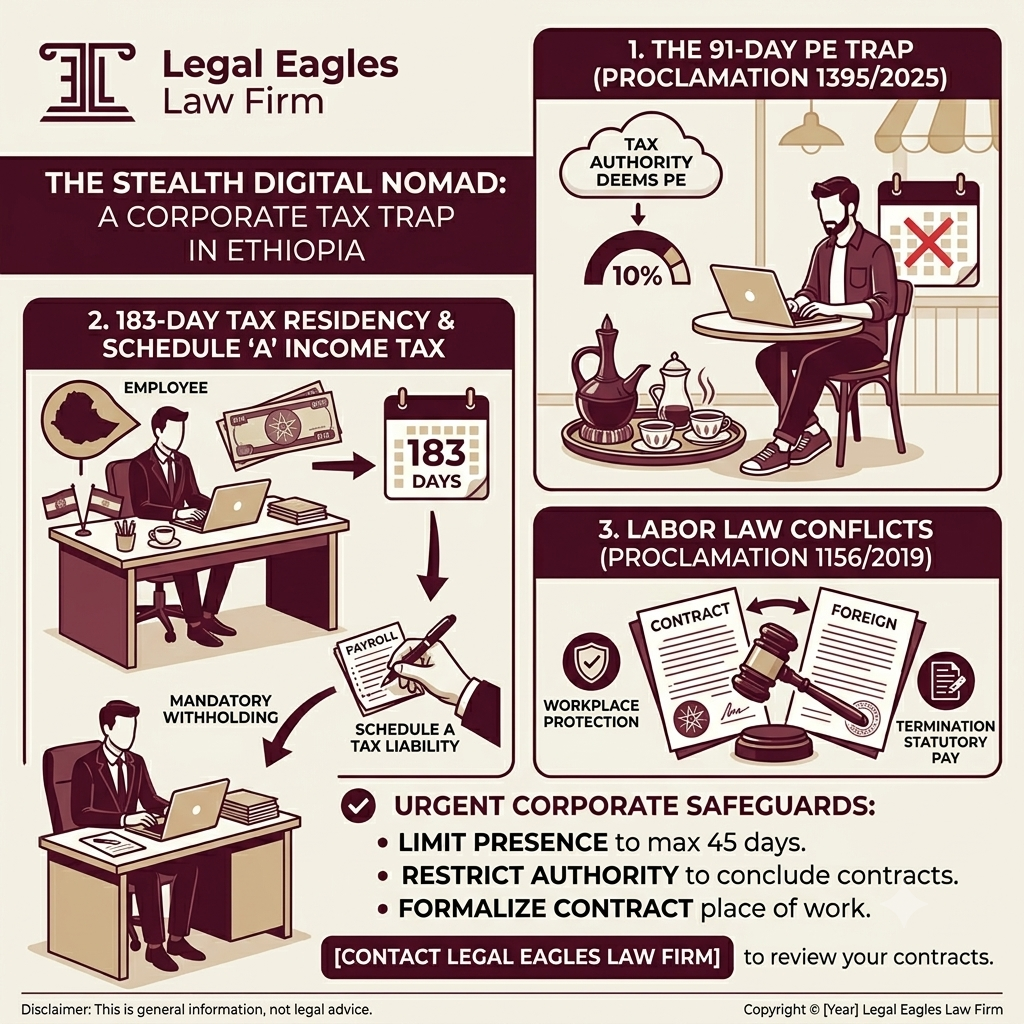
The Stealth Digital Nomad: The Nightmare Corporate Tax Trap Facing Ethiopian Businesses
For years, hiring a remote workers in Addis Ababa or letting a key manager work from a laptop in a different region seemed like the ultimate win-win. It bypassed traditional office overhead, kept top talent happy, and required nothing more than a solid internet connection.
But the borderless workforce has officially run into a hard wall of regulatory enforcement.
With the recent enactment of the Income Tax (Amendment) Proclamation No. 1395/2025, the Federal Democratic Republic of Ethiopia has radically modernized its tax net. What human resource department’s view as an innovative perk, the Ministry of Finance and the Ministry of Labor and Skills now view as a highly visible, taxable corporate presence.
Whether you are a foreign enterprise leveraging local digital talent, or an Ethiopian firm permitting employees to move across regional borders or international boundaries, an unmanaged remote worker is no longer just an HR detail it is a significant corporate liability.
Here are the three specific legal and tax landmines currently facing companies with a distributed workforce in Ethiopia.
The 91-Day “Permanent Establishment” Trap
The most significant shift comes from the Income Tax (Amendment) Proclamation No. 1395/2025, which explicitly expanded the tax net by cutting the minimum presence threshold required to create a Permanent Establishment exactly in half.
Historically, a foreign business only triggered a taxable Permanent establishment if their activities or employees stayed in Ethiopia for more than 183 days.
The New 91-Day Rule: Under Proclamation No. 1395/2025, if a person provides services—including technical, IT, legal, or consultancy services—through employees or engaged personnel in Ethiopia, and those services continue for an aggregate of more than 91 days within any one-year period, the tax authority legally deems that foreign entity to have a Permanent Establishment.
If a foreign company’s remote worker quietly logs just 3 months of work from a place in Addis Ababa, the parent company faces:
- Immediate exposure to Ethiopia’s standard 30% Corporate Income Tax on business income attributed to that local presence.
- A newly updated 15% tax on repatriated or undistributed profits applies if the company fails to reinvest those funds within 12 months (an increase from the old 10% rate).
- Heavy compliance penalties for failing to register a corporate entity with the Ministry of Trade and Regional Integration.
2. Schedule “A” Income Tax and the 183-Day Residency Rule
Under Federal Income Tax Proclamation No. 979/2016, the physical location of the work fundamentally drives employment income tax (Schedule A), rather than the country of corporate registration or bank account location.
According to Article 5 of the Proclamation, any individual who is present in Ethiopia, continuously or intermittently, for more than 183 days in a twelve-month period automatically becomes an Ethiopian tax resident.
The moment an employee crosses this 183-day mark:
- They are liable to pay Ethiopian employment income tax on their worldwide income.
- The law legally obligates the employer to withhold Schedule A taxes directly from the employee’s monthly pay using the newly revised progressive brackets (which top out at 35% for monthly earnings over 14,000 ETB).
- Failing to withhold means the employer bears the direct financial liability for the unpaid tax, plus steep administrative penalties under the Tax Administration Proclamation No. 983/2016.
3. Jurisdiction Conflicts under Labor Proclamation No. 1156/2019
Taxes represent only part of the legal risk; the situation also heavily impacts labor law compliance. Under Labor Proclamation No. 1156/2019, an employment contract must clearly define the specific place of work.
If an Ethiopian company permits an employee to move to a different country or jurisdiction without formal modifications, a massive gray area opens up regarding statutory protections. Conversely, if a foreign digital nomad works from an Ethiopian location long enough to trigger local employment protection, they may suddenly gain access to strict Ethiopian statutory termination protections, mandatory severance pay, and dispute resolution frameworks via local Labor Relations Boards regardless of what their original foreign contract says.
How to Protect Your Organization: A 3-Step Compliance Checklist
To prevent remote work flexibility from turning into an operational crisis, businesses should implement structured corporate safeguards:
- Enforce Hard Presence Limits: Limit international or inter-regional remote work permissions to a strict maximum of 30 to 45 days per year. This ensures the employee stays safely below both the 91-day Permanent Establishment service threshold and the 183-day tax residency limit.
- Restrict Contractual Authority: Explicitly state in all remote work agreements that the employee does not possess the authority to conclude contracts, negotiate commercial terms, or bind the company while operating outside the primary corporate jurisdiction.
- Formalize Inter-Regional Work Locations: For domestic remote workers moving between regional states in Ethiopia, ensure employment contract amendments clearly specify the tax-withholding office to avoid payroll alignment errors between regional tax bureaus.