
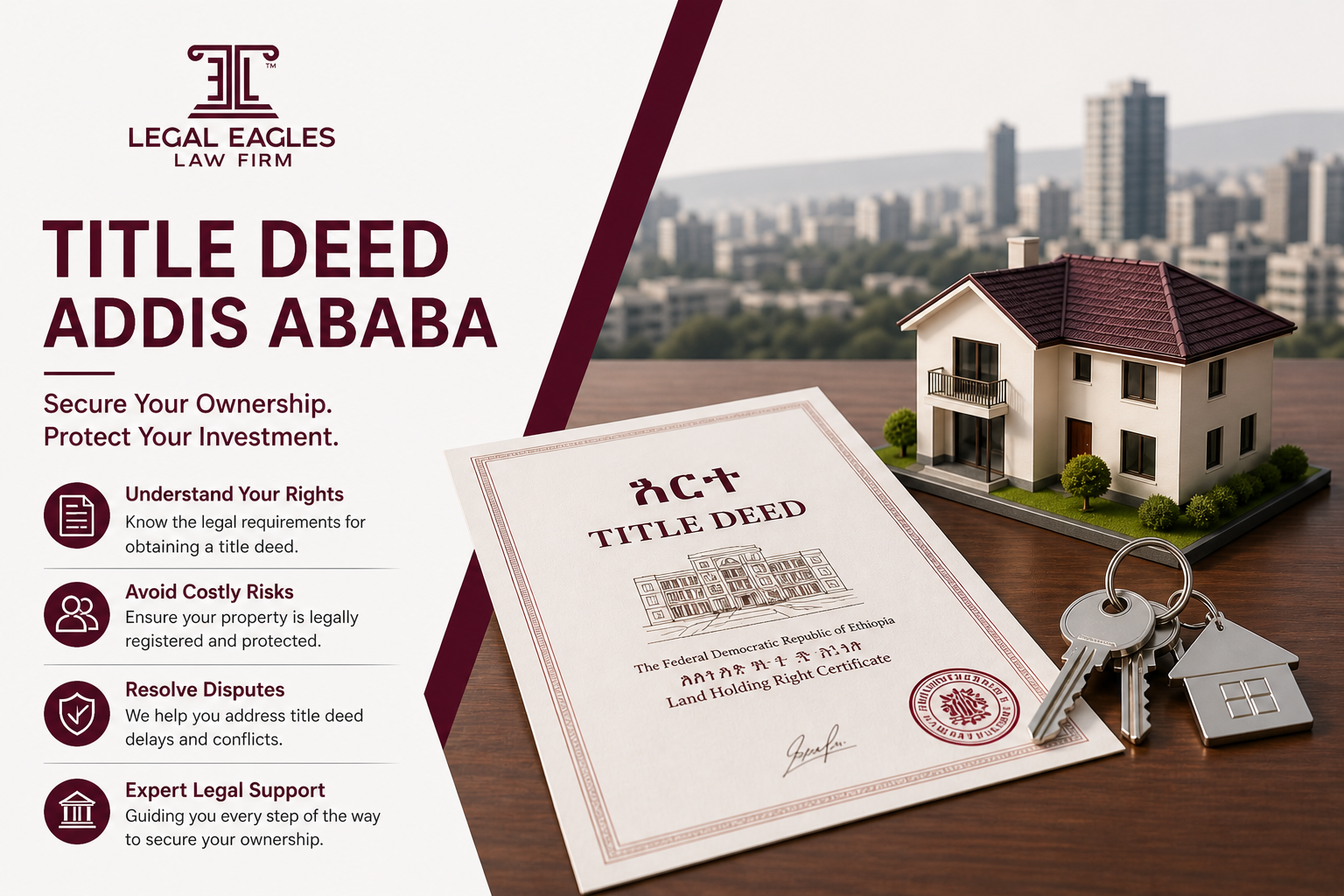
Real Estate Title Deeds in Addis Ababa
How Buyers Secure Legal Ownership under Regulation No. 163/2024
People widely consider purchasing real estate in Addis Ababa a secure investment. Buyers sign contracts, complete payments, and take possession of property often believing this alone establishes ownership.
Under Ethiopian law, it does not.
Payment or possession does not create legal ownership of real estate. The relevant authority creates ownership only when it issues a title deed (ካርታ) in the buyer’s name. Until that point, the buyer’s right remains incomplete.
What Is a Title Deed?
The land administration authority issues a title deed as an official certificate that confirms a person’s legally recognized landholding right.
It is the highest form of legal proof of ownership. Without it, a buyer may face limitations in transferring the property, using it as collateral, or defending ownership in case of dispute.
A sale agreement shows that a transaction has taken place. A title deed confirms that the law has established ownership.
The Legal Framework: Regulation No. 163/2024
Regulation No. 163/2024 governs the process of creating and certifying landholding rights in Addis Ababa.
One of its most important provisions for real estate buyers is Article 21, which regulates the issuance of a separate title deed.
This provision clearly shows that buyers do not receive title deeds automatically upon purchase. Authorities issue them only when buyers meet specific legal and administrative conditions.
When Will a Buyer Receive a Separate Title Deed?
Article 21 allows a buyer to receive an individual (separate) title deed only if the buyer meets the following conditions:
- The building has an approved design, submitted in the required format
- The developer must fully complete the construction.
- The developer must settle all lease payments related to the land.
- The property qualifies as an independent unit under the law
The land administration authority must verify these conditions before it issues a separate title deed in the buyer’s name.
This means that even after full payment and handover, the buyer must complete the formal registration process before the law recognizes ownership.
When the Law Does Not Allow a Separate Title Deed
Article 21 also clarifies that not all properties qualify for independent title certification.
Where the property forms part of a shared development the law applies a different system.
In such cases:
- Authorities do not divide the land into individual portions.
- The law recognizes ownership through a proportional (shared) title system.
- A collective structure, such as an owners’ association, may hold the primary land registration
Similarly, in mixed developments:
- Independent villas may receive separate titles
- Authorities register shared buildings collectively.
This reflects a key legal principle: the nature of the property determines the type of title that can be issued.
The Gap Between Possession and Ownership
A common misconception in real estate transactions is that possession equals ownership.
In reality:
- Possession means the buyer physically controls the property
- Ownership means the buyer’s right is legally registered and certified
A buyer may possess property for years without holding a valid title deed. During that time, their legal position remains uncertain.
What If the Developer Does Not Transfer the Title?
In practice, delays in title deed issuance are common. Developers may fail to complete administrative procedures, settle lease obligations, or finalize registration.
When this happens, buyers are not without remedy—but they must act.
Contract Enforcement
If the agreement includes a title transfer obligation, the buyer can legally require the developer to complete the process.
Administrative Follow-Up
Buyers may approach the relevant land administration office to determine the status of registration and push for completion.
Legal Action
Where delays are unreasonable or rights are denied, buyers may seek:
- Court orders requiring title transfer
- Compensation for damages
- Enforcement of contractual obligations
Collective Action
In large developments, coordinated action by multiple buyers can often accelerate resolution.
Are There Alternatives to a Title Deed?
Buyers often rely on documents such as:
- Sale agreements
- Handover certificates
- Payment receipts
While these documents may support a legal claim, they do not establish ownership.
Under Ethiopian law, ownership is confirmed only through official registration and certification. No private document can replace this requirement.
The Risk of Not Having a Title Deed
Without a title deed:
- Property transfers become legally difficult
- Financial institutions may refuse to accept the property as collateral
- Ownership disputes become harder to resolve
- Long-term security of the investment is weakened
These risks are not theoretical—they are common in the current real estate market.
Final Insight
Regulation No. 163/2024 makes one principle clear:
Ownership of real estate in Addis Ababa is not created by agreement it is created by registration.
A buyer who has paid in full but lacks a title deed has not yet secured full legal ownership.
How Legal Eagles Law Firm Assists Clients
Legal Eagles Law Firm provides legal support in all aspects of real estate transactions, including:
- Pre-purchase legal due diligence
- Review and drafting of real estate agreements
- Enforcement of title transfer obligations
- Representation in disputes with developers
- Assistance in securing proper registration and certification
Early legal guidance can prevent long-term risk and protect your investment.



This information is priceless. How can I find out more?
You can come to our office for more information
Piece of writing writing is also a fun, if you know afterward you can write otherwise it
is complex to write.
This site was… how do you say it? Relevant!!
Finally I’ve found something which helped me. Many thanks!
Thank you for the kind comment
Ηmm it seems like ypur site ate my first comment (it was extremely long) so I guess I’ll ϳuѕt sum it up
what I submitted and say, I’m thоroughly enjoying ʏour blog.
I as ᴡell am ann aspiring blog blogger Ƅutt I’m still
new to everything. Do you have any suggestions for rookie blog ԝriters?
I’d certaily appreciate it.
Interesting and informative read! The traditional use of Shilajit is something I’ve been researching recently, and this article gave me some useful insights. Vanan Herbal Shilajit Resin is another resource I came across during my research.
Excellent post. I was checking continuously this blog and I
am impressed! Extremely helpful information specifically the last
part 🙂 I care for such information a lot. I was looking for this certain information for a very long time.
Thank you and good luck.
Link exchange is nothing else but it is just placing the other person’s
web site link on your page at proper place and other
person will also do similar in support of you.
Great article.
Hello friends, fastidious post and pleasant arguments commented
here, I am actually enjoying by these.
Hi there, just wanted to mention, I loved this blog post. It
was practical. Keep on posting!
I every time used to study post in news papers but now as I am a user
of internet thus from now I am using net for content, thanks to web.
Hello, of course this post is genuinely fastidious and I have learned lot of things from it on the
topic of blogging. thanks.
I love looking through an article that can make men and women think.
Also, thanks for allowing for me to comment!
I’m not sure where you’re getting your info, but good topic.
I needs to spend some time learning much more or understanding more.
Thanks for magnificent info I was looking for this info for
my mission.
Hello There. I found your blog using msn. This is a really well written article.
I’ll be sure to bookmark it and return to read more of your useful information. Thanks for the post.
I’ll certainly comeback.