Multimodal Transport Of Goods: Contracts and Liability Explained
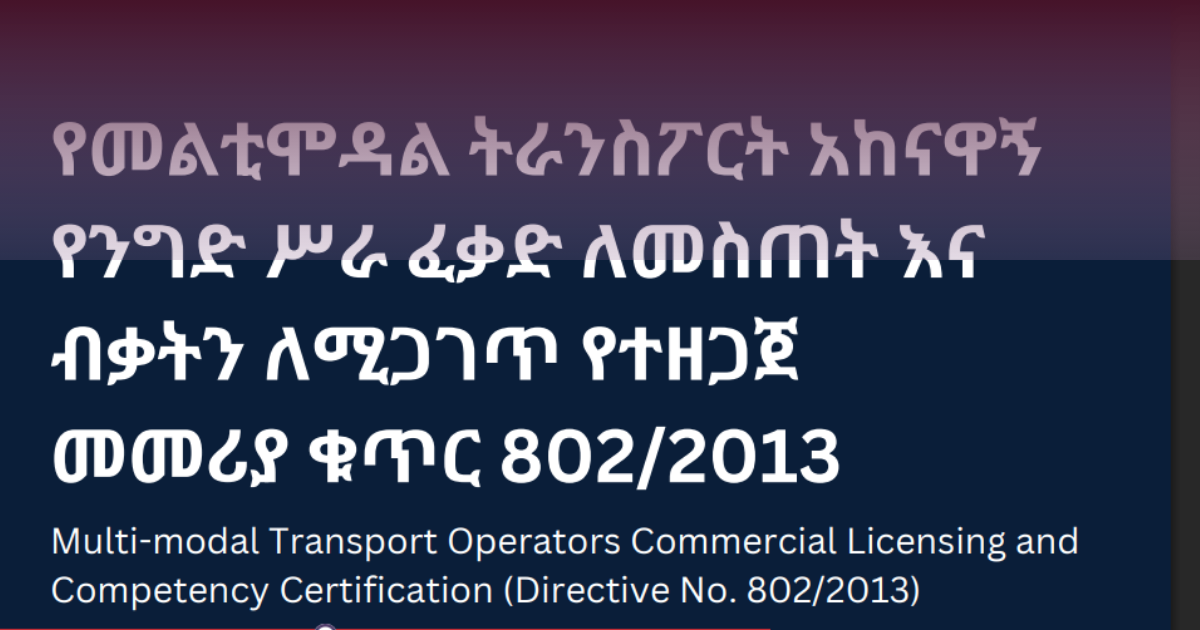
Ethiopia’s Multimodal Transport of Goods Proclamation No. 548/2007 sets a legal framework for transporting goods under a single contract using multiple modes (road, rail, sea, or air). Directive No. 802/2023 regulates licensing and competency certification of MTOs to ensure only qualified operators serve in the sector.
What Is a Multimodal Transport Contract?
A multimodal transport contract is an agreement in which an international MTO, for freight payment, undertakes to perform or arrange carriage using at least two different transport modes under a single contract.
Who Is an MTO?
A Multimodal Transport Operator (MTO) is an entity that concludes the contract in its own name and assumes full responsibility for performing or arranging the transport. They act as a principal, not merely as an agent.
Liability of the MTO
- General Basis of Liability (Article 17):
The MTO is liable for loss, damage, or delay if it occurs while the goods are in its custody.
- Basis of Liability Under Article 17(3):
Under Article 17(3) of the Proclamation, the MTO is presumed liable unless it proves all reasonable measures were taken to prevent the loss. The burden of proof lies on the MTO, so the claimant does not need to prove fault.
- Hybrid Liability System:
- If the specific stage of transport where the loss or damage occurred is known and governed by a different applicable law with a higher liability standard, that law applies.
- If the stage is unknown, the proclamation’s unified rules govern liability.
- Limitation of Liability:
The law allows limitation of liability unless the loss, damage, or delay resulted from intentional or reckless conduct.
Role of Directive No. 802/2023
Directive No. 802/2023 strengthens the legal framework by requiring MTOs to hold a commercial license and competency certificate, ensuring operators have the financial and technical capacity to perform multimodal transport services professionally.
Conclusion
Ethiopia’s multimodal transport regime simplifies logistics by providing a single contract and a clear liability structure. Article 17 (3) importantly places the burden of proof on the MTO, promoting higher standards of care and protection for consignors and consignees. Meanwhile, Directive No. 802/2023 ensures that only licensed, competent operators serve in the sector, enhancing reliability and compliance.