What You Don’t Know about Ethiopia’s Labour and Employment Law
Employment Actions the Law Does Not Expressly Mention but Still Regulates Indirectly
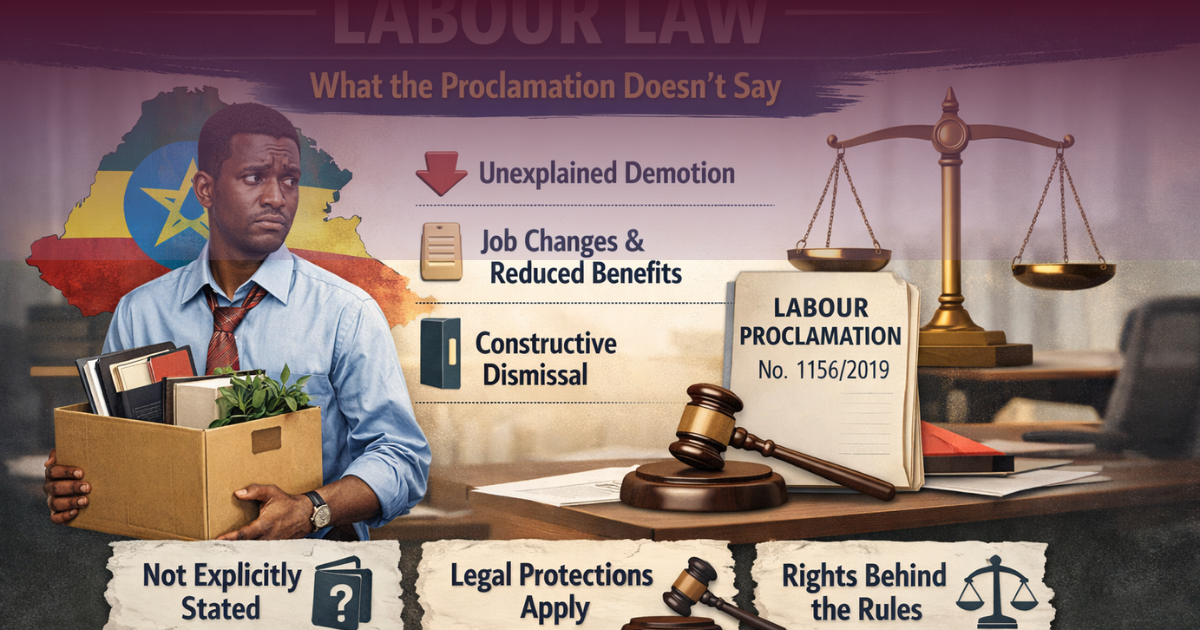
Ethiopia’s Labour Proclamation No. 1156/2019 is detailed on matters such as wages, working hours, leave, and termination. However, some common workplace actions like demotion or downgrading responsibilities are not expressly named or defined in the Proclamation.
This does not mean they are unregulated.
In reality, the Proclamation indirectly governs these actions through its core rules and protections.
Demotion: Not Expressly Stated, but Not Unregulated
The Labour Proclamation does not contain a specific article titled “Demotion.” However, demotion is implicitly addressed through provisions on:
- Variation of employment conditions
- Wage protection
- Unlawful disciplinary measures
- Termination disguised as management action
A demotion that results in:
- reduction of wages,
- loss of benefits,
- humiliation or punishment without due process,
may be treated as unlawful alteration of employment conditions or even constructive termination, depending on its effect.
Unilateral Change of Employment Conditions
Under the Proclamation, an employer cannot unilaterally change fundamental terms of employment. While the law does not list “demotion” as a prohibited act, it clearly protects:
- agreed job position,
- agreed remuneration,
- agreed duties and grade.
Any employer action that substantially alters these elements without the worker’s consent or lawful justification may violate the Proclamation.
Discipline Must Follow Legal Grounds
The Proclamation strictly regulates grounds for disciplinary action and termination. Employers are expected to act within these grounds.
When demotion is used as a punitive tool instead of:
- issuing lawful warnings,
- following disciplinary procedures,
- or applying proportionate sanctions,
it may be considered an illegal disciplinary measure, even though the word “demotion” is not used in the law.
Protection against Indirect Termination
The Proclamation recognizes termination not only in its formal sense, but also through employer actions that make continued employment unreasonable.
Thus, repeated demotion, stripping duties, or degrading an employee’s role may be interpreted as:
- indirect termination, or
- termination without lawful cause,
Which is prohibited under Ethiopian labour law.
The Law Protects Substance Over Labels
Ethiopian labour law focuses on the actual effect of an employer’s action, not the label attached to it.
So even if an employer calls an action:
- “reassignment,”
- “organizational restructuring,” or
- “management decision,”
labour authorities and courts may still assess whether it:
- violates wage protections,
- undermines job security,
- or circumvents termination rules.
Conclusion
Although the Ethiopian Labour Proclamation No. 1156/2019 does not expressly regulate demotion or similar actions, it indirectly acknowledges and controls them through its rules on job security, wage protection, disciplinary fairness, and termination.
In Ethiopian labour law, what matters is not whether an action is named but whether it unlawfully affects the worker’s rights.