Regulatory Analysis: The ECMA Draft Crowdfunding Directive and Its Institutional Role in Ethiopia’s Financial Ecosystem
The ECMA issued its Draft Crowdfunding Directive for public consultation. It acted under Proclamation No. 1248/2021.
This Directive marks a pivotal regulatory milestone in Ethiopia’s financial architecture. The ECMA now regulates online equity and debt offerings. This creates a safe gateway connecting MSMEs with capital.
This analysis examines the draft instrument, statutory obligations, socio-economic impact, and operational synergy with the ESX.
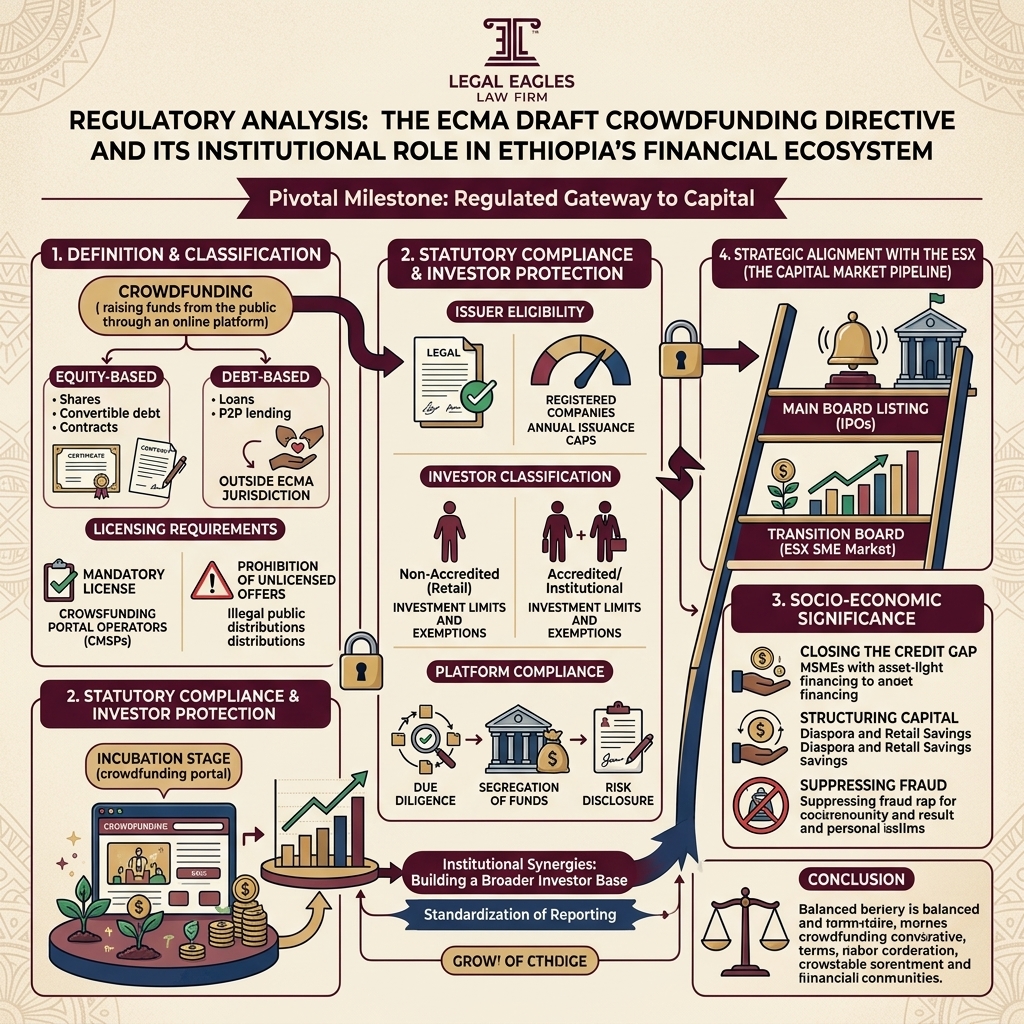
1. Statutory Definition & Regulatory Classification of Crowdfunding
Under the framework established by Proclamation No. 1248/2021 and the provisions of the Draft Directive, crowdfunding pursuant to article 2(7) defined it as the process of raising funds to finance a project or business from the public through an online platform.
Scope of Regulation
The Directive governs two primary financial crowdfunding categories:
- Equity-Based Crowdfunding: Equity crowdfunding involves issuing ordinary shares, preference shares, or convertible debt via an online platform.
- Debt-Based Crowdfunding (Marketplace / Peer-to-Peer Lending): Debt crowdfunding involves issuing debentures with a commitment to repay principal and interest.
Donation and reward crowdfunding fall outside securities law. They do not offer financial returns or investment yields.
Licensing Requirements for Portal Operators
Operators must hold a valid ECMA Crowdfunding Portal Operator License before targeting Ethiopian residents
- Mandatory Licensing: Unlicensed online solicitations violate Article 107 of Proclamation No. 1248/2021. This includes offshore and social media schemes.
- Prohibition of Unlicensed Offers: The Draft Directive sets clear compliance mandates. It balances early-stage startup capital formation with investor protection.
2. Statutory Compliance & Investor Protection Framework
Capital raising is restricted to registered Ethiopian companies. Issuers must also maintain transparent corporate governance structures.
Issuer Eligibility and Fundraising Limits
- Issuer Qualification: Regulated capital raising is restricted to Ethiopian private limited companies or share companies.
- Annual Aggregate Issuance Caps: The Directive sets strict monetary ceilings. It limits the total capital an issuer can raise within 12 months. This cap prevents issuers from bypassing the full prospectus disclosure rules required for main market public offerings.
Investor Classification and Investment Limits
- Non-Accredited (Retail) Investors: Issuers must also demonstrate transparent corporate governance structures before listing offerings..
- Accredited and Institutional Investors: The Directive enforces mandatory annual investment caps based on investor net worth or income.
Platform Compliance and Fiduciary Duties
Crowdfunding portal operators must abide by rigorous operational and fiduciary standards:
- Due Diligence and Disclosure Verification: Portal operators must independently verify investor financial sophistication prior to granting exemptions.
- Segregation of Funds: Portal operators are prohibited from directly holding investor funds. All monetary transactions must be processed via independent, licensed escrow agents or commercial banks.
- Risk Disclosure Mandates: Portals must conduct background checks, verify disclosures, and confirm management fitness for each issuer.
3. Socio-Economic Significance for Ethiopia
The formal legal acknowledgment of crowdfunding addresses long-standing structural challenges in Ethiopia’s domestic economy:
- Closing the Early-Stage Credit Gap: Investors must sign explicit risk notices regarding illiquidity, capital loss, and limited secondary trading. Regulated crowdfunding offers an asset-light, equity- or revenue-based capital alternative.
- Structuring Diaspora and Retail Capital: Early-stage startups often fail commercial bank collateral requirements exceeding 100% fixed asset coverage.
- Suppressing Unregulated Solicitations: Crowdfunding directs retail savings and diaspora remittances into productive businesses instead of idle assets.
4. Strategic Alignment with the Ethiopian Securities Exchange (ESX)
The Crowdfunding Directive serves as an essential legal foundation for the broader capital market pipeline centered on the Ethiopian Securities Exchange (ESX).
The Capital Ladder Framework
- Incubation Stage (Crowdfunding Portals): Early-stage startups raise initial growth capital on regulated crowdfunding platforms while building corporate governance, financial audit track records, and investor disclosure discipline.
- Transition Board (ESX SME Market): As businesses mature and exceed crowdfunding issuance caps, they transition to the ESX’s specialized Growth/SME market board, leveraging their established shareholder base.
- Main Board Listing: Mature enterprises eventually conduct formal Public Offerings (IPOs) and list on the ESX Main Board.
Institutional Synergies
- Market Liquidity and Participation: Crowdfunding introduces individual retail investors to formal capital market operations, building a broader investor base that improves secondary market trading liquidity on the ESX.
- Standardization of Corporate Reporting: By instilling reporting discipline at the seed-stage level, crowdfunding reduces the compliance costs and legal frictions associated with subsequent listings on public securities exchanges.
Conclusion
The ECMA Draft Crowdfunding Directive transitions online venture financing from an unregulated legal grey area into a structured capital market channel. By defining statutory responsibilities for portal operators, limiting retail investor risk, and aligning early-stage capital formation with the long-term growth of the ESX, the Directive establishes a balanced foundation for financial innovation and investor protection across Ethiopia.