Understanding Money Market Instruments & Collective Investment Schemes in Ethiopia: A Legal & Regulatory Analysis under Directive No. 1150/2026
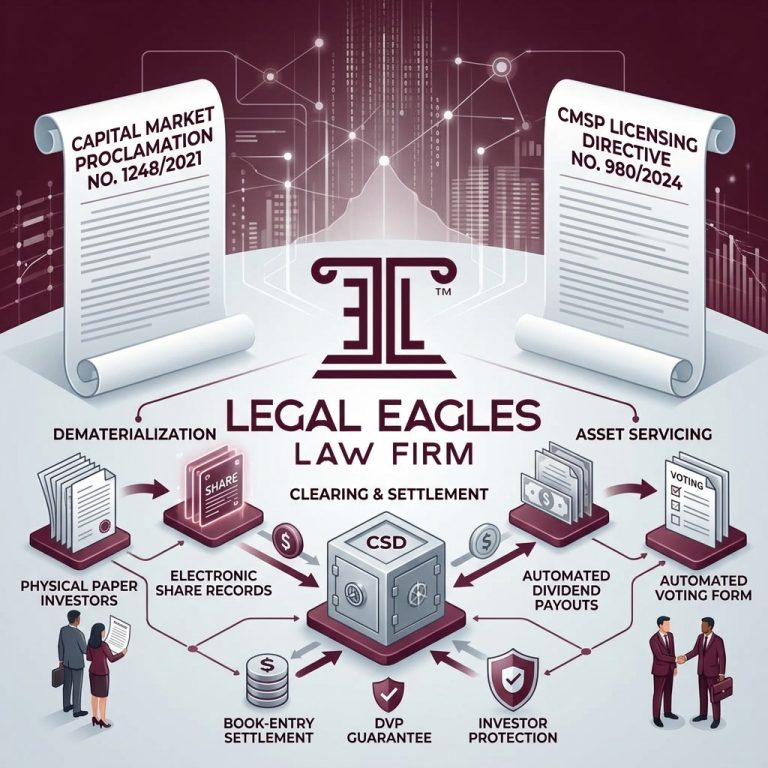
Ethiopia’s financial sector is undergoing major reforms. Consequently, corporate and institutional liquidity strategies are shifting dramatically. Following the launch of the ESX and Proclamation No. 1248/2021, short-term liquidity instruments now take center stage.
Directive No. 1150/2026 legalizes Ethiopian pooled funds, including Money Market Funds. This creates new corporate liquidity options.
1. Understanding Money Market Instruments in the Context of Capital Market Proclamation No. 1248/2021
Money market instruments are high-grade, highly liquid short-term debt securities with maturities ranging from overnight up to 364 days. Unlike long-term securities, money market tools manage short-term cash shortages or earn yields on excess liquidity.
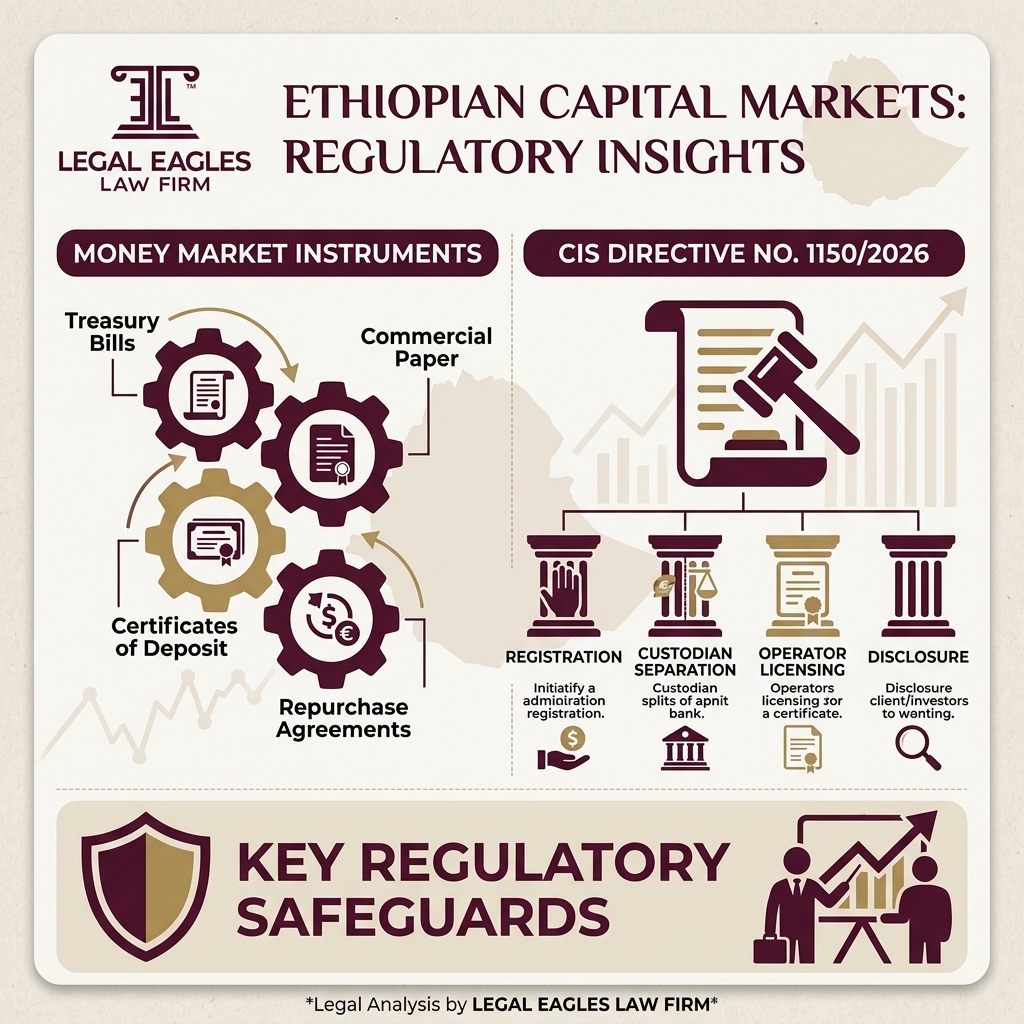
Under Ethiopian commercial practice and the modern capital market legal framework, key instruments include:
- Treasury Bills (T-Bills)
- Commercial Paper (CP)
- Certificates of Deposit (CDs)
- Repurchase Agreements (Repos)
- Banker’s Acceptances (BAs)
2. The Impact of ECMA Directive No. 1150/2026 on Pooled Investments
Before Directive No. 1150/2026, short-term debt instruments were accessible mainly to commercial banks and large institutions. Directive No. 1150/2026 formally categorizes and regulates six distinct Collective Investment Schemes (CIS):
- Money Market Funds (MMFs)
- Mutual Funds
- Real Estate Investment Funds (REIFs)
- Exchange-Traded Funds (ETFs)
- Alternative Investment Funds (AIFs)
- Special Designation Funds
Ø Why Money Market Funds (MMFs) Matter for Ethiopia’s Financial Sector
Under Directive No. 1150/2026, MMFs act as an intermediary layer between individual/corporate savings and government or corporate short-term debt. MMFs pool retail and corporate cash to buy high-grade short-term assets. This offers diversified risk to participants.
3. Core Legal & Governance Requirements under Directive No. 1150/2026
Directive No. 1150/2026 establishes strict regulatory designed to protect investor capitals and ensure transparency across all collective investment schemes:
Mandatory Registration & Public Offerings
- No Offerings without Approval: Public collective investment schemes in Ethiopia require prior registration and formal clearance by the ECMA.
Structural Separation of Assets (Operator vs. Custodian)
- Directive No. 1150/2026 strictly separates the Scheme Operator from the Custodian to prevent conflicts of interest.
- All scheme assets must be held independently by a licensed Custodian.
- Operators and Custodians must hold separate service licenses under ECMA Directive No. 980/2024.
Operational Disclosures & Reporting Obligations
- Scheme operators are required to maintain continuous, audited operational disclosures, standard fund valuation reports, and clear prospectus documents outlining investment mandates, risk factors, fee structures, and redemption terms.
- Failure to address investor grievances or report non-compliance issues within statutory timeframes exposes operators to regulatory penalties.
4. Strategic Implications for Ethiopian Businesses & Financial Institutions
- Corporate Treasuries: Ethiopian businesses can optimize cash reserves by investing excess working capital into regulated Money Market Funds or directly participating in commercial paper issuances.
- Commercial Banks: Banks must adjust to the dual role of issuing negotiable CDs and acting as independent custodians or distribution channels for MMFs under Directive No. 980/2024 and 1150/2026.
- Foreign & Cross-Border Investors: The creation of formal, regulated pooled vehicles governed by standardized directives brings Ethiopian short-term yield markets into alignment with international risk management standards.
Conclusion & Legal Advisory
The legal authorization of Collective Investment Schemes under Directive No. 1150/2026 marks a turning point in Ethiopia’s capital market journey. Establishing or participating in Money Market Funds requires careful adherence to operator licensing, custodian segregation, prospectus drafting, and statutory reporting.