When Does Carelessness Become a Crime? Ethiopia Intent vs Negligence
Introduction to Ethiopia Intent vs Negligence
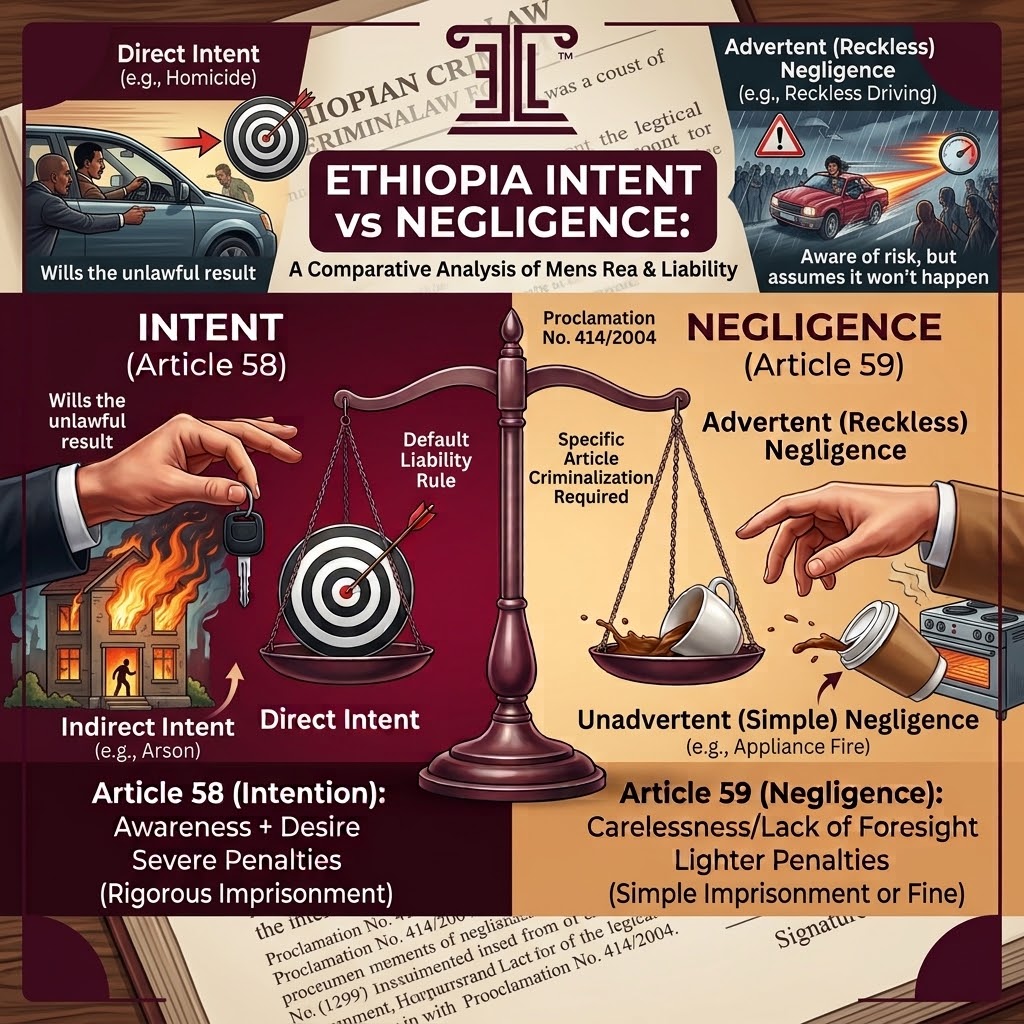
Under the Criminal Code of the Federal Democratic Republic of Ethiopia (Proclamation No. 414/2004), the central distinction regarding Ethiopia intent vs negligence comes down to the offender’s mental state (mens rea): Intention involves full awareness and a desire or acceptance of the illegal result, whereas Negligence stems from a lack of foresight, imprudence, or carelessness despite having the duty and capacity to act properly.
Criminal Intention Under Article 58: Intent vs Negligence Baseline
A person acts intentionally when they execute an unlawful act with full awareness of its illegal nature. Article 58 breaks this down into two distinct forms:
- Direct Intent: The person foresees the unlawful outcome and actively wills or desires it to happen.
- Indirect Intent: The person foresees that their conduct will likely or inevitably cause an unlawful result, and chooses to proceed anyway, accepting that outcome.
Liability and Punishment for Ethiopian Intentional Crimes
Intentional commission is the default rule for criminal liability in Ethiopia. Every offense defined in the Code is punishable when committed intentionally. However, as Article 58 specifies, no person can be convicted beyond what they intended or accepted as a consequence.
Offenses committed with criminal intention carry the most severe penalties—such as rigorous imprisonment or life imprisonment—because the offender consciously chose to break the law. An intentional criminal act is always punishable unless there exists a specific legally recognized ground of justification or excuse under Articles 68 through 81 (such as self-defense or necessity).
Examples of Ethiopia Intentional Crimes and Legal Consequences
- Direct Intent (Homicide): A person holds a grudge against an individual, sees them walking along the roadside, and deliberately drives a vehicle directly into them to kill them. Because the driver actively willed the death, they are liable for intentional homicide (Article 588), which carries long-term or life imprisonment.
- Indirect Intent (Property Damage/Arson): Person A wants to destroy Person B’s store. Person A knows that Person C is sleeping in the back room and that lighting the building on fire will almost certainly kill or severely injure Person C. Person A sets the fire anyway because they accept that outcome as part of destroying the store. Person A is liable for intentional homicide regarding Person C under indirect intent.
Criminal Negligence Under Article 59: Carelessness as a Crime
A person acts negligently when they commit an unlawful act not because they wanted or accepted the illegal result, but because they lacked foresight, acted imprudently, or disregarded possible consequences. Article 59 divides negligence into two types:
- Unadvertent (Simple) Negligence: The person acts without realizing that their conduct will cause an illegal result, even though, given their personal circumstances and capacity, they should have and could have been aware of the danger.
- Advertent (Reckless) Negligence: The person is aware that their act carries a risk of producing an unlawful result, but recklessly proceeds anyway, mistakenly relying on the belief that the result will not happen.
Liability and Punishment for Criminal Negligence in Ethiopia
Unlike intentional acts, negligent acts are not generally punishable unless explicitly provided by law. A person cannot be criminally convicted for a negligent act unless the specific article in the Special Part of the Criminal Code explicitly states that committing that particular offense negligently is a crime.
When negligent commission is explicitly criminalized, the law imposes significantly lighter penalties—typically simple imprisonment or a fine—reflecting the lower degree of personal guilt compared to intentional offenses.
Examples of Negligent Offenses in Ethiopian Criminal Law
- Advertent Negligence (Homicide): A driver speeds through a crowded pedestrian zone during heavy rain, fully aware of the risk, but assuming their professional driving skills and brakes will prevent an accident. The car skids and strikes a pedestrian, causing their death. The driver did not want or accept the death, but acted recklessly. They are liable for negligent homicide (Article 593), which carries a much lighter sentence, such as simple imprisonment or a fine.
- Unadvertent Negligence (Property Damage): Person A forgets to turn off an industrial heating appliance in their workshop before leaving for the weekend, causing an accidental fire that spreads to a neighboring building. Person A did not realize the fire would happen, but as a reasonable person in that position, they should have and could have checked the equipment. Person A will only face criminal charges if the specific arson/damage provision in the Code explicitly penalizes negligent commission; otherwise, the matter remains purely a civil liability for damages.
Conclusion: Key Takeaways on Ethiopia Intent vs Negligence
In Ethiopian criminal law, understanding Ethiopia intent vs negligence is the difference between choice and carelessness. Criminal intention reflects a conscious decision to commit or accept an illegal act (Article 58), making it universally punishable with severe penalties. Criminal negligence, on the other hand, involves a failure of foresight or care (Article 59), drawing significantly lighter penalties and requiring an explicit legal provision to be punishable at all. Ultimately, this distinction ensures that punishment strictly matches an offender’s mental state and level of personal fault.