Whose House Is It? HoF Common Property Limits Clarified
Introduction
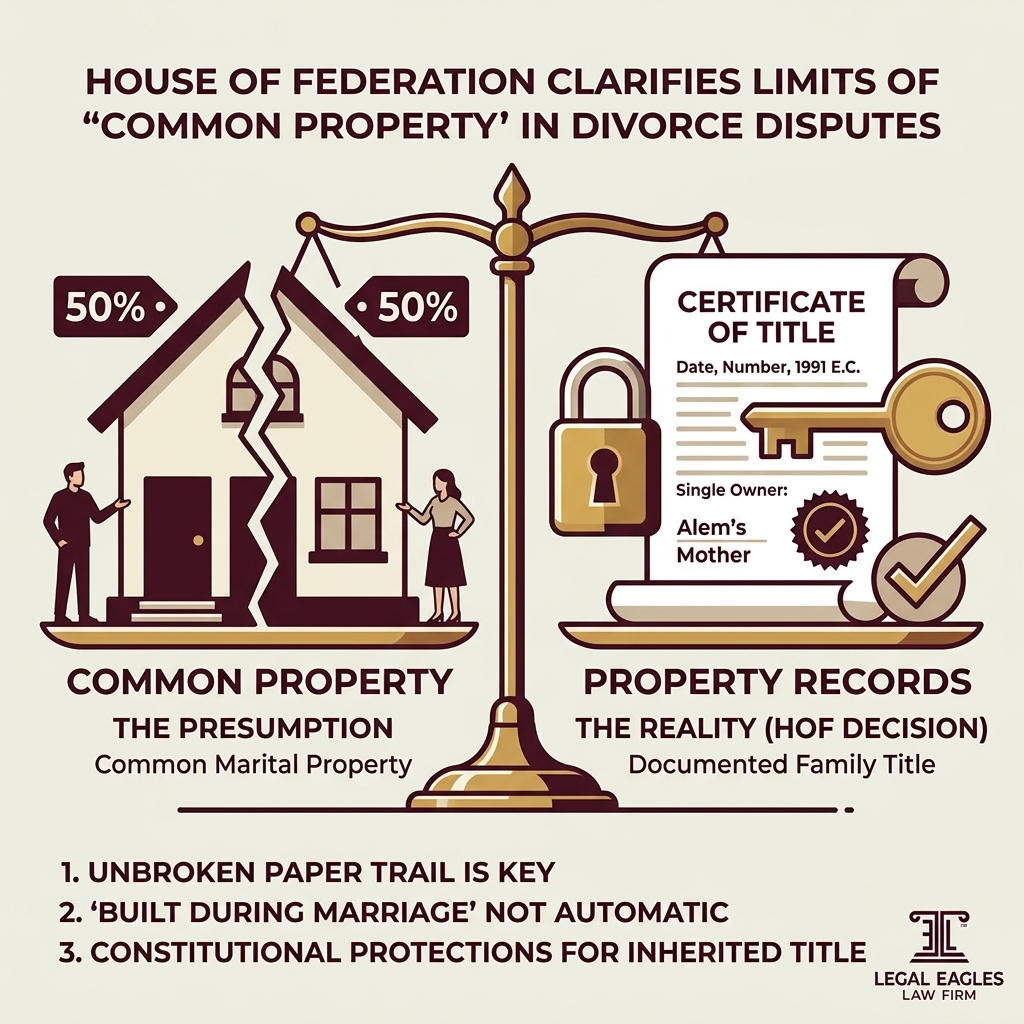
The landmark HoF common property limits decision in File No. 13275 establishes how Ethiopian courts must balance marital property claims against documented personal title. Generally, Ethiopian family law treats property acquired during marriage as jointly owned. However, what happens when a couple lives in a house that official records assign to someone else? Does physical cohabitation automatically expand joint ownership boundaries? Consequently, the House of Federation (HoF) addressed these critical HoF common property limits after the Council of Constitutional Inquiry referred the case to determine whether living together can override a registered paper trail.
Background
The case originally started as a divorce property-division suit testing the HoF common property limits regarding inherited and registered real estate. Specifically, after the marriage ended, the wife (Respondent) sued her ex-husband (Petitioner) at the Arba Minch City Court. She sought an equal share of a house in Arba Minch City (Plot No. BM 47, about 200 m²), claiming the couple built it together during the marriage and that it fell within their shared property scope.
In contrast, the husband strongly disagreed with her claim. He argued that the land fell outside their marital asset limits because it had gone to his mother in 1991 E.C., before the marriage began. Furthermore, he maintained that the house was her personal property—completely separate from any joint property rights—as it carried her name on the official registration and later passed to him.
Procedural History
- Trial Court: The couple rented a home until 1998 E.C., when the house was finished. Subsequently, they moved in together in 1999 E.C. The court ruled the couple had effectively built the house and ordered an equal split.
- Zonal High Court (Appeal): The court affirmed this ruling. Specifically, it cited Civil Code Arts. 1195 & 1196: registration only creates a rebuttable presumption of ownership. Therefore, the court held that the husband failed to rebut it.
- SNNPR and Federal Cassation Benches: Both declined to review the case further.
As a result, the husband petitioned the CCI, arguing that the lower courts had violated his constitutional property rights under Article 40.
Key Arguments on HoF Common Property Limits
To support his claim, the husband pointed to an unbroken paper trail: tax records, the site plan, the building permit, and utility connections. Because all of them carried his mother’s name, he argued that the courts had incorrectly overridden solid documents with a mere inference about cohabitation.
On the other hand, the wife made a different case. Under Article 40(3), land belongs to the state and the people. Thus, she argued, land registration alone cannot settle who owns a house built on it. Furthermore, she said she and her husband had the financial means to build it and had lived there continuously since 1999 E.C. Consequently, she invoked Article 40(7), which protects people who invest labor and capital in land. She also cited Civil Code Art. 1179(1), asserting that a builder who constructs without the landholder’s objection becomes the structure’s owner.
The House of Federation’s Reasoning
In its evaluation, the House drew on its own precedent, File No. 022/08 (2009 E.C.). That decision held that a documented title under Civil Code Art. 1195 can only be rebutted through the specific grounds in Art. 1196 — not through general inference. Moreover, the House examined Art. 1258 and the provisions that follow it, which require an express contract or a clear legal basis to establish co-ownership. However, neither existed in this case.
Additionally, the House noted that the wife and lower courts relied on Arts. 1179(1), 1206, 1149, and 1150. While these provisions can transfer ownership to a builder, they apply only to undocumented or contested land. Here, however, a clear, documented chain of title ran from the mother to the Petitioner. Therefore, the House found that this chain deserved full
Practical Takeaways on HoF Common Property Limits
In conclusion, documented title carries real legal weight in Ethiopian law. Tax records, permits, and utility connections can clearly outweigh a simple inference drawn from cohabitation. Therefore, understanding these HoF common property limits is essential for legal practitioners—clients facing divorce-related property disputes should secure a complete chain of title early, well before any dispute begins.