Force Majeure Under the Ethiopian Civil Code: What the Law Actually Says
One of the most common misconceptions in Ethiopian commercial practice is assuming that when a deal becomes financially painful, unexpected, or logistically messy, you can simply claim force majeure and walk away.
Under the Ethiopian Civil Code, the standard is intentionally strict. Article 1791 sets the foundation: if you fail to perform a contractual obligation, you are strictly liable for damages—even if you acted without fault—unless you can legally prove that a genuine force majeure event made compliance impossible.
The Legal Baseline: Article 1792
Article 1792 defines force majeure as an occurrence that the debtor could normally not foresee and which prevents them absolutely from performing their obligations.
To rely on this legal defense, you must satisfy two strict conditions simultaneously:
- Unforeseeability: The event could not have been reasonably anticipated at the exact time the contract was executed.
- Absolute Impossibility: The obstacle must render performance completely impossible for anyone in that position, not just harder or more expensive for you.
The Reality Check [Article 1792(2)]: If an event was predictable when you signed, or if it merely cuts into your profit margin, Ethiopian law does not treat it as force majeure. Period.
Grounds Explicitly Recognized: Article 1793
Article 1793 outlines five specific scenarios where non-performance is legally excused:
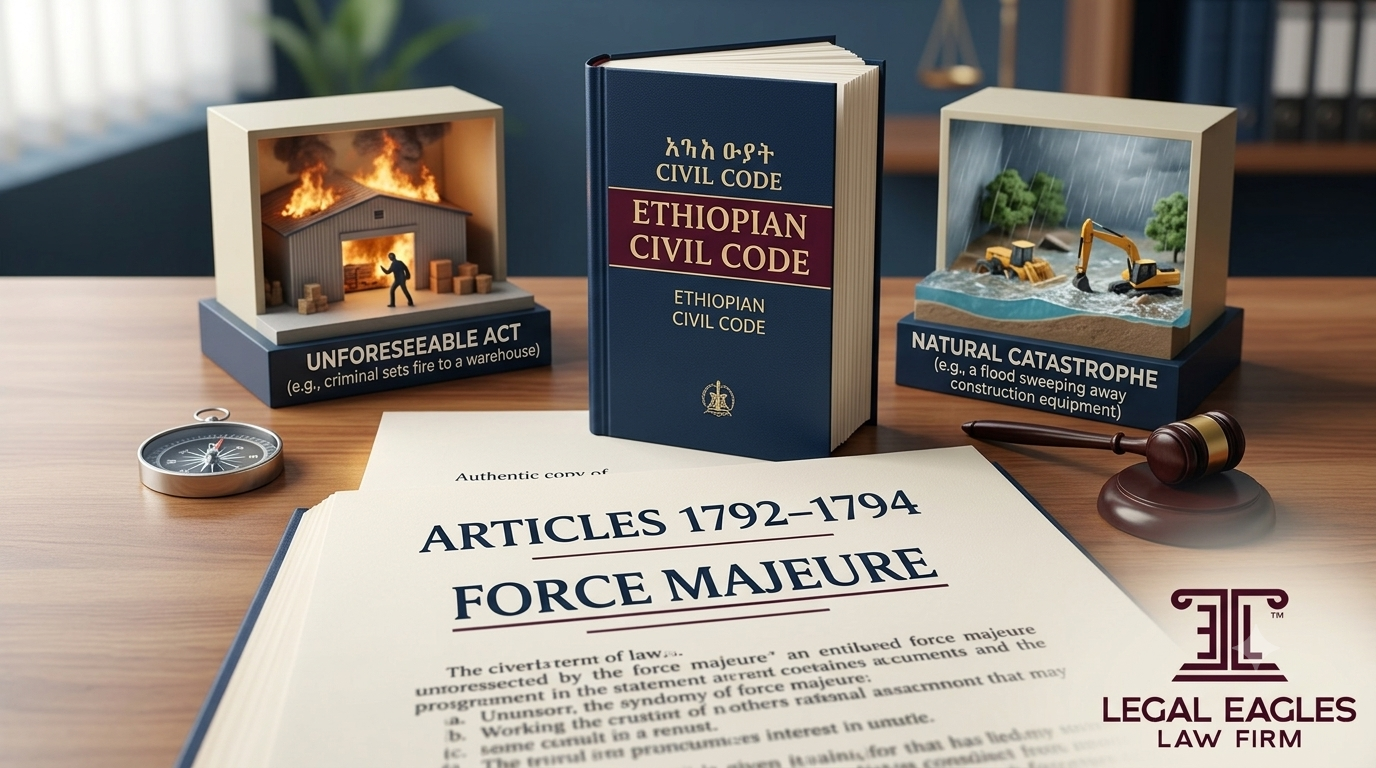
1. Unforeseeable Act by an Uninvolved Third Party [Art. 1793(a)] A completely unrelated criminal or external action destroys the means of performance. For example, if a supplier stores goods for delivery, but an unrelated party deliberately sets fire to the warehouse, destroying the inventory.
2. Official Government Prohibition [Art. 1793(b)] A regulatory intervention makes fulfilling the contract illegal overnight. For instance, a sudden legal restriction on virtual asset transactions prohibits carrying out a cryptocurrency-based service agreement.
3. Natural Catastrophe [Art. 1793(c)] Severe natural disasters physically halt work. For example, a flash flood in the Rift Valley sweeps away a contractor’s equipment and work site before a project can be completed.
4. War or Civil Conflict [Art. 1793(d)] Armed conflict disrupting logistics or safety completely. For instance, active military hostilities force an international port closure, preventing an exporter from shipping goods out of the region.
5. Debtor Incapacity in Personal Contracts [Art. 1793(e)] Sudden death, severe accident, or illness of the individual hired specifically for their unique skill. For example, a consultant engaged specifically for personal services suffers an incapacitating medical emergency, making personal performance impossible.
What Does Not Qualify in Article 1794?
Unless both parties explicitly agree otherwise in writing within their contract, Article 1794 firmly excludes three common business disruptions from being used as a force majeure defense:
Internal Strikes and Lockouts
Labor disputes or worker strikes occurring within your own enterprise or industrial sector do not excuse delay or default. If a garment factory faces a worker strike, it remains liable to the client for delayed uniform deliveries.
Spikes in Raw Material Prices
This is where many businesses get caught off guard. Real estate developers and contractors frequently claim that soaring costs for cement, steel, or raw inputs count as force majeure. Article 1794(b) makes it clear: price fluctuations are ordinary commercial risks. Higher costs make performance burdensome, not impossible.
Taxes and Burdensome Legislation
If a new tax or custom duty raises the cost of importing machinery or fulfilling a service, it makes performance more expensive, but not legally or physically impossible. Consequently, new tax burdens do not release a party from liability.
Practical Application
Because the Civil Code sets the default threshold at absolute impossibility, relying on standard law leaves little room for maneuver when markets shift or supply chains stall. If you want protection against inflation, labor strikes, or price surges, you cannot rely on statutory force majeure—you must explicitly write custom risk-allocation and price-adjustment clauses directly into your contract.