The Application Phase under Ethiopia’s Carbon Market Proclamation
Recently, mainstream and social media platforms have seen a massive surge in attention regarding the carbon market. By aligning market mechanisms with domestic interests, the Proclamation protects Ethiopian sovereignty over its environmental assets. In response to this momentum, our country has taken a decisive step forward by publishing the Carbon Market Proclamation. Crucially, lawmakers designed this statutory framework to strictly protect our national sovereignty in any activity related to carbon trade. This discussion captures the focus of professionals and the public alike.
This domestic momentum reflects a wider global shift toward market-based climate instruments. This shift compels nations to establish robust legal frameworks for carbon trade. In this context, the Proclamation serves as the foundational regulatory instrument. It governs the identification, development, and validation of greenhouse gas (GHG) mitigation activities. Furthermore, it operationalizes cooperative approaches under Article 6 of the Paris Agreement. The framework balances private climate finance with environmental integrity.
Central to the success of this regulatory architecture is the specific, step-by-step procedure mandated for developing a mitigation activity. Project developers, state authorities, and intermediaries must navigate a rigorous legal pathway. This path transforms an emission-reduction concept into a tradeable carbon asset. This process is not merely technical. It is a highly structural legal journey. It safeguards host-country ownership and ensures clear rules of credit title. Today, we will examine the procedures for project development, focusing specifically on activity approvals.
The Application Procedure for Carbon Mitigation Activities in Ethiopia
To operate legally within Ethiopia, any GHG mitigation activity must undergo a formal review process. The Designated National Authority (DNA) manages this system. Appointed by the Government, the DNA regulates and coordinates the national carbon market. DNA in this context is ministry of planning and development.
If you want to undertake a mitigation activity in Ethiopia, you must first register with the DNA. The legal pathway begins with the Application Phase. Proponents submit project concepts to seek a formal Letter of No Objection. They must obtain this before full project implementation. Depending on the applicant and project type, specific supporting files must accompany the MAIN.
Below is the detailed, step-by-step procedure for navigating the formal application process.
The Step-by-Step Application Process
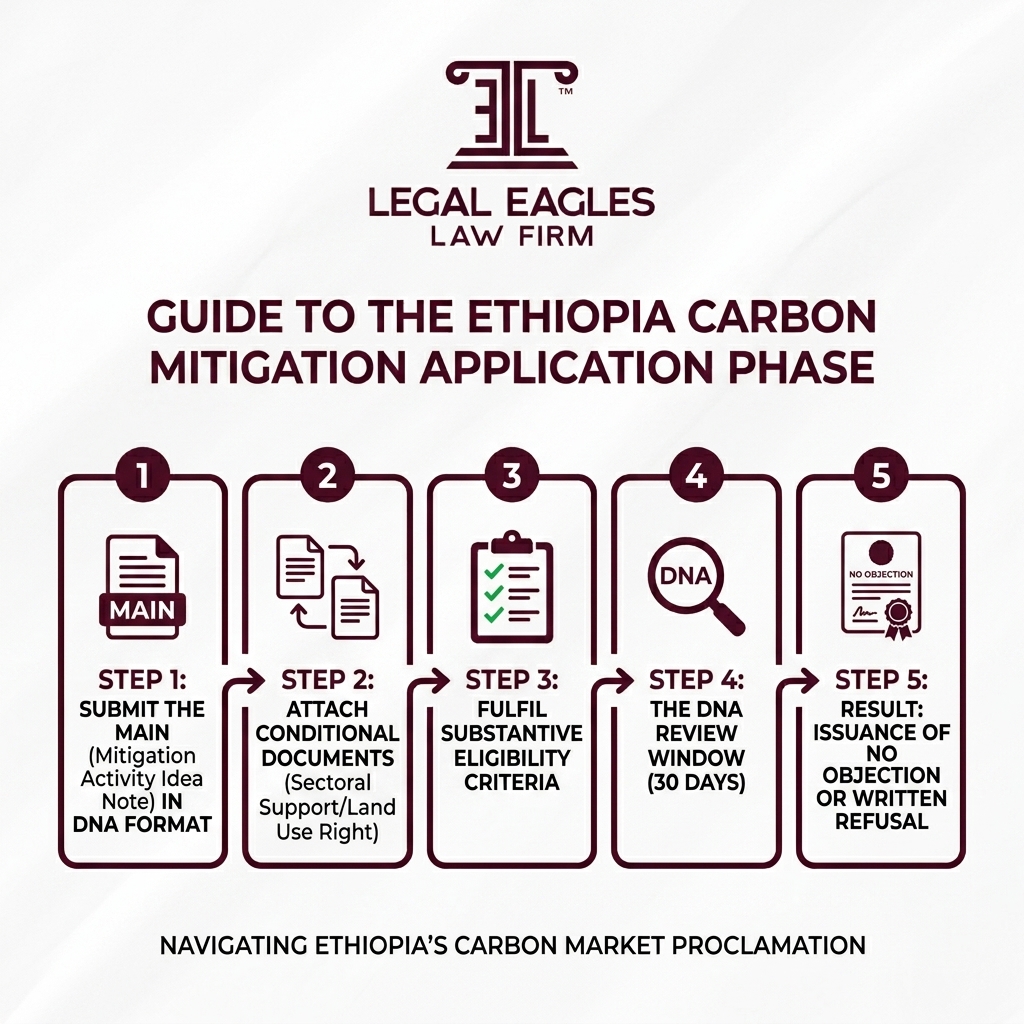
Step 1: Submit the Mitigation Activity Idea Note (MAIN)
The formal process begins when a project proponent completes and submits the first part of the application to the DNA. The authority calls this initial filing the Mitigation Activity Idea Note (MAIN).
- Format: Proponents must complete and submit the application in the strict format that the authority prescribes.
- Administrative Fees: Proponents must pay the mandatory administrative fee as prescribed by the DNA’s schedules at the time of submission.
Step 2: Attach Conditional Supporting Documents
Depending on the applicant’s identity and the type of project they propose, the Proclamation mandates that specific supporting files must accompany the MAIN:
- For Non-State Entities (Letter of Sectoral Support): If the proponent is a private commercial enterprise, NGO, or other non-state actor, the application must include a formal Letter of Sectoral Support. The relevant Ethiopian line ministry issues this document to confirm that your proposed mitigation activity aligns with Ethiopia’s sector-specific plans.
- For Land-Based Activities (Land Use Right Document): If the application covers land-based mitigation (such as forestry, agroforestry, or soil management), the proponent must submit a valid land use right document. A competent local or federal authority must issue this document to legally prove the project owner’s landholder status.
Step 3: Fulfil Substantive Eligibility Criteria
The substance of the application must explicitly demonstrate that the proposed project satisfies all core eligibility benchmarks. Proponents must prove that their activities align with the specific guidelines that the DNA will issue, showing full fulfillment of the criteria within the application form.
Step 4: The DNA Review Window (30 Days)
Once the DNA receives a complete MAIN and preliminary application package, the authority enters a strict statutory timeline to evaluate the submission:
- Issuance of No Objection: Within thirty (30) days of receiving a complete application, the DNA will review the files. If the MAIN successfully demonstrates that the activity meets all guideline requirements, the DNA will issue a formal Letter of No Objection.
- Written Notification of Refusal: If the application fails to meet the required criteria, the DNA will reject the preliminary application. The law requires the authority to notify the proponent in writing with a detailed explanation of why the DNA refused the application.
Conclusion
The formalization of the application and screening procedures under the Carbon Market Proclamation marks a transformative milestone in our country’s environmental governance and green economic strategy. By transitioning from a previously fragmented regulatory approach to a centralized, highly structured legal system overseen by the Designated National Authority (DNA), the Proclamation introduces the transparency and procedural predictability necessary to mobilize robust private climate finance. By embedding clear operational boundaries, institutional guardrails, and explicit validation phases into the project cycle, this statutory mechanism successfully lowers investment barriers while systematically insulating the domestic market from the risks of double-counting or carbon fraud.
Ultimately, the strict gatekeeping mechanism established during the preliminary application phase most notably the mandatory 30-day DNA review window, the explicit land-use right requirements for land-based projects, and the sectoral alignment checks for non-state entities proves that market-based climate actions can coexist with strong state regulation. These rigorous procedural steps do not merely serve a bureaucratic or technical function; they act as a vital legal shield to safeguard Ethiopian territorial sovereignty over its atmospheric and natural assets. By binding all mitigation activities to strict domestic oversight and national green growth priorities before the DNA issues or transfers carbon credits internationally, the Proclamation guarantees that our natural resources serve first and foremost to advance our own Nationally Determined Contributions (NDCs) and long-term sustainable development goals.