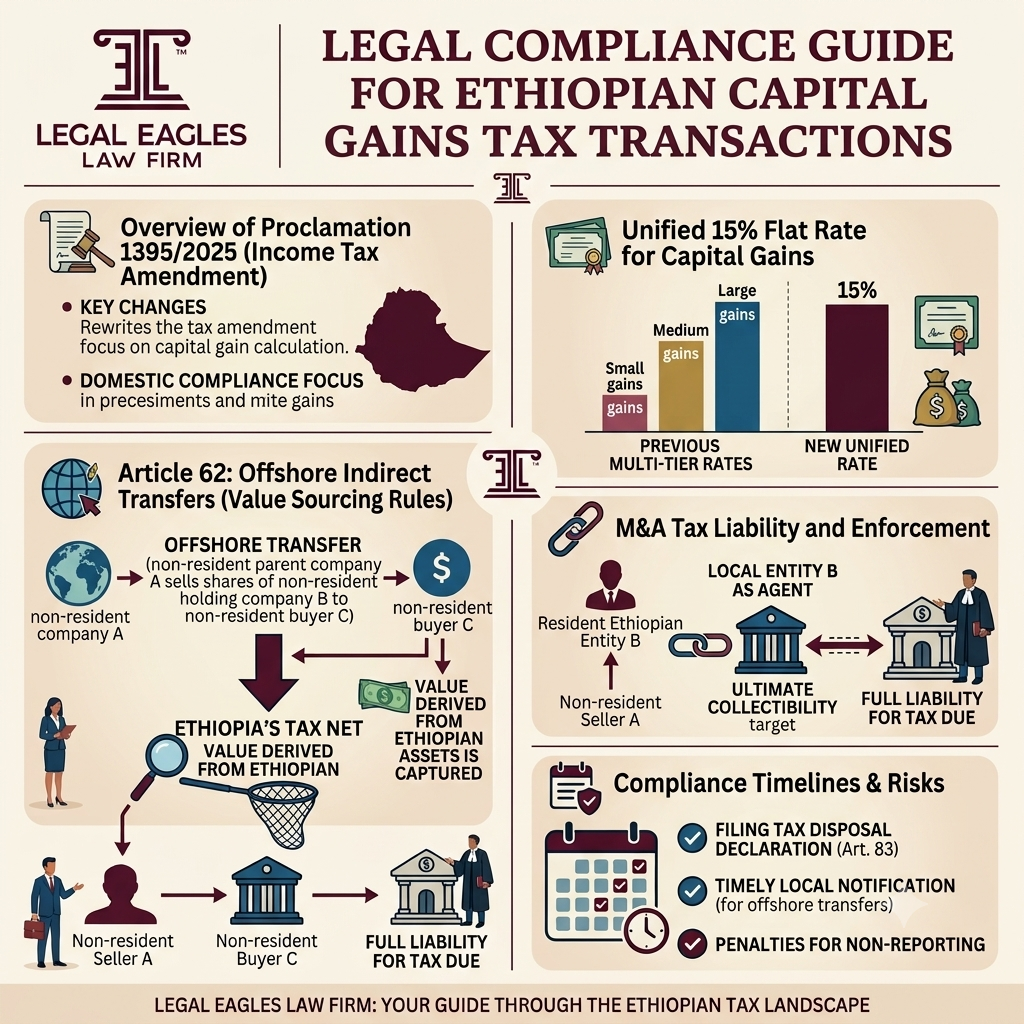
The Paradigm Shift: From Proclamation No. 979/2016 to the Income Tax (Amendment) Proclamation No. 1395/2025
The corporate tax landscape in Ethiopia has undergone its most significant legislative recalibration in a decade. The Federal Income Tax (Amendment) Proclamation No. 1395/2025 fundamentally alters the baseline rules established under Proclamation No. 979/2016.
The Amendment Proclamation expands the domestic tax base, eliminates corporate loopholes, and aligns Ethiopia with global standards. Most notably, it overhauls the Capital Gains Tax regime by unifying historical asymmetric tax brackets. It also captures offshore indirect asset transfers and grants statutory safe harbors for share premiums.
These updates fundamentally alter corporate transaction modelling, mergers and acquisitions (M&A), and divestment planning in Ethiopia.
The Macro-Fiscal Reconstruction of Ethiopian Capital Gains Taxation
The 2025 revisions are both corrective and expansionary. These changes relieve domestic share liquidation friction while aggressively extending the jurisdiction of the Ministry of Revenues over cross-border transactions.
1. Harmonization of Rates: Elimination of the Asymmetric 30% Equity Bracket
Under Schedule “D” of the Principal Proclamation (No. 979/2016), the legislature split capital gains into two uneven categories:
- Under Class “A” (Immovable Property), the tax authority applied a 15% rate to gains from disposing of commercial buildings.
- Class ‘B’ (Shares and Bonds): Gains from disposing of corporate equity or debt instruments faced an aggressive 30% rate.
The Amendment Proclamation introduces a unified flat rate of 15% on the disposal of all taxable business assets. This explicitly includes company shares, bonds, and business real estate. By cutting the share transfer tax burden in half, the legislature significantly reduced financial drag on corporate restructuring.
2. The Statutory Valuation Framework and Inflation Buffering
To establish legal certainty and minimize administrative disputes, the amendment reinforces the statutory formula used to isolate net chargeable appreciation:
Taxable Gain = A – (B + C)
Where:
- A (Total Consideration): The gross amount received or receivable (in cash or kind) from the disposal.
- B (Statutory Inflation Adjustment): A mandatory 30% inflation allowance applied to the cost basis. This acts as an economic shield, protecting taxpayers from paying punitive taxes on artificial “paper gains” caused by domestic inflation.
- C (Cost of Asset): The original net book value or acquisition cost, factoring in permitted historical depreciation.
3. Closing the Offshore Loophole: The Indirect Transfer Dragnet
Historically, multinational corporations avoided local capital gains exposure by transferring ownership at the foreign holding company level.
The introduction of Article 62 expands Ethiopia’s tax jurisdiction to stop this avoidance strategy. Its operational mechanics break down into four key components:
- Under Sub-Articles 1 and 3, the tax net captures gains if offshore interests derive value from Ethiopian property. The law legally deems that the transaction occurred inside Ethiopia and classifies it as Ethiopian-sourced income under Article 61.
- The Threshold Binary and Proportional Formula (Sub-Article 2): To determine the taxable local exposure, the law divides transactions into two clear rules:
- The 50% Rule: If the offshore interests derived more than 50% of their value from Ethiopian property at any time during the 365 days preceding the sale, 100% of the gain is taxable locally.
- Proportional Apportionment: In all other cases, the ministry isolates the taxable amount using the formula:
Taxable Gain = A× B/C
(Where A represents the total gain realized, B represents the value derived from the underlying Ethiopian property, and C represents the absolute total value of the transferred interest).
- Immediate Local Notification Mandate (Sub-Articles 4, 7 & 8): Sub-Article (4) places an immediate written burden on the direct resident owner of the Ethiopian property to notify the Tax Authority when an upstream transaction occurs. Taxpayers must file a formal tax disposal declaration under Article 83; failure to report triggers severe administrative penalties.
- The Deemed Local Agent Enforcement Trap (Sub-Articles 5 & 6): Because collecting tax from non-resident entities overseas is difficult, the law creates a local collection target. The law automatically deems the resident entity in Ethiopia as the agent of the non-resident and holds it fully liable for paying the tax due, unless another party settles it first.
4. The Statutory Protection of Share Premiums
Under the old interpretation of Proclamation No. 979/2016, tax authorities frequently attempted to assess capital gains tax on share premiums collected when existing companies issued new shares above par value to incoming investors.
The Amendment Proclamation comprehensively resolves this corporate governance bottleneck by updating the list of Exempt Income:
- The Safe Harbor: It explicitly codifies that premiums collected from the issuance of new shares by an existing company are entirely exempt from income and capital gains tax.
- The Legal Distinction: The law now enforces a clear statutory boundary: the liquidation or exchange of existing equity triggers a 15% capital gains event, whereas the generation and primary distribution of new equity to expand corporate capital reserves completely insulates the company from tax.
Conclusion
The enactment of the Federal Income Tax (Amendment) Proclamation No. 1395/2025 marks a major turning point in Ethiopia’s fiscal policy, balancing investor-friendly relief with aggressive regulatory oversight. By halving the capital gains tax on corporate equity to a unified 15% and codifying clear safe harbors for share premiums, the legislature has removed historical friction points for M&A and private equity injections.
However, a sophisticated compliance dragnet counterweights this liberalization. Article 62 effectively closes the offshore holding company loophole, shifting the enforcement burden directly onto localized resident subsidiaries via the “Deemed Local Agent” mechanism. Ultimately, Proclamation No. 1395/2025 demands that multinational entities and domestic corporations completely re-model their transaction structures. Moving forward, early tax-impact modeling, rigorous local asset valuations, and proactive notification planning will be mandatory to successfully navigate Ethiopia’s modern tax landscape.