Termination of Employment Without Prior Notice Under Article 27 of Ethiopian Labour Proclamation No. 1156/2019
What Is Termination Without Prior Notice?
Generally, either the employer or the employee must give the required notice period before terminating an employment contract.However, Ethiopian Labour Proclamation No. 1156/2019 recognizes exceptional circumstances in which an employer may lawfully terminate an employment contract without prior notice. Article 27 of the Proclamation governs this type of termination, which people commonly call summary dismissal.
The purpose of Article 27 is to protect employers from serious acts of misconduct while simultaneously safeguarding employees from arbitrary dismissal. Because termination without notice deprives an employee of the opportunity to continue working during the notice period, the law permits it only on specifically enumerated grounds.
Grounds for Termination Without Prior Notice Under Article 27
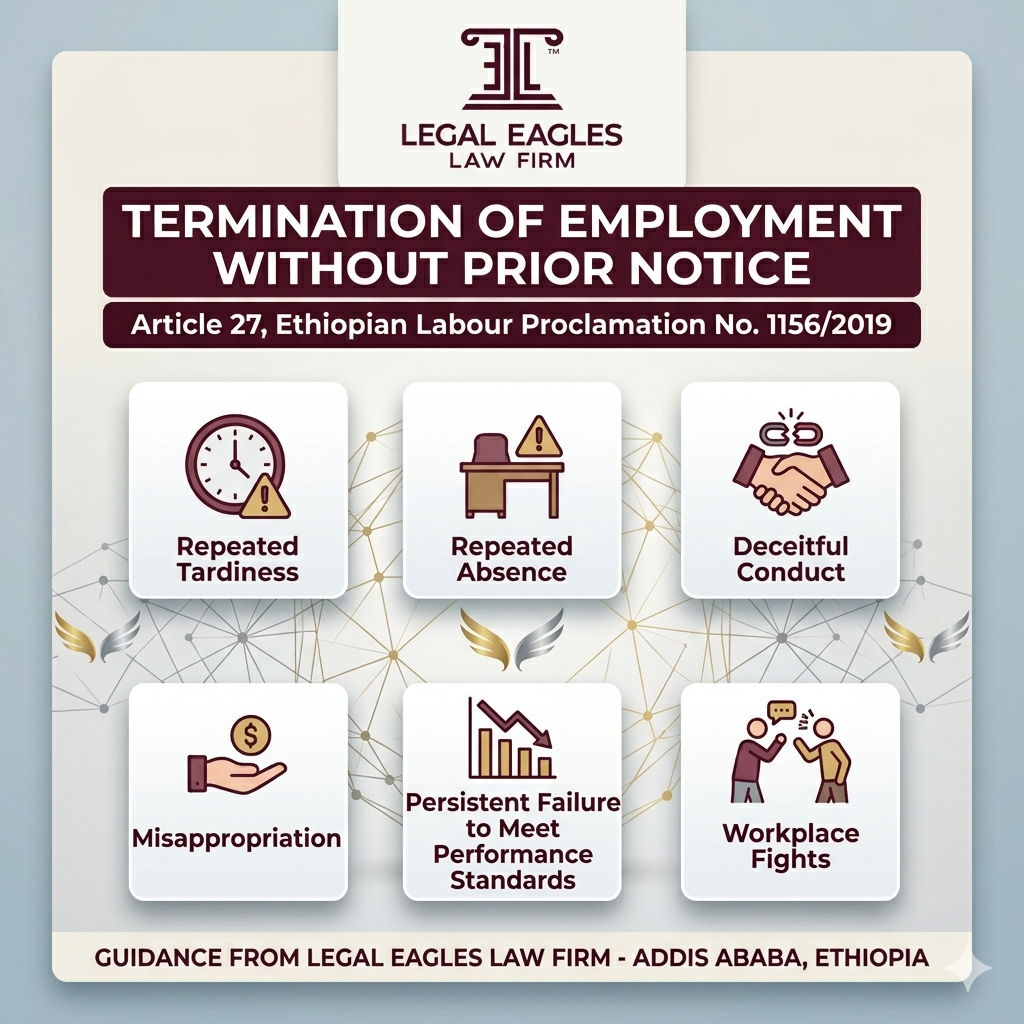
1. Repeated Tardiness
Article 27 of the Proclamation governs this type of termination, which people commonly call summary dismissal. The lateness must not be justified by a collective agreement, workplace rules, or the employment contract. The law recognizes punctuality as an important employment obligation, and repeated failure to report to work on time may constitute serious misconduct.
In such cases, the law requires the employer to issue written warnings before resorting to dismissal. If the employee continues arriving late despite those warnings, summary dismissal may be justified.
2. Repeated Absence from Work
An employer can dismiss a worker without notice if he or she misses a total of five work days within a six-month period after receiving written warnings, provided that the absence does not fall under any legally recognized leave entitlement.
Attendance is a fundamental obligation of every employee. Therefore, when an employee repeatedly fails to report to work without lawful justification, the employer may terminate the employment contract. Courts have also examined how judges should interpret this provision, particularly regarding warning requirements and the nature of the absences.
3. Fraudulent or Deceitful Conduct
An employer may immediately dismiss a worker who engages in fraudulent or deceitful conduct in the performance of his or her duties. Fraud undermines the trust that forms the foundation of every employment relationship.
Examples include falsifying reports, intentionally providing false information, manipulating records, or engaging in dishonest acts for personal gain.
4. Misappropriation of the Employer’s Property or Funds
An employer can immediately terminate an employment contract if a worker unlawfully takes uses, or misappropriates the employer’s property or funds for personal benefit or for the benefit of a third party. The law regards theft, embezzlement, and other forms of financial dishonesty as serious breaches of trust.
The law treats such conduct severely because employers must be able to trust employees who handle money, equipment, inventory, and confidential assets.
5. Persistent Failure to Meet Performance Standards
Termination without notice may also occur when a worker’s performance consistently falls below the quality and quantity standards established by the parties or by a collective agreement, despite possessing the ability to perform better.
The law does not intend this provision to punish employees who genuinely lack the capacity to perform a task. Rather, it applies where an employee is capable of meeting the required standards but persistently fails to do so.
6. Participation in Workplace Fights or Quarrels
An employer can summarily dismiss a worker who starts serious fights or quarrels in the workplace. Management must consider the gravity of the incident before executing the dismissal.
Workplace violence threatens safety, disrupts operations, and damages professional relationships. Consequently, the Proclamation empowers employers to take immediate disciplinary action when serious incidents occur.
7. Criminal Conviction Incompatible with Employment
An employer can terminate an employment contract without notice if a court convicts a worker of an offense that makes them unsuitable for their position.
For example, companies may no longer consider a financial officer convicted of fraud or a driver convicted of a serious traffic offense fit for their roles.
8. Intentional or Grossly Negligent Damage
An employer may dismiss a worker who intentionally, or through gross negligence, causes damage to the employer’s property or to property directly connected with the employer’s business.
The law distinguishes ordinary mistakes from gross negligence. While minor errors may result in disciplinary measures, serious and reckless conduct causing substantial damage may justify immediate dismissal.
9. Commission of Prohibited Acts Under Article 14(2)
Article 27 also permits termination where a worker commits any of the prohibited acts listed under Article 14(2) of the Proclamation. These acts concern fundamental employment obligations and workplace discipline. Their violation is considered sufficiently serious to warrant summary dismissal.
10. Absence from Work Due to a Court Sentence
An employer may terminate an employment contract without prior notice when an employee is absent from work due to a court-imposed sentence for a period exceeding thirty consecutive days. In such circumstances, the employment relationship may be terminated because the employee is unable to perform his or her duties for an extended period.
The law permits termination without notice when the prolonged absence resulting from the court sentence makes the continuation of the employment relationship impracticable.
11. Commission of Violations Stipulated in a Collective Agreement
Under Article 27 of Labour Proclamation No. 1156/2019, an employer may terminate an employment contract without prior notice when an employee commits a violation that is expressly identified in a collective agreement as a ground for summary dismissal.
Such violations may include serious breaches of workplace rules, safety regulations, or disciplinary standards. However, the employer must prove the violation and ensure that the dismissal complies with both the law and the applicable collective agreement.
Limitations and Procedural Requirements Under Article 27(2), (3), and (4)
Article 27(2), (3), and (4) of Labour Proclamation No. 1156/2019 impose important limitations on an employer’s right to terminate an employment contract without prior notice. Before effecting the termination, the employer must provide the employee with a written statement specifying the reasons for the dismissal. The right to terminate without notice lapses after thirty days from the date on which the employer became aware of the act or omission constituting the ground for dismissal.
Furthermore, the grounds and duration of suspension from duty pending termination may be determined by a collective agreement; however, such suspension may not exceed thirty days. In any dispute concerning summary dismissal, the burden of proof rests on the employer, who must establish that the alleged misconduct occurred and that the termination was carried out in accordance with the law.
Conclusion
Article 27 of Labour Proclamation No. 1156/2019 establishes a careful balance between managerial authority and employee protection. Employers are granted the power to immediately dismiss workers who commit serious misconduct, but that power is subject to procedural safeguards and evidentiary requirements. The grounds for dismissal are specifically enumerated, the employer must act within the prescribed time limit, and the burden of proof remains on the employer.
For both employers and employees, a proper understanding of Article 27 is essential. Failure to comply with its requirements may result in a finding of unlawful termination and the legal consequences that follow. Understanding these provisions helps promote fairness, accountability, and legal compliance in the workplace.