Understanding the Investment Gap in Ethiopia: Challenges Investors Face and the Way Forward
Introduction
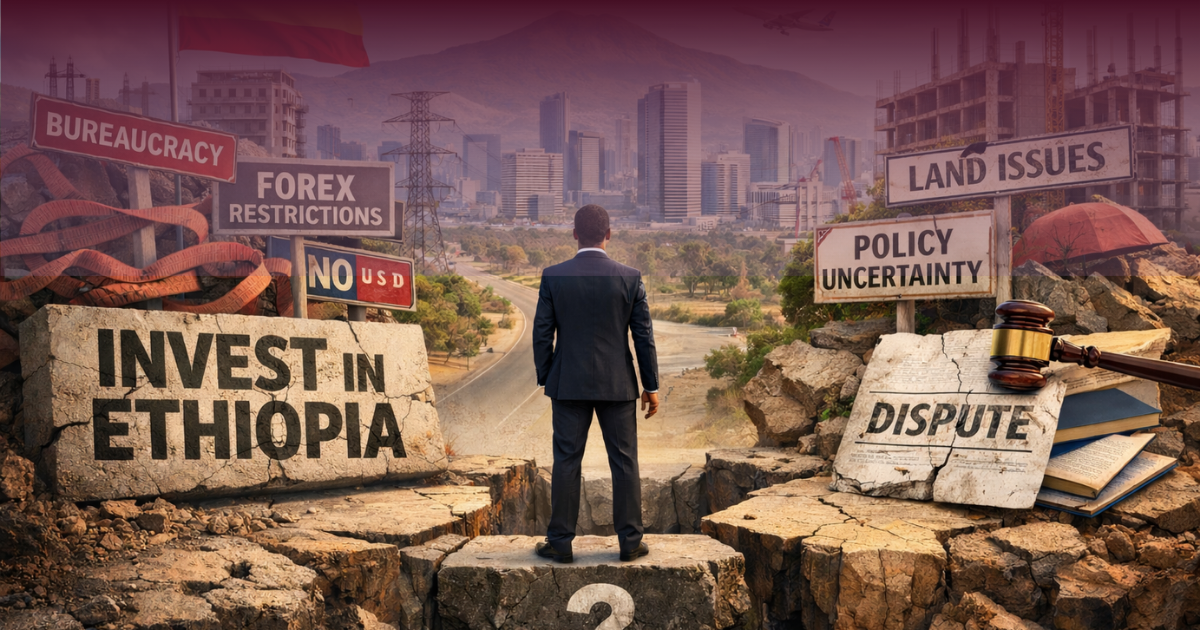
The Ethiopia investment gap highlights the disconnection between the country’s legal and policy frameworks and the actual experience of investors. Ethiopia remains one of Africa’s most promising investment destinations. It offers a large domestic market and a strategic location. Labour costs are competitive, and the government provides strong support for both foreign and domestic investors. Over the past decade, the government has introduced reforms to improve the investment climate. However, operational, regulatory, and institutional challenges continue to affect investor confidence.
Understanding the Ethiopia Investment Gap and Investor Challenges
- Regulatory Challenges Within the Ethiopia Investment Gap
Although Ethiopia has introduced modern investment laws and incentive frameworks, implementation often varies across institutions and regions. Investors commonly face inconsistent guidance and administrative delays. They also encounter requirements that go beyond what is clearly provided in law. These issues increase compliance costs and reduce legal certainty.
Ongoing digitalization efforts have improved some processes. However, licensing, permits, land allocation, and customs procedures often remain slow. This can affect project timelines and financing, especially for time-sensitive investments.
- Land and Infrastructure Issues in Ethiopia’s Investment Gap
Access to land remains a major constraint. While the legal framework for land leasing is established, allocation is often unpredictable, especially outside industrial parks. Delays, lack of serviced land, and weak coordination between federal and regional authorities continue to affect investor planning.
Infrastructure gaps particularly in power reliability, logistics, and transport persist and disproportionately impact manufacturing, agro-processing, and export-oriented investments.
- Financial and Foreign Exchange Challenges in the Ethiopia Investment Gap
Foreign exchange availability remains one of the most significant challenges for investors. Delays in accessing foreign currency continue to challenge investors. Restrictions on profit repatriation and limited long-term local financing also reduce cash-flow predictability. These issues particularly affect capital-intensive projects and can undermine investor confidence.
- Legal and Dispute Risks Affecting Ethiopia’s Investment Gap
While contractual freedom is recognized under Ethiopian law, court-based contract enforcement can be slow and unpredictable. Although arbitration is increasingly accepted, institutional capacity and enforcement experience are still developing. This creates uncertainty, especially in disputes involving public entities.
- Policy Changes Impacting Ethiopia’s Investment Gap
Ethiopia’s on-going economic reforms are necessary, but frequent policy adjustments and transitional uncertainty particularly in incentives and administrative procedures can affect investor confidence when not accompanied by clear transition mechanisms.
Closing the Ethiopia Investment Gap: Solutions for Investors and Policymakers
Recommendations for Policymakers
- Improve coordination between federal and regional authorities
- Ensure consistency and transparency in regulatory implementation
- Strengthen land administration and incentive frameworks
- Continue predictable financial and foreign exchange reforms
For Investors:
- Conduct robust legal and regulatory due diligence
- Engage local legal and regulatory advisors early
- Use contractual protections and risk-mitigation structures
For Legal and Advisory Institutions:
Legal professionals play a key role in bridging the gap by translating law into practice, managing regulatory engagement, anticipating institutional risks, and supporting dispute prevention and resolution.
Conclusion
Ethiopia’s investment potential remains strong, but realizing it requires closing the gap between law and practice. Acknowledging this gap is not a criticism it is a necessary step toward creating a more predictable, transparent, and investor-friendly environment.
For investors, understanding these challenges enables informed decision-making. For policymakers, addressing them is essential to sustaining long-term growth and credibility.