Explaining Directive No. 1150/2026: How Ethiopia’s New Collective Investment Rules Open Capital Markets to Every Saver
On September 23, 2026, the Ministry of Justice formally approved the Collective Investment Schemes Operation Directive No. 1150/2026. Issued under Proclamation No. 1248/2021, this regulation creates Ethiopia’s first formal framework for pooled investment funds.
For decades, retail savers in Ethiopia faced limited choices, mostly relying on low-yield bank deposits or physical property. Directive No. 1150/2026 enables professional asset managers to pool capital from investors into regulated, diversified portfolios.
1. What is a Collective Investment Scheme?
At its foundation, a Collective Investment Scheme (CIS) is a financial structure that aggregates money from multiple investors. Instead of buying individual stocks or property directly, an investor buys units in a managed fund.
A licensed Scheme Operator manages the collective pool and distributes proportional returns back to unit holders. This vehicle bridges the gap between small-scale household savings and large-scale capital investments, allowing everyday savers to access institutional-grade assets.
2. Six Recognized Scheme Categories under Directive 1150/2026
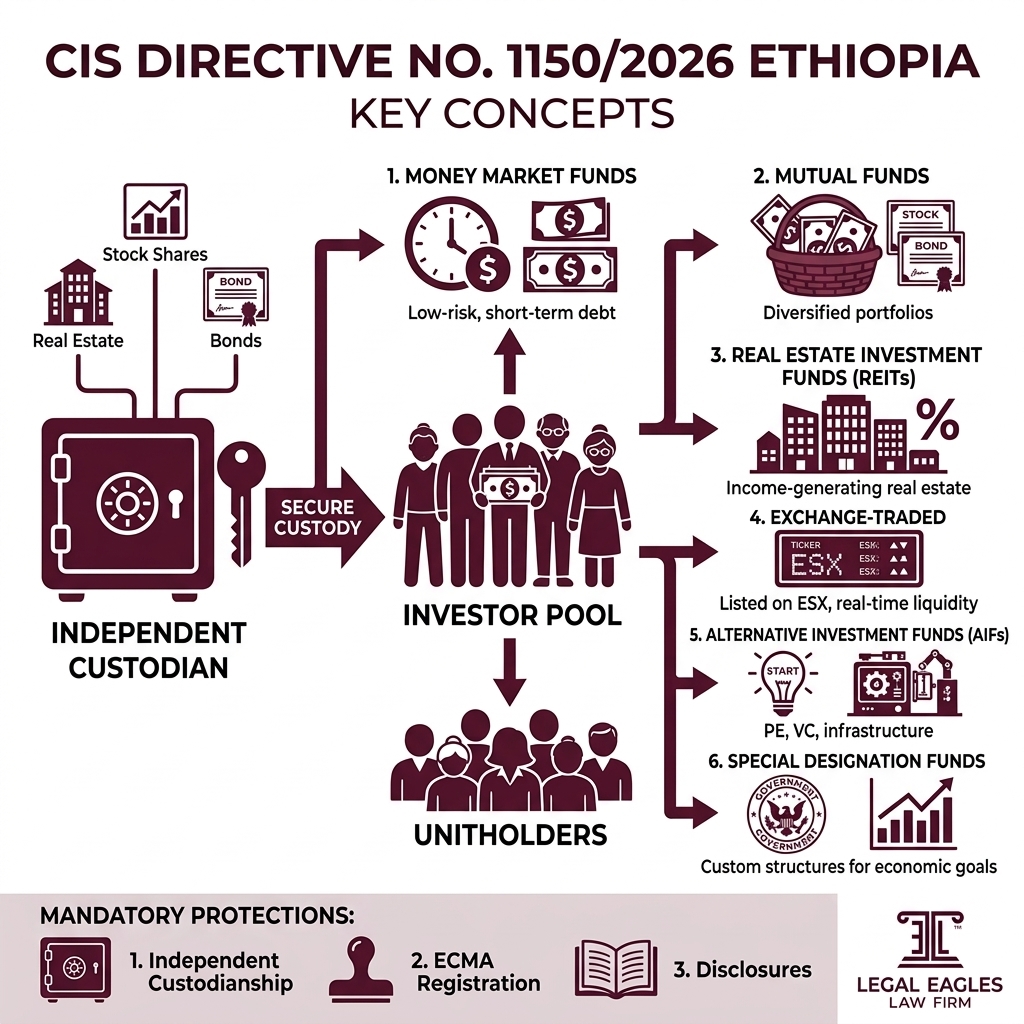
Directive No. 1150/2026 establishes regulatory guidelines for six distinct fund categories tailored to different risk tolerances and liquidity needs:
- Money Market Funds (MMFs): Low-risk funds focus on treasury bills and short-term debt, offering savers a stable alternative to bank accounts.
- Mutual Funds: Managed portfolios invest across equities and bonds, allowing small investors to share in corporate growth.
- Real Estate Investment Funds (REITs): Pooled funds specifically structured to acquire, develop, or operate income-generating commercial and residential real estate.
- Exchange-Traded Funds (ETFs): Listed funds on the Ethiopian Securities Exchange track specific indices or asset classes with real-time liquidity.
- Alternative Investment Funds (AIFs): Vehicles designed for non-traditional assets, including venture capital, private equity, and infrastructure deals.
- Special Designation Funds: Custom scheme structures tailored to specific policy mandates, strategic investments, or specialized economic sectors.
3. How Directive No. 1150/2026 Evolved from the ECMA Draft
Building on the foundational ECMA draft directive, the finalized law introduces important refinements and expansions:
- Explicit Categorization of Funds: The original draft broadly grouped vehicles under four general headings.The enacted directive sets explicit categories and operational definitions for Money Market Funds and Exchange-Traded Funds.
- Corporate Form Flexibility: The directive accommodates modern vehicles like Limited Partnerships and PLCs alongside traditional Share Companies.
- Harmonization with Service Provider Rules: Directive No. 980/2024 integrates operational rules for managers and custodians directly with licensing standards.
- Tax Neutrality Alignment: The framework aligns with capital market tax rules, ensuring pass-through taxation to avoid double taxation on earnings.
4. Mandatory Investor Protections: Structural Safeguards
To prevent self-dealing, mismanagement, or operator insolvency risks, Directive No. 1150/2026 introduces strict structural separations and supervisory obligations:
- Independent Custodianship: The directive prohibits Scheme Operators from holding investor cash, requiring an independent Custodian to hold all assets.
- Mandatory Registration: Operators must review and register every investment fund with the ECMA before offering it to the public.
- Ongoing Financial Disclosures: Schemes must provide periodic financial reporting, clear fund prospectuses, and transparent Net Asset Value (NAV) valuations.
5. What This Means for Everyday Investors and the Market
For Individual Savers
- Accessibility: Investors no longer require millions of Birr to participate in commercial property or large corporate ventures; fractional unit ownership makes wealth building accessible to smaller account balances.
- Risk Diversification: Spread-out exposure across multiple companies or properties insulates individual portfolios from single-asset default risks.
- Professional Management: Licensed investment professionals manage these portfolios, saving everyday investors from tracking complex market movements personally.
For the Capital Market and Economy
- Mobilizing Domestic Savings: Aggregating micro-savings into institutional funds unlocks large capital reserves to deploy into national infrastructure, housing, and corporate expansion.
- Fueling ESX Liquidity: Mutual funds and ETFs create continuous institutional buy-and-sell volume, helping to stabilize price discovery on the Ethiopian Securities Exchange.
- Fund-Level Tax Neutrality: Aligned tax structures ensure that collective schemes operate with pass-through tax treatment, preventing double taxation before dividends reach unit holders.
Looking Ahead
The launch of Directive No. 1150/2026 represents a crucial operational step toward modernizing Ethiopia’s domestic financial architecture. As asset managers register the first wave of retail and institutional funds with the ECMA, Ethiopian investors gain a structured, regulated framework to build long-term personal wealth.